


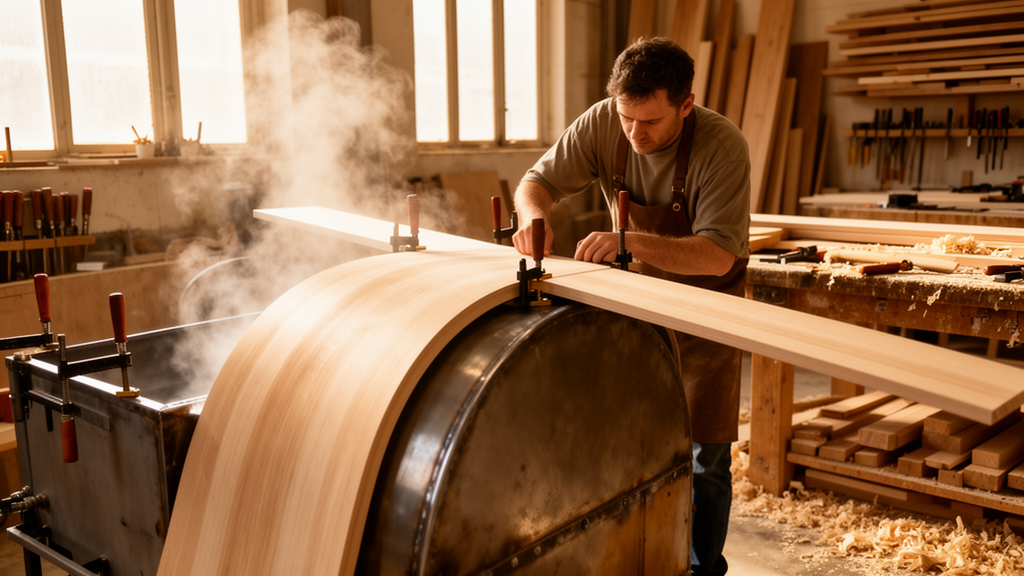
At the Kronenplatz square in Karlsruhe, Germany, a striking new shading structure called Komorebi is demonstrating a radical way to build with wood. Rather than milling, gluing, or molding timber into double-curved shapes, researchers at Karlsruhe Institute of Technology (KIT) let the material do the work: they bent straight wooden laths elastically into complex spatial curves and stacked them into a load-bearing column. The column, described in a new study in Frontiers in Built Environment, is entirely free of synthetic adhesives, which means it can be fully separated at the end of its life and its components reused or recycled. The trick that makes this possible is a new inverse-design method the team calls guided bending, which uses precisely placed incisions to steer the natural deformation of wood into a prescribed target geometry.
The motivation behind the research is both environmental and practical. The construction industry accounts for a substantial share of global resource depletion, while sustainably managed regrowing materials such as timber offer an abundant, self-regenerating resource. Engineered wood products like glued laminated timber have already enabled remarkable mass-timber buildings, including the Centre Pompidou-Metz and the Multihalle gridshell in Mannheim. But double-curved structural timber elements remain notoriously resource-intensive: they typically require extensive molding, gluing, and machining, or generate substantial waste through subtractive milling. Elastic bending offers an alternative form-giving strategy, in which initially straight planks are deformed into curved configurations while remaining strain-free along their length.
The geometric foundation of the approach lies in differential geometry, specifically in geodesic curves. A geodesic is the shortest and straightest path between two points on a surface, characterized by vanishing geodesic curvature. Unlike asymptotic curves, which only exist on surfaces with negative Gaussian curvature, geodesics can be generated on any surface, giving designers considerable flexibility. Crucially, planks aligned with geodesic curves remain tangent to the design surface, allowing them to be stacked efficiently in superposed layers. This property helps overcome the structural limitations that normally constrain bending-active structures, where material strength and bending curvature limit the cross-section of individual elements and make large-scale systems vulnerable to snap-through buckling.
Generating the geodesic curve network for the column was itself a computational challenge. Because the researchers wanted the lamellae to fully wrap around the column, with start and end points positioned above one another on the same generatrix, neither a boundary value nor an initial value formulation was suitable. Instead, the team used constrained relaxation: control points sampled along the generatrix were rotated around the central axis to form a polyline, which was then relaxed on the design surface using Kangaroo2, a live physics engine for form-finding. The process can be pictured as wrapping a rope around the surface and tightening it by pulling at each end. The resulting helix-like curves were verified by measuring their geodesic curvature, which remained well below ten percent of the normal curvature, an acceptable deviation from a true geodesic.
Materializing the geodesic network as physical planks required the strips to be developable, meaning they can be unrolled into flat sheets without stretching. Developable surfaces have zero Gaussian curvature, and the ruling directions of a developable strip along a spatial curve must be chosen as the vector conjugate to the curve tangent, not simply aligned with the Darboux frame as is common for planar curves. The conjugate vector, defined through the second fundamental form of the surface, corresponds to the intersection line of two neighboring tangent planes. Because the rulings are straight lines lying in the tangent plane, determining their lengths reduces to a straightforward geometric calculation that directly yields the plank width.
One subtle geometric singularity demanded special treatment. At a point in the upper region of the column, the curvature graph of the geodesic suddenly changes direction, and the curve normal rotates 180 degrees around the tangent vector. This can only occur where the normal curvature passes through zero, meaning the geodesic temporarily aligns with an asymptotic direction. At that point the strip undergoes pure twist rather than bending, a non-isometric deformation that does not yield a developable surface. The team tolerated a limited deviation from true developability, computing the resulting strain to be below one percent and assuming the material could accommodate the corresponding stresses. Notably, this non-developable region propagates further for wider planks, covering roughly 71 centimeters along the curve for the 8-centimeter-wide planks used, less than ten percent of the total area.
The structural innovation at the heart of the project is guided bending. An elastically bent element naturally deforms into a state of minimal elastic energy, known as the elastica shape. Forcing it to follow a different path introduces residual stresses and spring-back effects that cause geometric deviations from the intended design. To steer the deformation instead, the researchers introduced a series of incisions aligned with the conjugate vector, extending halfway through the lamella thickness and spaced 4 centimeters apart along the centerline. Acting as controlled hinges, these incisions direct the local bending at each point, guiding the overall deformation of the lamellae toward the target shape. Because the incisions were placed in the compression zone, simple experiments confirmed that lamellae achieved much smaller bending radii than when incisions were on the tension side.
The column itself was assembled from five continuous ash lamellae, 80 millimeters wide and 8 millimeters thick, arranged in six axes in both directions and bolted together at their intersections, following construction principles developed by Julius Natterer. Shorter infill lamellae filled the gaps created by the weave-like stacking, and the entire assembly was mechanically laminated with self-drilling timber screws, resulting in a compound depth of 72 millimeters comprising five continuous and four infill layers. The straight-development property of the geodesic planks simplified fabrication dramatically: bolt hole positions and incision angles could be mapped directly onto straight lines, allowing the entire production to be carried out with a standard three-axis CNC mill. During erection, a prefabricated reference scaffolding with predefined notches fixed each lamella endpoint precisely in space, and the column’s shape emerged as successive layers were installed and locked into their final geometry.
Finite element analysis, validated against the full-scale testing approach of Lara-Bocanegra and colleagues for elastically bent timber gridshells, revealed the column’s remarkable structural behavior. Owing to its proportions, with a height-to-width ratio of approximately five, the column acts structurally as a shell rather than a slender clamped column, so bending moments remain close to zero and the lamellae are verified essentially for normal forces. The asymmetric wind load case proved decisive, generating a rotational moment at the column head resisted by compression and tension forces within the column, with the inner layers experiencing the highest loads. The utilization of the inner lamella layer reached a maximum local value of 92 percent. Including the infill layers raised the buckling capacity from 113 to 135 percent of the design load in one configuration, confirming that their contribution is concentrated in compound stability rather than lamella verification, and was retained as a structural reserve rather than relied upon in design.
The project demonstrates that guided bending can significantly broaden the feasible design space of elastically bent compound beam assemblies, establishing a direct link between geometric design, fabrication logic, and structural performance. Unmodified lamellae of identical thickness could not have been bent around the column without structural failure, and although thinner lamellae could theoretically have achieved the target geometry, thicker lamellae proved structurally advantageous because fastener size scales with material thickness. The researchers acknowledge that only the orientation of the incisions was theoretically derived, while their width, depth, and spacing were kept constant, and that the precise effect of the incisions on load-bearing capacity remains to be quantified. Experimental validation of the built assembly also remains outstanding. Still, with nearly ten times more infill pieces than continuous lamellae produced, ongoing research aims to reduce or eliminate their necessity, improve fabrication efficiency, and calibrate incision patterns, paving the way for structurally efficient, adhesive-free curved timber architecture.
Subject of Research: Elastic bending and geodesic geometry for adhesive-free curved timber structures
Article Title: A guided bending strategy for the geometric and structural design of an elastically bent geodesic timber column
Article References: Andersson Largueche, D., & La Magna, R. (2026). A guided bending strategy for the geometric and structural design of an elastically bent geodesic timber column. Frontiers in Built Environment, 12, Article 1942204. https://doi.org/10.3389/fbuil.2026.1942204
Image Credits: AI Generated
DOI: 10.3389/fbuil.2026.1942204
Keywords: timber construction, guided bending, geodesic curves, elastic deformation, structural design, computational geometry, guided, bending, strategy, geometric, structural, design
Cite Scienmag News
Violet Maxwell. (October 17, 2026). Guided Bending Turns Straight Timber Into Curved Load-Bearing Columns. Scienmag. https://scienmag.com/guided-bending-turns-straight-timber-into-curved-load-bearing-columns/
Violet Maxwell. "Guided Bending Turns Straight Timber Into Curved Load-Bearing Columns." Scienmag, 17 October 2026, https://scienmag.com/guided-bending-turns-straight-timber-into-curved-load-bearing-columns/. Accessed 17 October 2026.
Violet Maxwell. "Guided Bending Turns Straight Timber Into Curved Load-Bearing Columns." Scienmag. October 17, 2026. https://scienmag.com/guided-bending-turns-straight-timber-into-curved-load-bearing-columns/


