


In the semiarid Motagua Valley of eastern Guatemala, where patches of tropical dry forest survive amid melon fields, pastures and expanding towns, researchers have completed the first molecular survey of avian malaria in the country’s wild birds. The study, published in Neotropical Biology and Conservation, examined blood from hundreds of birds representing dozens of species and found that 38 percent carried malaria parasites of the genera Plasmodium or Haemoproteus. Contrary to expectations, infection rates were essentially the same in urban and rural sites, although Plasmodium was significantly more common in urban birds.
Avian malaria is caused by hemosporidian parasites, single-celled organisms related to the agents of human malaria that are transmitted by biting insects. In birds, Plasmodium is spread by mosquitoes, Haemoproteus chiefly by biting midges and louse flies, and Leucocytozoon by black flies. Urbanization is widely recognized as a driver of increased pathogen transmission, primarily through landscape modification and heightened contact rates between hosts and vectors, which can elevate parasite prevalence and virulence. Urban environments can enhance vector distribution and increase host contact rates, and are often associated with adverse effects on bird health, including compromised body condition due to exposure to pollutants and lower-quality food sources.
Research on the relationship between urbanization and avian malaria has produced varied findings. Most studies report higher infection rates in urban bird populations, while others find no significant differences between habitat types. These differences likely reflect the influence of local environmental conditions that shape malaria transmission dynamics, including vegetation cover, land use, and especially water availability, which has been shown to be a strong predictor of hemosporidian infection in wild birds. Although rural or more natural areas are generally assumed to experience lower transmission due to reduced human impact, agricultural activities and habitat disturbance can still influence infection risk. Degraded or transitional landscapes, which are increasingly common, may not fit neatly into rural–urban categories.
Understanding these transmission patterns is particularly crucial in regions where native bird species already face multiple threats. Habitat loss, climate change, and the introduction of novel pathogens can compound the effects of avian malaria, making disease outbreaks even more detrimental. In New Zealand, avian malaria has been implicated in the decline of native bird populations, with studies linking higher parasitemia levels to increased mortality risk. In Hawaii, rising temperatures and shifting precipitation patterns have contributed to an increase in avian malaria prevalence, further endangering endemic bird species. In Central America, extensive land-use changes over recent decades—driven by large-scale agricultural expansion, cattle ranching, infrastructure development, and illegal deforestation—have led to widespread degradation and loss of dry forests, potentially altering vector distributions and host–pathogen interactions. Yet avian malaria research in the region remains sparse.
The survey was carried out in the Motagua Valley region, located in the department of Zacapa at elevations ranging from 300 to 900 meters above sea level. The valley has a tropical subhumid climate, with an average annual temperature of 26.9 °C and average annual precipitation of 815 mm, and a pronounced dry season lasting up to five months from November to May. The landscape comprises a mosaic of tropical dry forest patches with varying levels of anthropogenic disturbance, surrounded by human settlements and land uses centered on crop cultivation, pastures, grazing areas and urban development. The team assessed twelve distinct sites, nine in rural environments and six in urban areas.
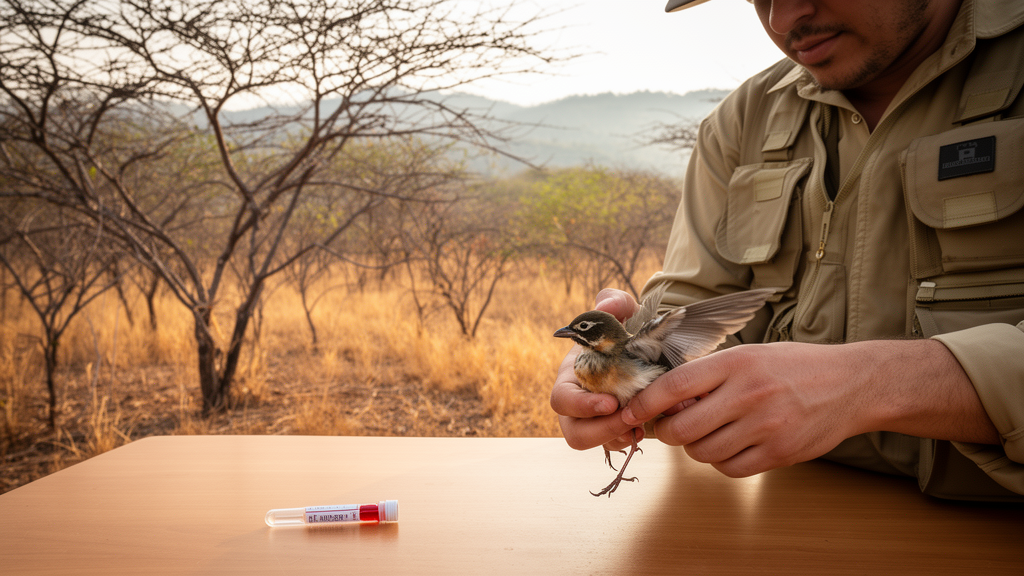
Wild birds were captured via six 12-meter mist nets over two-day periods between March and October 2021, from 6:30 am to 11:30 am, and backyard birds were captured directly at their breeding sites. Blood samples of 20–40 microliters were drawn from the sub-brachial wing vein, never exceeding one percent of a bird’s body weight, preserved in EDTA and stored at −20 °C. Each bird underwent sex determination, weight measurement and comprehensive morphometrics, including wing, tail and beak dimensions. Blood smears were fixed with ethanol, stained with Giemsa and screened under a light microscope. When infection was detected, parasitemia was estimated by counting infected erythrocytes in ten randomly selected fields, each typically containing between 1,000 and 5,000 red blood cells, and classified as low, moderate, moderate to high, or high.
Total DNA was extracted from each blood sample, and multiplex PCR was performed with genus-specific primer sets for Plasmodium, Haemoproteus and Leucocytozoon. Thermocycling conditions included a hot-start denaturation at 94 °C, 35 cycles of denaturation, annealing at 54.5 °C and extension at 72 °C, followed by a final extension step. Amplification products were run on 1.5 percent agarose gels and visualized on a transilluminator. Associations between prevalence and habitat type were assessed with Fisher’s exact test, and a binomial logistic regression model was used to determine whether malaria prevalence differed between urban and rural sites.
The results revealed a moderate overall prevalence of 38 percent, with Plasmodium spp. being the most prevalent, followed by Haemoproteus spp. Notably, no Leucocytozoon infections were detected. Among positive samples, 26 were infected with Plasmodium, 14 with Haemoproteus, and two had mixed infections—a Baltimore oriole and a turquoise-browed motmot carried parasites of both genera. The Inca dove (Columbina inca) was the most heavily sampled species, with 13 of 30 individuals infected. Microscopic examination of 209 blood smear slides found 33 positive, and approximately 69 percent of these presented a moderate level of parasitemia. Most infected birds exhibited low to intermediate parasitemia, a pattern consistent with chronic infections that promote long-term parasite survival within populations, as certain bird species, including members of the Columbidae family and some Passeriformes, are considered chronic hosts of hemosporidian parasites.
Statistically, the study found no significant difference in overall prevalence between habitat types, with an odds ratio of 1.04 for urban sites compared to rural sites, indicating a negligible difference in infection probability. However, Plasmodium prevalence varied significantly across habitat types, with higher prevalence in urban areas, while no significant variation was observed for Haemoproteus. The overall prevalence is consistent with previous studies in arid ecosystems of the Neotropical region, where rates typically range from 30 to 50 percent, such as 32 percent in the southern Chihuahuan Desert and 35 percent in tropical dry forests of Brazil. The absence of Leucocytozoon, transmitted by black flies, aligns with its low prevalence in the Neotropics and likely reflects unfavorable conditions for these vectors at the valley’s low altitude.
The number of infections detected via PCR differed from those identified through microscopy, consistent with previous research comparing the two methods. PCR can detect infections even at extremely low parasite loads—fewer than one parasite per million host cells—a threshold unlikely to be captured in standard microscopic examinations, which typically analyze 10,000 to 100,000 cells. Conversely, some PCR-detected infections may be controlled by the host and never progress to stages circulating in the bloodstream. Low parasitemia levels in mist-netted birds may also reflect a capture bias, since high parasitemia significantly impairs bird mobility, reducing the likelihood of heavily infected individuals being captured. This suggests that, in natural conditions, avian populations may experience more severe impacts from malaria than mist-net surveys reveal. The researchers conclude that habitat type does not necessarily correlate with overall prevalence or parasitemia intensity, and that future longitudinal studies across diverse habitats will be essential to comprehend the temporal and spatial dynamics of avian malaria, especially in regions experiencing rapid environmental change.
Subject of Research: Prevalence and parasitemia of avian malaria parasites in wild birds across urban and rural tropical dry forest habitats in eastern Guatemala
Article Title: Avian malaria in wild birds within a tropical dry forest area in Guatemala
Article References: Bustamante-Castillo, M., De León-Robles, E., Barrios-Izas, M. A., & Calderón-Aguirre, L. A. (2025). Avian malaria in wild birds within a tropical dry forest area in Guatemala. Neotropical Biology and Conservation, 20(3), 205-219. https://doi.org/10.3897/neotropical.20.e153327
Image Credits: AI Generated
DOI: 10.3897/neotropical.20.e153327
Keywords: avian malaria, Plasmodium, Haemoproteus, wild birds, tropical dry forest, Guatemala, urbanization, parasitemia, PCR, microscopy, vector-borne disease, Motagua Valley
Cite Scienmag News
Drew Townsend. (October 17, 2026). Avian malaria found in nearly 40 percent of wild birds in Guatemala’s transforming dry forest. Scienmag. https://scienmag.com/avian-malaria-found-in-nearly-40-percent-of-wild-birds-in-guatemalas-transforming-dry-forest/
Drew Townsend. "Avian malaria found in nearly 40 percent of wild birds in Guatemala’s transforming dry forest." Scienmag, 17 October 2026, https://scienmag.com/avian-malaria-found-in-nearly-40-percent-of-wild-birds-in-guatemalas-transforming-dry-forest/. Accessed 17 October 2026.
Drew Townsend. "Avian malaria found in nearly 40 percent of wild birds in Guatemala’s transforming dry forest." Scienmag. October 17, 2026. https://scienmag.com/avian-malaria-found-in-nearly-40-percent-of-wild-birds-in-guatemalas-transforming-dry-forest/


