


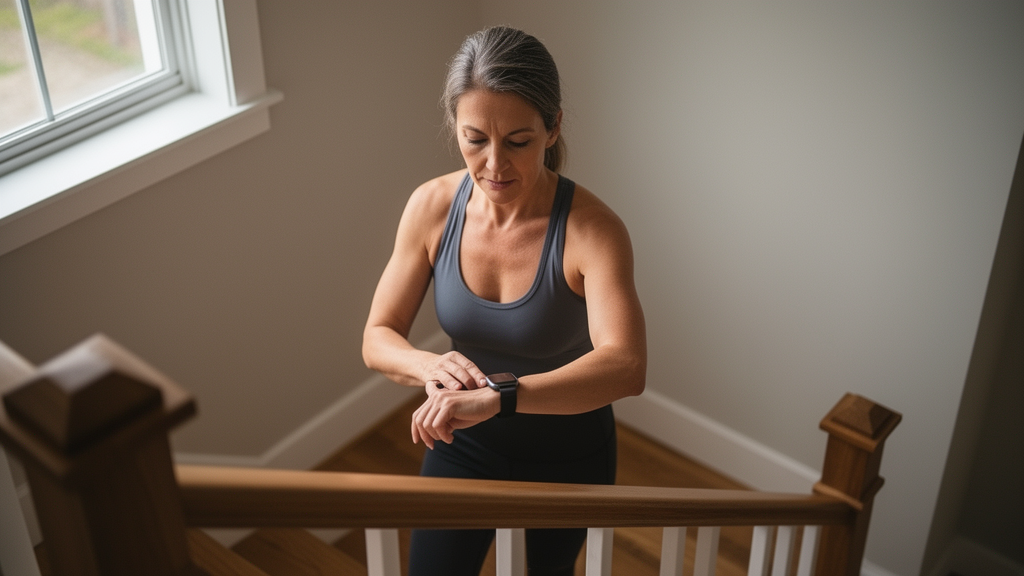
When a virus begins to invade the body, the immune system does not wait for a cough or a fever before mounting a response. Researchers at a Canadian laboratory have now shown that the earliest signs of this response may be detectable not at rest, but during a brief, controlled physical challenge. In a study published in Frontiers in Sensors, a team led by Amir Jlassi and Philippe Dixon used wearable biosensors to monitor healthy adults before and after exposure to influenza, and found that heart rate variability measured during the first minute of recovery from a three-minute stair stepping test emerged as the strongest predictor of early inflammation.
The study enrolled 16 healthy adults who performed the stair stepping test under controlled laboratory conditions. Each participant wore an Astroskin biosensor vest that continuously recorded respiration, heart rate, and heart rate variability. The researchers collected data during a baseline period before exposure and again during the days following exposure, allowing them to track how physiological signals changed as the immune response developed. Rather than relying on self-reported symptoms, the team used quantitative measurements of inflammation as their target variable, an approach that distinguishes their work from most prior studies that depended on self-reported diagnoses.
To establish an objective ground truth for inflammation, the researchers used an individualized coefficient of variation approach. Each participant’s baseline physiological variability was calculated during the pre-exposure period, and post-exposure values were classified as elevated only when they exceeded what would be expected from that person’s normal day-to-day fluctuation. This method accounts for the substantial individual differences in baseline physiology that would otherwise confound attempts to detect early inflammation. The approach allowed the researchers to classify each post-exposure event objectively, rather than depending on symptom questionnaires that may be unreliable in the earliest stages of infection.
The researchers developed several models using different combinations of physiological signals. Models built on respiration and heart rate data collected during the three minutes of stair stepping performed moderately, while models using heart rate variability data collected during the first minute of recovery performed best. The team also tested models combining all available signals, but these did not outperform the heart rate variability models alone. The researchers evaluated model performance using quantitative measures appropriate for their regression task, rather than relying on classification metrics that would have been inappropriate for their continuous target variable.
The best-performing model achieved an area under the curve of 0.70, indicating moderate discriminatory ability. The researchers note that this performance was achieved with a relatively small sample size and that the stair stepping test was performed under controlled laboratory conditions with a fixed step height and pacing protocol. The team suggests that the approach could potentially be adapted for real-world use if algorithms become robust enough to detect physical activity automatically and perform under uncontrolled conditions, though they caution that the current version requires controlled execution of the stair stepping test.
The researchers identified several factors that may influence the applicability of their findings. The stair stepping test was performed under controlled laboratory conditions with a fixed step height, and the level of physiological response depends on individual fitness and baseline physiology. The team notes that the current version requires controlled execution of the stair stepping test and that algorithms would need to become robust enough to perform under uncontrolled conditions before the approach could be adapted for real-world use. The researchers also note that the relatively small sample size may limit the generalizability of their findings and that further validation in larger and more diverse populations is needed.
The researchers suggest that the approach could potentially be adapted for real-world use if algorithms become robust enough to detect physical activity automatically and perform under uncontrolled conditions. They note that the current version requires controlled execution of the stair stepping test and that further investigation is needed to validate the findings in larger and more diverse populations. The team also suggests that the approach could potentially be adapted for use with other wearable devices and that further research is needed to determine whether the approach can be generalized to other populations and settings.
The researchers suggest that further research is needed to validate the findings in larger and more diverse populations and to determine whether the approach can be adapted for real-world use. They note that the current version requires controlled execution of the stair stepping test and that algorithms would need to become robust enough to perform under uncontrolled conditions before the approach could be adapted for real-world use. The team also suggests that further investigation is needed to determine whether the approach can be generalized to other populations and settings.
The choice of a live attenuated influenza vaccine as the study challenge reflects a deliberate methodological compromise. Because deliberately infecting healthy volunteers with a virulent respiratory virus raises serious ethical obstacles, the team instead used vaccination to provoke a controlled, low-grade inflammatory response that mimics the earliest immunological stages of a natural viral respiratory tract infection. Circulating inflammatory biomarkers such as interleukin-6, interleukin-8, monocyte chemotactic protein 1, interferon gamma-induced protein 10, and tumor necrosis factor alpha typically rise within hours of viral exposure, well before a person notices a sore throat or congestion. By anchoring the machine learning targets to these measurable immune signals rather than to symptom reports, the study design captures the presymptomatic window in which early intervention would be most valuable.
The physiological rationale for why a brief physical challenge might unmask early inflammation rests on how the autonomic nervous system responds to immune activation. Inflammatory cytokines act on the brain and on the heart itself, shifting autonomic balance and dampening the variability in the timing between consecutive heartbeats. Prior research has consistently shown that heart rate variability is inversely correlated with systemic inflammation, and the research team’s earlier work in the WE SENSE study demonstrated that nighttime wearable data could predict inflammatory surges following low-grade influenza exposure, achieving a real-time area under the curve of 0.73 and a 24-hour tolerance area under the curve of 0.89. The present study extends that logic from passive overnight monitoring to an active provocation test: by asking the cardiovascular system to respond to a standardized exertion, the protocol may amplify subtle autonomic differences that would be too faint to detect at rest.
The stair stepping protocol itself was tightly standardized. Participants completed three minutes of stepping at a constant rate followed by two minutes of seated or standing recovery, with the entire sequence captured by a garment-based biosensor that recorded heart rate, breathing rate, minute ventilation, and the R-wave to R-wave interval from the electrocardiogram at one-second resolution. Standardization matters here because an uncontrolled challenge would conflate differences in effort, fitness, and pacing with differences in immune status. A fixed step height and metronomic cadence ensure that each participant’s physiological response can be interpreted against their own baseline, which is essential for the individualized coefficient of variation approach used to define abnormal inflammatory responses.
The machine learning pipeline employed gradient-boosting algorithms, a family of models that build ensembles of decision trees and have become a workhorse for tabular physiological data because they handle nonlinear relationships and modest sample sizes reasonably well. Hyperparameter tuning was combined with a leave-one-subject-out validation scheme, meaning that for every iteration of training, one participant’s entire dataset was held out and used only for testing. This design is considerably more demanding than random record-level splitting because it tests whether the model generalizes to a completely unseen person rather than to unseen time points from a person the model has already learned. Given the modest cohort size, leave-one-subject-out validation provides a more honest estimate of how the approach would perform when deployed for new individuals.
The reported sensitivity of 70 percent and specificity of 77 percent for heart rate variability features should be interpreted in the context of the intended use case. A screening tool that misses three in ten early inflammatory events but correctly clears most healthy individuals could still be useful if it operates continuously and cheaply, since the cost of a false negative is partially offset by repeated daily testing. Conversely, the roughly one in four false positive rate highlights the importance of treating the output as a prompt for confirmatory molecular testing rather than as a diagnosis in itself. The comparison with existing approaches is instructive: rapid PCR systems for influenza and respiratory syncytial virus achieve sensitivities above 97 percent, but require laboratory infrastructure and trained personnel, while symptom-based machine learning models reported in prior literature have achieved areas under the curve ranging from 0.65 to 0.81 but cannot detect presymptomatic or asymptomatic infection.
Several practical considerations will shape whether this approach moves from the laboratory to everyday use. The Astroskin and Hexoskin garments used in the study are research-grade devices that measure electrocardiographic signals with clinical fidelity, whereas consumer wearables typically rely on optical heart rate sensing with different noise characteristics. The study also excluded anyone with pre-existing health conditions or recent inflammation, so the model has not yet been tested in older adults, people with chronic disease, or individuals whose baseline autonomic function differs substantially from that of healthy young and middle-aged adults. Data were collected between December 2021 and February 2022 in Montreal, a setting and season in which respiratory virus circulation was high, which may aid recruitment but also limits seasonal generalizability.
Nevertheless, the conceptual contribution is notable. Most wearable-based infection detection research has relied on passive monitoring of rest and sleep, waiting for physiological deviations to emerge on their own. The idea of a standardized, three-minute physical challenge as a diagnostic probe suggests a different paradigm: actively interrogating the body’s regulatory capacity at a moment when early immune activation is most likely to leave a detectable autonomic fingerprint. If future work confirms these findings in larger cohorts, demonstrates robustness with consumer-grade devices, and automates activity recognition so that the test can be performed without supervision, the approach could complement rather than replace molecular diagnostics, offering a continuous, low-cost early warning layer that directs scarce testing resources toward the people most likely to benefit from timely antiviral treatment and isolation.
Subject of Research: Using wearable biosensor heart rate variability during recovery from brief stair stepping tests to detect early inflammatory responses to influenza vaccination
Article Title: Predicting viral respiratory tract infections using wearable biosensor monitoring during 3-minute constant rate stair stepping tests
Article References: Jlassi, O., Hadid, A., McDonald, E. G., Ding, Q., Phillipp, C., Trottier, A., Cheng, M. P., Papenburg, J., Libman, M., Jensen, D., & Dixon, P. C. (2026). Predicting viral respiratory tract infections using wearable biosensor monitoring during 3-minute constant rate stair stepping tests. Frontiers in Sensors, 7, Article 1736869. https://doi.org/10.3389/fsens.2026.1736869
Image Credits: AI Generated
DOI: 10.3389/fsens.2026.1736869
Keywords: Predicting, viral, respiratory, tract, infections, wearable, biosensor, monitoring, during, minute, constant, rate
Cite Scienmag News
Kristina Jarvis. (October 17, 2026). A three-minute stair test may reveal early viral infection through heart rate recovery. Scienmag. https://scienmag.com/a-three-minute-stair-test-may-reveal-early-viral-infection-through-heart-rate-recovery/
Kristina Jarvis. "A three-minute stair test may reveal early viral infection through heart rate recovery." Scienmag, 17 October 2026, https://scienmag.com/a-three-minute-stair-test-may-reveal-early-viral-infection-through-heart-rate-recovery/. Accessed 17 October 2026.
Kristina Jarvis. "A three-minute stair test may reveal early viral infection through heart rate recovery." Scienmag. October 17, 2026. https://scienmag.com/a-three-minute-stair-test-may-reveal-early-viral-infection-through-heart-rate-recovery/


