


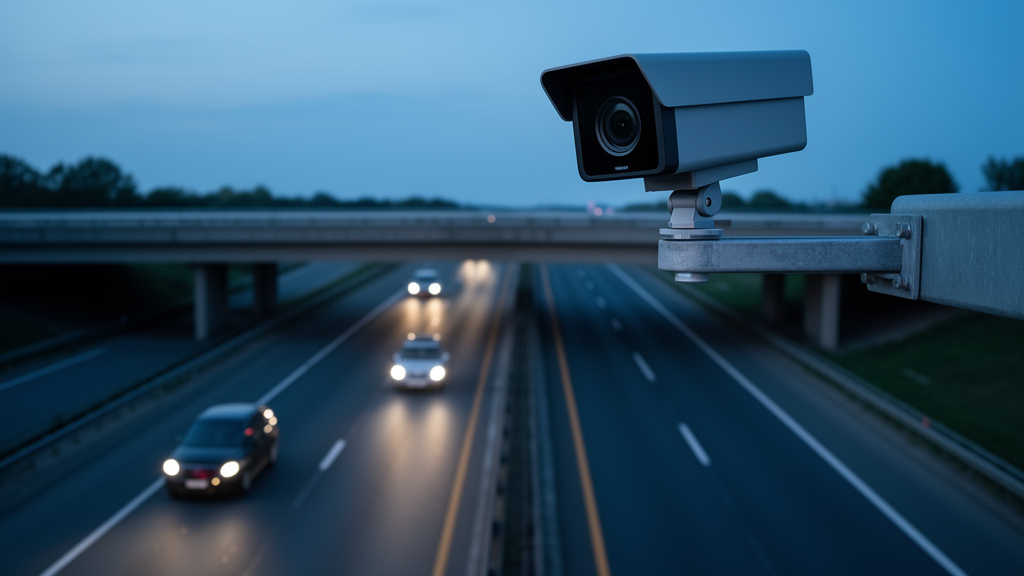
Wrong-way driving on a high-speed highway is one of the most terrifying failure modes in road transportation. A vehicle traveling against the flow of traffic can close on an oncoming car at a combined speed of more than 200 kilometers per hour, leaving drivers mere seconds to react. Although such events are rare, they are disproportionately lethal, and transportation agencies have long sought surveillance systems that can flag them in real time. A new study published in Frontiers in Future Transportation presents a camera-based detection framework that not only spots wrong-way drivers with high accuracy but also survives two of the most disruptive realities of roadside deployment: cameras that physically rotate out of alignment, and visual illusions that make parked vehicles look like they are moving.
The research, led by Dian Liu of South China University of Technology together with collaborators at Salesforce, an independent research group in Palo Alto, and the University of Oulu, addresses a problem that has plagued earlier wrong-way detection systems: they assume the world stands still. Most existing camera-based approaches rely on fixed lane-direction settings that are calibrated once and never updated. But highway surveillance cameras are mounted on poles exposed to wind, vibration, and maintenance crews. A small physical rotation can silently invalidate the hard-coded lane regions and reference directions, causing ordinary vehicles to be misclassified as wrong-way targets. The consequences are not merely technical. False alarms erode operator trust in automated traffic safety systems, while missed detections defeat the entire purpose of early warning.
The new framework tackles this with two coupled modules: online dynamic calibration and cascaded filtering detection. The calibration module begins by using DeepLabv3+, a well-established semantic segmentation network, to extract drivable road areas and generate a binary road mask, which is then refined with morphological operations and clustered into individual lanes using connected-component labeling. Lane directions are not manually annotated. Instead, the system mines them from history: it aggregates displacement vectors from vehicles that have previously traversed each lane, compiling a standardized reference direction that reflects the statistically dominant flow. This design deliberately excludes the instantaneous motion of any current candidate vehicle, preventing a single anomalous trajectory from contaminating the reference itself.
The most striking innovation is how the system detects when its own viewpoint has been compromised. Rather than running computationally expensive optical flow or homography estimation on every frame, the framework employs difference hashing, or DHash, a technique that compresses each video frame into a 64-bit binary code by comparing the grayscale values of adjacent pixels in a downsampled image. By computing the average Hamming distance between hash codes of consecutive frames, the system can tell when a substantial perspective rotation has occurred. When the distance exceeds a configured threshold of 25.5, the framework concludes that the camera has physically moved, reinvokes the segmentation network on the post-rotation stream, reconstructs the lane partitioning, and updates the direction references accordingly. A five-frame dormancy lock prevents the mechanism from repeatedly firing during the unstable transition period of a single rotation event. The entire rotation-perception step costs less than 0.1 milliseconds per frame.
Once calibration is handled, the second module confronts a subtler enemy: pseudo-motion. Vehicles that are actually stationary can appear to move when their bounding boxes drift, when they are partially occluded by passing trucks, or when flashing hazard lights create local illumination changes that mimic displacement. The cascaded filtering pipeline addresses this in stages. First, a temporal continuity filter maintains a wrong-way status counter for every tracked vehicle. Only when the counter continuously grows across consecutive frames, exceeding a persistence threshold, does the target graduate from transient tracking noise into a suspected wrong-way candidate. Validation experiments showed this threshold matters enormously: with a threshold of one frame, precision was a dismal 68.29 percent, but at five consecutive frames it reached 96.77 percent with recall unchanged, striking the optimal balance between alarm latency and false-alarm suppression.
Suspected candidates then undergo a deeper semantic examination. The framework captures the start and end frames of each candidate trajectory and computes the deep feature difference between them using a VGG-16 network pretrained on ImageNet. The resulting feature difference map is normalized and cropped to the target’s bounding box, and the arithmetic mean of the feature differences within that region quantifies whether the vehicle actually moved during the interval. Stationary vehicles, the researchers found, produce feature difference values clustered around 0.21 to 0.25 on a normalized scale, while genuinely moving vehicles produce values from 0.75 to 0.97, a separation wide enough for a max-margin classifier to draw a robust decision boundary. The classifier is trained offline on a dedicated feature-difference dataset using a support-vector-machine-style optimization with a non-linear kernel, solved as a convex quadratic programming problem.
To evaluate the system under realistic conditions, the team constructed a dedicated highway surveillance dataset of 99 video sequences drawn from operational cameras, spanning open highways, tunnels, and deliberate camera-rotation events. The sequences were partitioned at the video level into 51 training, 20 validation, and 28 independent test videos, comprising more than five hours of footage and 43 independent wrong-way events. Frames from the same video never appeared in both tuning and testing sets, preventing data leakage. The videos were sampled down to approximately 2.08 frames per second to emulate the low-frame-rate streams typical of roadside edge deployments, and the feature-difference dataset contained 20,864 training samples of stationary and moving vehicles for the secondary verification module.
The results are striking. Across the full independent test set, the proposed framework achieved 97.62 percent precision, 95.35 percent recall, and a 96.47 percent F1-score, with an operational false alarm rate of just 0.12 false alarms per hour. The advantage was most dramatic under camera rotation, the scenario that cripples conventional systems. There, the framework maintained 93.33 percent recall and precision with only 0.15 false alarms per hour, while baseline methods relying on static direction references collapsed to F1-scores between 40 and 59 percent with false alarm rates as high as 4.2 per hour. Ablation studies confirmed that every component earns its place: removing the dynamic calibration module dropped camera-rotation recall from 93.33 to 46.67 percent, while removing temporal filtering or feature-difference verification each degraded overall performance substantially.
The system also runs fast enough for practical deployment. On a workstation equipped with an NVIDIA RTX 2080 SUPER GPU, the complete pipeline achieved an average throughput of 48.5 frames per second, or about 20.6 milliseconds per frame including video decoding and memory transfer overhead. Object detection via YOLOv8 consumed 9.8 milliseconds per frame, tracking via ByteTrack 2.6 milliseconds, and the VGG-16 verification step, triggered only on demand for candidate wrong-way trajectories, added an amortized 5 milliseconds per frame. Average alarm latency across the test set was 9.8 seconds, a modest delay the authors attribute to the secondary verification stage that buys the dramatic reduction in false alarms. In open highway scenes, the YOLOv8+ByteTrack baseline actually triggered alarms slightly faster at 7.8 seconds, but at nearly eight times the false alarm rate.
The authors are candid about limitations. The current calibration strategy handles single-roadway and two-roadway highway scenes but not complex interchanges, ramps, or urban intersections. The rotation module targets large viewpoint reversals rather than gradual drift or zoom, and the feature-difference verification may lose robustness under heavy rain, dense fog, or strong road reflections that shift the feature distribution. A single camera view also cannot fully resolve long-term occlusion or blind spots behind large vehicles. Future work, the team says, will explore weather-aware feature normalization, multi-camera cooperative detection, cross-region adaptation, and optimization for embedded edge hardware. Still, the core message stands: treating wrong-way detection as an operational reliability problem, not merely a computer vision benchmark, may be what finally makes roadside intelligent infrastructure trustworthy enough to shift highway safety from post-incident response to genuine prevention.
Subject of Research: Adaptive calibration and spatio-temporal filtering for robust camera-based highway wrong-way driving detection
Article Title: Adaptive calibration and spatio-temporal filtering for robust highway wrong-way driving detection
Article References: Liu, D., Yuan, X., Zhang, Z., Zhang, L., Wang, H., & Liu, Y. (2026). Adaptive calibration and spatio-temporal filtering for robust highway wrong-way driving detection. Frontiers in Future Transportation, 7, Article 1935771. https://doi.org/10.3389/ffutr.2026.1935771
Image Credits: AI Generated
DOI: 10.3389/ffutr.2026.1935771
Keywords: wrong-way driving, highway surveillance, adaptive calibration, spatio-temporal filtering, computer vision, difference hashing, vehicle tracking, traffic safety, intelligent transportation systems, false alarm reduction, semantic segmentation, deep learning
Cite Scienmag News
Blake Davidson. (October 17, 2026). Adaptive AI Camera System Catches Highway Wrong-Way Drivers Even When Cameras Rotate. Scienmag. https://scienmag.com/adaptive-ai-camera-system-catches-highway-wrong-way-drivers-even-when-cameras-rotate/
Blake Davidson. "Adaptive AI Camera System Catches Highway Wrong-Way Drivers Even When Cameras Rotate." Scienmag, 17 October 2026, https://scienmag.com/adaptive-ai-camera-system-catches-highway-wrong-way-drivers-even-when-cameras-rotate/. Accessed 17 October 2026.
Blake Davidson. "Adaptive AI Camera System Catches Highway Wrong-Way Drivers Even When Cameras Rotate." Scienmag. October 17, 2026. https://scienmag.com/adaptive-ai-camera-system-catches-highway-wrong-way-drivers-even-when-cameras-rotate/


