


Deep beneath the waves of the world ocean, lanternfishes drift in enormous swarms, …
The significance of this new collection lies not only in the number of species recovered but also in the sheer abundance of specimens available for study. Nearly 2,400 otoliths were catalogued across the six localities, and this volume of material allows paleontologists to assess relative abundance rather than simply presence or absence. The dominance of a single species, Diaphus hataii, which accounts for well over 1,700 of the counted specimens, illustrates how strongly lanternfish otoliths can dominate pelagic and neritic sediments. Such numerical dominance mirrors the ecological role of lanternfishes in modern oceans, where they form one of the most biomass-rich vertebrate groups on the planet and undertake nightly vertical migrations toward the surface to feed on plankton before returning to mesopelagic depths by day.
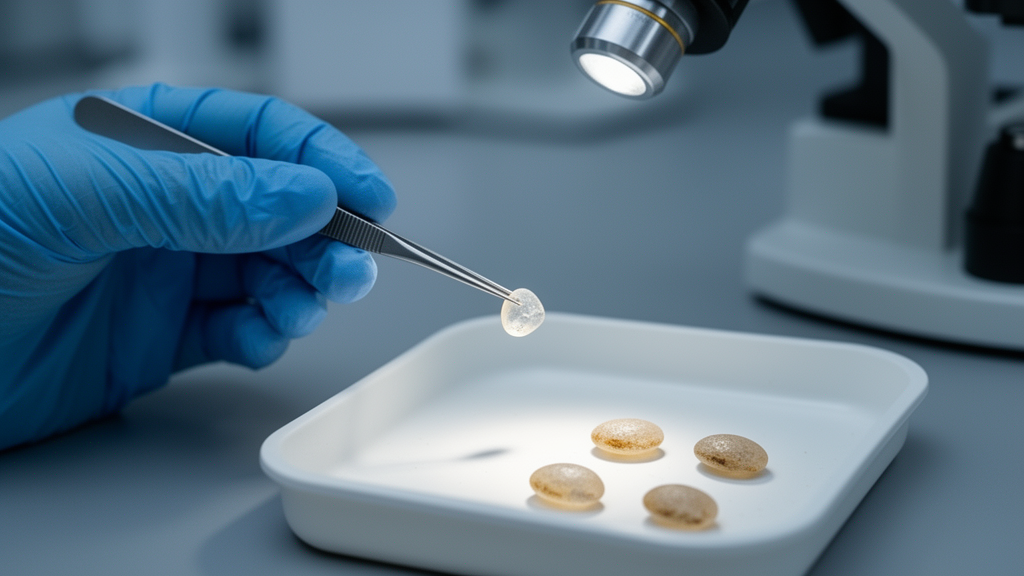
Otoliths themselves deserve some explanation, since they are the structures on which this entire study rests. These aragonitic concretions form in the inner ears of teleost fishes, where they serve in balance and hearing. Each fish family, and indeed many genera and species, produces otoliths with characteristic shapes, margins, and sculpturing, which means that isolated otoliths recovered from sediment can often be identified even when no skeletal material is preserved. Because otoliths are composed of calcium carbonate in the form of aragonite, they dissolve readily in acidic conditions but survive well in many marine sediments, particularly fine-grained muds deposited below depths where bottom waters remained oxygenated. This combination of taxonomic distinctiveness and preservational durability makes otoliths among the most valuable microfossils available for reconstructing ancient fish faunas, often far outperforming bones and teeth in both abundance and identifiability.
The geographic setting of the Japanese localities adds an important dimension to the findings. During the late early Miocene, the Japanese Islands were largely submerged, with broad seaways connecting the Northwest Pacific to marginal basins. Warm-water influence across western and central Honshu, noted at all six sampling sites, reflects the paleogeographic position of Japan at the margin of the subtropical to warm-temperate Northwest Pacific. The Toyama localities border what is now the Sea of Japan, a basin whose early Miocene connection to the open Pacific was different from today, and the faunal composition recovered there can therefore inform debates about when and how the Sea of Japan attained its modern circulation pattern. The presence of warm-water myctophid assemblages in these deposits is consistent with the broader picture of a Miocene climatic optimum, a globally warm interval during which tropical and subtropical marine faunas extended poleward well beyond their present ranges.
The correlation of the sampled intervals with planktonic foraminifer zone N8 and diatom zones 2B through 4A of the northern Pacific scheme demonstrates the fine temporal control available for these sections. Planktonic microfossils such as foraminifers and diatoms evolve rapidly and are widely distributed, making them the backbone of Cenozoic marine biostratigraphy. By tying the otolith assemblages to these independently established zones, the study anchors each fish fauna to a narrow window of geological time, roughly spanning the late Burdigalian and early Langhian stages. This temporal precision is what transforms a regional faunal list into a tool for correlation: if the same otolith species appear in sediments of equivalent age in New Zealand or Europe, the shared assemblage can be used to test or refine age assignments in those distant regions.
The biogeographic connections reported in the study are particularly striking. At least nine of the Japanese species are also known from coeval deposits outside Japan, most notably in New Zealand and Europe. Such a distribution implies that many lanternfish species achieved near-cosmopolitan ranges in warm and temperate oceanic waters by the early Miocene. Modern lanternfishes are indeed famous for their broad distributions, with some circumglobal species spanning entire ocean basins, aided by a pelagic lifestyle in which eggs, larvae, and adults drift with surface and subsurface currents. The fossil record now shows that this capacity for wide dispersal was already well established more than sixteen million years ago. For paleobiogeographers, this means that myctophid otoliths can serve as tracers of oceanic connectivity, revealing which marine basins were in communication and which barriers, if any, limited faunal exchange.
The taxonomic composition of the assemblage also carries ecological information. The collection includes representatives of the Myctophinae, Lampanyctinae, Diaphinae, and Gymnoscopelinae, the principal lineages within the family. The genus Diaphus dominates numerically, a pattern consistent with the modern ocean where Diaphus is among the most speciose and abundant lanternfish genera. Stenobrachius ohashii, one of the new species, is remarkably abundant at the Tsuyama locality, with more than two hundred specimens recovered, suggesting locally favorable conditions for this lineage in the neritic waters of the Katsuta Group basin. The mixture of oceanic and neritic-influenced assemblages across the localities reflects the range of depositional settings sampled, from continental slope mudstones at Niimi to shallower nearshore deposits elsewhere, and demonstrates how otolith assemblages can record gradients in water depth and proximity to the open ocean.
From a methodological standpoint, the study exemplifies the value of detailed stratigraphic measurement combined with systematic sampling. The Tsuyama section, for example, was measured across twenty-three levels, allowing the researchers to document faunal change through time within a single basin. Such fine-scale sampling is essential if otolith assemblages are ever to be used for biostratigraphic zonation in their own right, since first and last appearances of species must be documented with confidence before they can serve as index fossils. The authors explicitly frame their work as a foundation for future supraregional biostratigraphy, and the comparison of stratigraphic ranges of the observed species with data from other world regions is a first step toward building a global framework for Miocene lanternfish evolution.
The recognition of eight new species in a single regional collection also speaks to how incompletely the fossil record of mesopelagic fishes has been explored. Deep-water fishes are rarely preserved as complete skeletons, and their fossil history has traditionally been far less studied than that of shallow-water groups. Yet the abundance of lanternfish otoliths in pelagic sediments since at least the Miocene means that a rich record exists, waiting to be sampled and described. Each new regional monograph, such as this one on the Miocene of Japan, adds species that may later be recognized elsewhere, gradually knitting together a worldwide picture of mesopelagic fish evolution. The earlier review of Pliocene and Pleistocene myctophid otoliths from Japan by the same research collaboration established a younger baseline, and the present study now extends that record back into the early Miocene, opening the possibility of tracing lineages across many millions of years.
For paleoceanographers, the assemblages offer a proxy for water temperature and productivity. Lanternfishes are most diverse in warm, productive waters, and the composition of their fossil assemblages can indicate the position of oceanographic fronts and the strength of current systems. The warm-water character of the Honshu assemblages fits within the broader context of the early Miocene, when the closing of the Tethys seaway was reshaping global ocean circulation and when the Northwest Pacific supported rich neritic faunas across the flooded Japanese archipelago. Continued study of these otoliths, integrated with diatom and foraminiferal data from the same sections, promises to refine reconstructions of the paleoenvironment of the Northwest Pacific during a key interval of global climatic and tectonic change.
Subject of Research: Miocene lanternfish otoliths from Japan
Article Title: Lanternfish otoliths ( Myctophidae , Teleostei ) from the Miocene of Japan
Article References: Schwarzhans, W., Ohe, F., Tsuchiya, Y., & Ujihara, A. (2022). Lanternfish otoliths (Myctophidae, Teleostei) from the Miocene of Japan. Zitteliana, 96, 103-134. https://doi.org/10.3897/zitteliana.96.83571
Image Credits: AI Generated
DOI: 10.3897/zitteliana.96.83571
Keywords: lanternfish, otoliths, Myctophidae, Miocene, Japan, paleobiogeography, biostratigraphy, new species, mesopelagic, fossil fish, Teleostei, scientific research
Cite Scienmag News
Violet Maxwell. (October 17, 2026). Eight new species of Miocene lanternfish unveiled from tiny ear bones in Japan. Scienmag. https://scienmag.com/eight-new-species-of-miocene-lanternfish-unveiled-from-tiny-ear-bones-in-japan/
Violet Maxwell. "Eight new species of Miocene lanternfish unveiled from tiny ear bones in Japan." Scienmag, 17 October 2026, https://scienmag.com/eight-new-species-of-miocene-lanternfish-unveiled-from-tiny-ear-bones-in-japan/. Accessed 17 October 2026.
Violet Maxwell. "Eight new species of Miocene lanternfish unveiled from tiny ear bones in Japan." Scienmag. October 17, 2026. https://scienmag.com/eight-new-species-of-miocene-lanternfish-unveiled-from-tiny-ear-bones-in-japan/


