


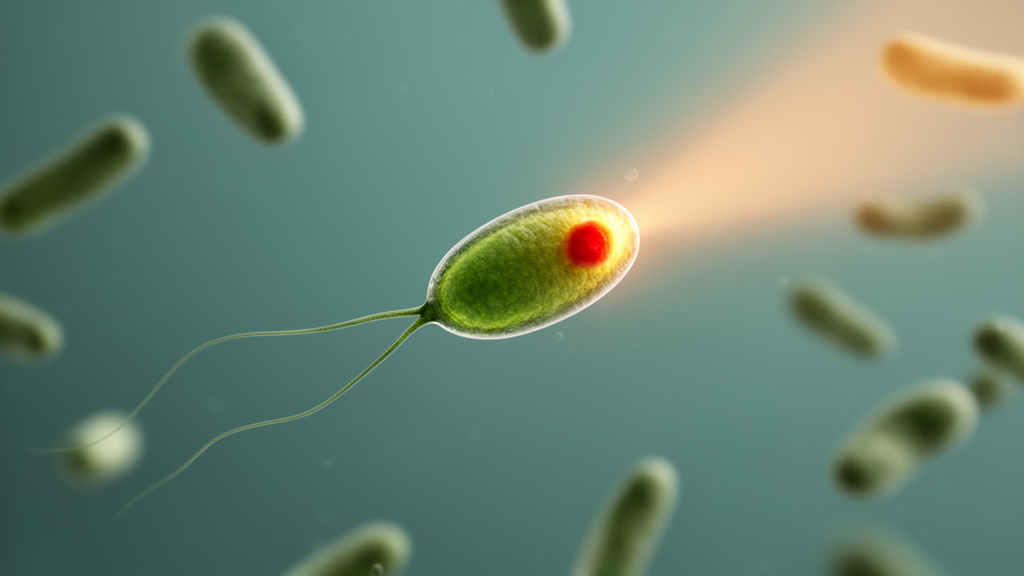
When a green alga swims toward light, the response looks deceptively simple from the outside: a population drifts in one direction, and a single average number seems to capture it. A new study argues that this averaging is precisely what hides the real biology. Researchers at Politecnico di Milano and the Istituto Italiano di Tecnologia in Milan have developed an integrated single-cell framework that decomposes the phototactic response of the unicellular green alga Chlamydomonas reinhardtii into coherent behavioural subpopulations, revealing structure that population-level averages erase. The work, published in Frontiers in Photobiology, addresses a long-standing practical gap in the study of biological microswimmers: how to quantify heterogeneous tactical responses that operate simultaneously at the individual and collective levels.
The problem the team set out to solve is one that anyone who has watched a crowd of swimming microorganisms under a microscope will recognise. Within a single sample, some cells race in straight lines, others orbit in tight circles, and still others barely move at all. When the trajectories of these kinematically distinct groups are pooled together, their contributions partially cancel. A coherent response to a light stimulus can therefore appear weak, noisy, or entirely absent, even when organised subpopulations are clearly present. Traditional population-averaged descriptors, such as mean velocities or global direction vectors, simply cannot disentangle these overlapping behaviours.
The new workflow couples large-scale automated tracking with a sequence of analytical stages designed to extract behavioural resolution from mixed populations. Fluorescence videos of swimming cells are processed with the open-source FIJI-ImageJ software using the TrackMate plugin, which detects cells with a Laplacian-of-Gaussian detector and links them frame-to-frame by nearest-neighbour matching. In the representative dataset, approximately 400 to 600 cells were tracked per video, and 607 trajectories were returned for a single 60-second acquisition, of which 497 passed consistency checks and were retained for full kinematic analysis. Each acquisition was deliberately limited to 60 seconds at 10 frames per second, a compromise that balances temporal resolution against the statistical density of trajectories available per unit time.
From each reconstructed trajectory, the framework computes a suite of kinematic parameters: incremental displacement, instantaneous and average velocity, directional change rate, track duration, net and total displacement, mean direction, and directional strength. Net displacement, the straight-line distance between the start and end of a track, distinguishes actively migrating cells from those that remain confined near an initial position. Total displacement, the sum of distances between all consecutive points, measures absolute motility even when a cell moves along a convoluted path without net migration. Together, these quantities form the basis for an initial classification of trajectories into stationary, confined, or directional behaviours.
The segmentation proceeds in two steps. Tracks are first partitioned using a threshold displacement: cells whose net displacement falls below the threshold are classified as stationary or unmotile, since their positional changes are comparable to noise or passive drift rather than active swimming. Among motile tracks, a straightness index, defined as the ratio of net displacement to total path length, separates confined or circling trajectories from directional ones. Values of the index close to zero indicate highly convoluted or looping paths, while values close to one indicate trajectories that closely follow a straight line. Both thresholds were calibrated empirically on representative tracks and then fixed uniformly across all experimental conditions to ensure comparability between datasets.
For directional trajectories, the method applies k-means clustering in circular feature space, operating on the angular components of each cell’s motion rather than on raw coordinates. This clustering isolates two kinematically coherent subgroups within the directional population: one characterised by positive phototaxis, moving toward the light source, and one by negative phototaxis, moving away from it. The two clusters share comparable speed profiles but differ in orientation, confirming that the segmentation captures genuine directional information rather than a kinematic artefact. Statistical validation with a Kruskal-Wallis test revealed a highly significant difference in mean swimming speed across the four subpopulations, and post-hoc pairwise comparisons with Dunn’s test confirmed significant differences between all group pairs except the two directional clusters, which differ in direction rather than in speed.
Beyond static classification, the framework characterises how motion regimes evolve over time through time-windowed mean squared displacement analysis. The experiment is divided into short windows, and for each window the mean squared displacement of every particle is calculated as a function of time lag, then averaged over all trajectories in that window. The resulting curves are fitted with a library of dynamical models, including free Brownian diffusion, ballistic motion, anomalous diffusion, exponential growth and saturation models, and the Ornstein-Uhlenbeck process for harmonic confinement. Model selection relies on coefficient of determination, root-mean-square error, and parameter confidence intervals, allowing the framework to distinguish subdiffusive confinement from superdiffusive persistent motion.
The power-law model proved most suitable for the overall sample and the motile subpopulations. The anomalous diffusion exponent extracted from the fits shows a clear gradient across behavioural classes: stationary cells yield the lowest values, circling cells fall in between, and the two phototactic clusters stabilise around a value of approximately two, indicative of superdiffusive and highly coherent motion. The global population, dominated by the directional subgroups despite representing only a fraction of the total sample, yields an intermediate value. This gradient quantifies what the segmentation reveals qualitatively: the directional clusters account for the dominant contribution to the collective phototactic response, and their dynamic regimes differ measurably from those of confined or stationary cells.
The biological implications extend beyond phototaxis itself. Because the analysis is independent of the molecular origin of the response, it can be strengthened by orthogonal controls enabled by the genetic tractability of Chlamydomonas. Phototaxis-impaired mutants or strains with altered photoreceptor signalling could be analysed within the same workflow to verify the expected loss or inversion of stimulus-aligned directionality, providing a benchmark for segmentation and clustering performance against a known negative-control phenotype. The ability to distinguish subpopulations with opposite reactions to the same stimulus, or with different modes of motility, offers a substantial advantage in the study of intra-population variability, an aspect the authors note is rarely explored in the phototaxis literature.
Methodologically, the framework is built entirely on open-source software and robust mathematical analysis, making it highly reproducible and easily extendable. It is applicable to other biological or synthetic microswimmers, different stimulation patterns, and variable experimental contexts, from chemotaxis in bacteria to the behaviour of light-driven microrobots. The complete datasets and code from three independent biological replicates are publicly available, supporting cross-replicate comparison. The central message of the work is that the motility of active systems cannot be understood through a single aggregate measure. Behaviour must be decomposed into coherent kinematic components, each quantified for its contribution to the collective response, before the full dynamics of a microswimmer population can be read.
Subject of Research: Quantifying motility-based biological responses in Chlamydomonas reinhardtii using an integrated single-cell framework
Article Title: Quantifying motility-based biological responses in Chlamydomonas reinhardtii using an integrated single-cell framework
Article References: Bosc, A., Pianetti, A., & Paternò, G. M. (2026). Quantifying motility-based biological responses in Chlamydomonas reinhardtii using an integrated single-cell framework. Frontiers in Photobiology, 4, Article 1800988. https://doi.org/10.3389/fphbi.2026.1800988
Image Credits: AI Generated
DOI: 10.3389/fphbi.2026.1800988
Keywords: Quantifying, motility-based, biological, responses, Chlamydomonas, reinhardtii, integrated, single-cell, framework, scientific research
Cite Scienmag News
Drew Townsend. (October 17, 2026). Single-Cell Tracking Reveals Hidden Phototactic Subpopulations in Chlamydomonas. Scienmag. https://scienmag.com/single-cell-tracking-reveals-hidden-phototactic-subpopulations-in-chlamydomonas/
Drew Townsend. "Single-Cell Tracking Reveals Hidden Phototactic Subpopulations in Chlamydomonas." Scienmag, 17 October 2026, https://scienmag.com/single-cell-tracking-reveals-hidden-phototactic-subpopulations-in-chlamydomonas/. Accessed 17 October 2026.
Drew Townsend. "Single-Cell Tracking Reveals Hidden Phototactic Subpopulations in Chlamydomonas." Scienmag. October 17, 2026. https://scienmag.com/single-cell-tracking-reveals-hidden-phototactic-subpopulations-in-chlamydomonas/


