


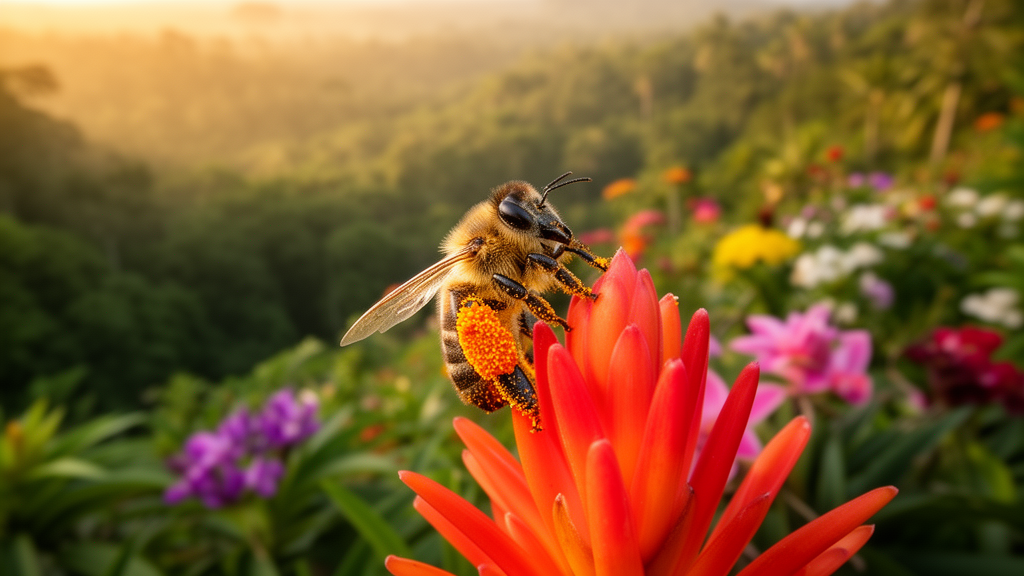
Deep in the Eastern Highlands of Papua New Guinea, honeybees are quietly assembling one of the most nutritionally complete food stores in the animal kingdom. Bee bread, the fermented pollen mixture that developing larvae and adult bees consume, is far more than a simple pantry item. It is a biochemical archive of everything the colony has foraged, and its fatty acid composition can reveal whether the surrounding landscape is rich in flowers or stripped of them. A new study published in Frontiers in Bee Science has now shown that the diversity of flora in tropical landscapes directly shapes the fatty acid profile of bee bread, with important implications for honeybee health in a world where tropical forests are vanishing at alarming rates.
The research team, led by Chris Cannizzaro of Griffith University in Australia, set out to answer a question that has long puzzled bee scientists. While the relationship between floral diversity and honeybee nutrition has been studied extensively in temperate environments, tropical systems have remained largely unexplored. This is a significant gap because tropical deforestation is particularly severe, and the nutritional consequences for managed honeybees in these regions are poorly understood. The team collected bee bread from 24 hives across eight apiary sites in the Eastern Highlands of Papua New Guinea in March 2019, carefully selecting sites that were either surrounded by forest cover exceeding 20 percent of the land area or had no forest within a 2.5-kilometre radius of the apiary centre.
Bee bread was chosen over freshly collected pollen because it represents pollen that has undergone microbial processing and storage within the hive, making it the form actually consumed by developing brood and adult bees. As bee bread accumulates over time, it provides a time-integrated representation of dietary intake and reduces the short-term variability associated with individual foraging bouts. The researchers collected six samples per hive from three hives per site, with one site yielding only two hives, for a total of 138 bee bread samples. Each sample was preserved in n-hexane to maintain lipid content, then vortexed, centrifuged, and stored at minus 20 degrees Celsius until analysis.
To determine the botanical composition of the bee bread, the team employed DNA metabarcoding targeting the chloroplast rbcL marker, which offers broad amplification across flowering plants and reliable genus-level taxonomic resolution. The metabarcoding yielded over 5.1 million sequencing reads after quality filtering, representing 80 plant taxa across all samples. In parallel, the researchers extracted oil from the bee bread and converted the fatty acids into methyl ester derivatives, known as FAMEs, for analysis by gas chromatography-mass spectrometry. This dual approach allowed the team to link specific plant taxa to specific fatty acids in the bee bread, providing an unprecedented picture of how floral diversity translates into nutritional chemistry.
The results revealed that bee bread fatty acids consisted of 43 percent saturated and 57 percent unsaturated lipids on average, with no significant difference between forest and no-forest landscapes. The fatty acids present at the highest concentrations were oleic acid, an omega-9 fatty acid, followed by palmitic acid, linoleic acid, and stearic acid. However, the most striking findings emerged when the researchers compared landscapes with and without forest cover. Myristic acid, palmitoleic acid, and stearic acid were all significantly higher in bee bread from forested landscapes. Myristic acid possesses strong antimicrobial properties and is an effective inhibitor of Paenibacillus larvae, the bacterium responsible for American foulbrood, one of the most devastating honeybee diseases worldwide. Palmitoleic acid, an omega-7 fatty acid, is considered a strong complementary fat to omega-3 and is a good source of unsaturated fat. Stearic acid plays a critical role in wax production, supporting colony growth, and serves as an important precursor compound used in synthesising mandibular excretions in queens and worker bees.
In contrast, lauric acid was significantly higher in bee bread from landscapes without forest cover. Lauric acid also exhibits high antimicrobial activity against Paenibacillus larvae and may benefit honeybee nutrition in disease resistance at sites lacking forest plant sources. The researchers noted that bee bread samples contained a high proportion of herbaceous taxa from the Asteraceae family, approximately 28 percent of herbaceous taxa, which may have contributed to elevated lauric acid levels. This finding suggests that even in deforested landscapes, certain weedy species can provide fatty acids with disease-resistance benefits, though the overall nutritional completeness of the diet may still be compromised.
Perhaps the most significant result of the study was the demonstration that total fatty acid diversity in bee bread increased significantly with the Shannon-Wiener diversity and Pielou’s evenness of plant sources detected in the samples. Although the correlation coefficients were relatively weak, the relationship was statistically significant and held regardless of landscape type. This finding supports the role of plant diversity in the landscape for honeybee nutrition and demonstrates that more diverse pollen diets were associated with a more complete fatty acid profile. Honeybees are known to detect fatty acid concentrations in pollen and actively select sources higher in lipid content, suggesting that colonies possess a remarkable capacity to seek out diverse plant sources to achieve balanced nutrition for the colony.
The study also revealed that concentrations of eight of the twelve fatty acids identified were positively correlated with the relative read abundances of 23 plant taxa detected in bee bread samples. Notably, relative reads of Bidens pilosa, a common herbaceous species, were highly correlated with stearic, palmitic, myristic, and eicosenoic acids. Three Piper species were correlated with elaidic acid, and two were correlated with linoleic acid. Four fern taxa showed significant correlations with palmitic and stearic fatty acids, both of which have been identified in previous studies exploring the lipid chemistry of fern spores. Ferns release spores containing starches, proteins, and lipids at similar quantities relative to their total mass as pollen grains do, and honeybees in tropical environments have been observed making use of these resources. Pine pollen in bee bread was also correlated with palmitoleic and eicosenoic acids, highlighting the contribution of gymnosperms to honeybee lipid nutrition.
One of the most nutritionally important findings concerned the balance of essential omega fatty acids. The mean ratio of omega-6 to omega-3 across all samples was 3.8 to 1, considerably higher than the 1 to 1 ratio that has been shown in artificial feeding experiments to produce the best health outcomes for bee development and survival. This suggests that plant taxa in tropical rainforests may be deficient in omega-3 fatty acids but high in other important fats such as omega-6 and omega-9. The researchers noted that linolenic acid, the omega-3 fatty acid, was present at low concentrations in tropical bee bread, contrasting sharply with temperate environments where it is one of the most abundant fatty acids in pollen, ranging from approximately 20 to 30 percent. The range of linolenic acid concentrations in pollen is highly dependent on botanical sources, varying between 0.9 and 61 percent in pollen from temperate flora, and in some species being entirely absent.
Herbaceous and introduced species represented 52 percent of the plant taxa relative read abundance that was significantly correlated with bee bread fatty acids, despite the majority of relative abundance plant taxa in bee bread samples coming from trees. This demonstrates how herbaceous species and weeds provide an important supplementary source of nutrition for honeybees in tropical landscapes. The native rainforest trees Calophyllum soulattri, Dillenia papuana, Callicarpa arboreta, and Melanolepis multiglandulosa also provided significant lipid nutrition, mostly in the form of myristic, lauric, and behenic acids. Coffee arabica, a widely cultivated species in the region, was among the tree taxa correlated with fatty acid concentrations.
The implications of this research extend far beyond Papua New Guinea. As tropical deforestation continues at unprecedented rates, driven by agricultural expansion and urban development, the floral diversity available to honeybee colonies is diminishing. This study provides compelling evidence that maintaining floral diversity in tropical landscapes is essential for supporting the health of honeybees, not merely by providing more food but by ensuring a complete and balanced fatty acid profile in their diets. The researchers recommend that beekeepers and land managers in tropical regions prioritise the preservation of diverse floral resources, including native rainforest trees, herbaceous species, and even ferns, to support the nutritional needs of managed honeybee colonies. As the world grapples with pollinator decline and food security challenges, understanding how landscape composition shapes the nutritional chemistry of bee diets has never been more critical.
Subject of Research: Bee nutrition and tropical ecology
Article Title: Floral diversity in tropical landscapes affects fatty acid composition in bee bread
Article References: Cannizzaro, C., Brooks, P., Ovah, R., Inae, K., Wilson, R., Kämper, W., Bar, I., Shapcott, A., & Wallace, H. M. (2026). Floral diversity in tropical landscapes affects fatty acid composition in bee bread. Frontiers in Bee Science, 4, Article 1773714. https://doi.org/10.3389/frbee.2026.1773714
Image Credits: AI Generated
DOI: 10.3389/frbee.2026.1773714
Keywords: bee bread, fatty acids, honeybee nutrition, tropical forests, floral diversity, DNA metabarcoding, pollen, omega fatty acids, Papua New Guinea, landscape ecology, bee health, American foulbrood
Cite Scienmag News
Daisy Hatcher. (October 17, 2026). Floral diversity in tropical landscapes affects fatty acid composition in bee bread. Scienmag. https://scienmag.com/floral-diversity-in-tropical-landscapes-affects-fatty-acid-composition-in-bee-bread/
Daisy Hatcher. "Floral diversity in tropical landscapes affects fatty acid composition in bee bread." Scienmag, 17 October 2026, https://scienmag.com/floral-diversity-in-tropical-landscapes-affects-fatty-acid-composition-in-bee-bread/. Accessed 17 October 2026.
Daisy Hatcher. "Floral diversity in tropical landscapes affects fatty acid composition in bee bread." Scienmag. October 17, 2026. https://scienmag.com/floral-diversity-in-tropical-landscapes-affects-fatty-acid-composition-in-bee-bread/


