


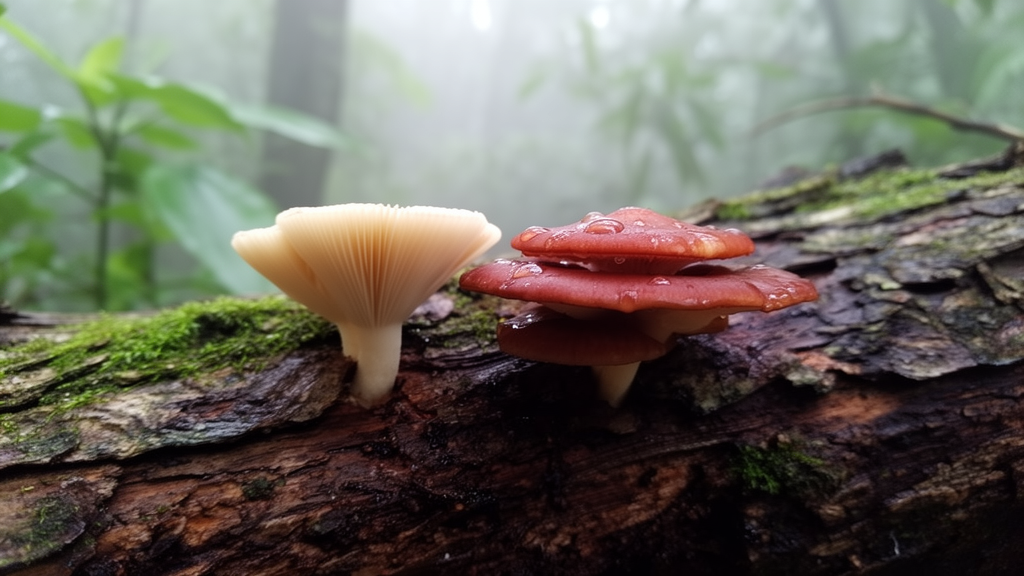
Deep in the forests of China, clinging to well-decayed wood in tiny gray cups barely wider than a grain of rice, two previously unknown mushrooms have just been formally introduced to science. Mycologists surveying the genus Resupinatus, a group of small saprotrophic fungi in the family Resupinataceae, have described Resupinatus meihui and Resupinatus cinereofuscus as new species, raising the number of known members of the genus to 49 worldwide. The discovery, published in the journal MycoKeys, also delivers the most complete identification key ever assembled for the genus and adds crucial Chinese material to a group whose evolutionary history has long been reconstructed largely from European and North American specimens.
Resupinatus is a genus of what mycologists call pleurotoid fungi: mushrooms whose caps are attached to the substrate laterally or dorsally rather than by a central stem. Most species are sessile, lacking a true stipe, though some develop a lateral pseudostipe. Their caps are dark brown to dark gray, occasionally pale, and distinctly gelatinous, giving the basidiomata, the fungal fruiting bodies, a tough, elastic, translucent quality. The hymenophore, the spore-bearing surface, may be lamellate with gills, poroid with pores, merulioid, or cyphelloid. Under the microscope, the genus is defined by smooth, inamyloid basidiospores that show no blue-black reaction in Melzer’s reagent, cylindrical to coralloid cheilocystidia bearing finger-like apical protrusions, and cap hyphae with branches or protrusions. These fungi are typical saprotrophs, decomposing dead branches and well-rotted wood of both conifers and broad-leaved trees, and occasionally appearing on gymnosperm cones, standing dead trees, or strongly decayed bamboo.
Until this study, only 47 species of Resupinatus were recognized worldwide, representing 92 names recorded in Index Fungorum. Europe leads the count with 20 species, followed by North America with 19, and none have been recorded from Antarctica. China, despite its vast and varied forests, had yielded only 12 species, most of them described only recently. Northeast China accounts for seven recorded species and Southwest China for five. The researchers behind the new paper argue that this gap reflects a lack of type specimens from China in most molecular systematic studies of the genus rather than a genuine scarcity of the fungi. During field collection, the team obtained nearly 40 specimens, a haul that strongly suggests Resupinatus is widely distributed across the country and that Chinese diversity remains substantially underexplored.
The taxonomic status of Resupinatus itself has been controversial for nearly two centuries. The genus was first proposed by Gray in 1821 within Hymenotheceae, Agaricales, characterized by dorsally attached basidiomata with an orbicular, membranaceous pileus and no stipe, annulus, or volva. Gray provided no micromorphological characters and recorded only the type species, R. applicatus. Singer later revised the concept using both macroscopic and microscopic features, placing Resupinatus in the tribe Resupinateae within Tricholomataceae and defining it by pleurotoid basidiomata, a gelatinous pileus, a lamellate hymenophore, smooth inamyloid basidiospores, dendroid cheilocystidia, and a pileipellis with stellate protrusions or a Rameales structure. In 2015, McDonald reconstructed phylogenetic relationships from ITS and nrLSU sequences and showed that the tribe Resupinateae formed a strongly supported independent lineage within Agaricales. The lineages of Rhodocyphella, Stromatocyphella, and Stigmatolemma fell inside the Resupinatus clade, so their species were transferred into the genus. A large-scale multigene phylogenetic study by Vizzini and colleagues in 2024 further confirmed the monophyly of Resupinatus, and the tribe was elevated to family rank as Resupinataceae.
The specimens behind the two new species were collected from the Guangxi Zhuang Autonomous Region and from Hubei, Shandong, Yunnan, and Zhejiang provinces. Fresh basidiomata, substrates, and habitats were photographed with high-resolution digital cameras, and each collection was assigned a field number as its voucher. The team recorded basidioma size and color, pileus surface texture, striation, tomentum, lamella number, the presence or absence of coarse felt at the point of attachment, substrate type, habitat, and forest type in detail, with colors following Ridgway’s 1912 standards. Specimens were dried at 40 degrees Celsius for roughly 48 hours and stored in sealed bags with color-indicating silica gel. For microscopy, dried material was rehydrated in 5 percent KOH, stained with 1 percent Congo red when necessary, and tested in Melzer’s reagent. For each basidioma, 25 mature basidiospores in side view were randomly selected and measured, and at least 20 structures were measured for other microscopic characters. Vouchers were deposited in the Fungarium of the Fujian Academy of Agricultural Sciences.
DNA was extracted from dried specimens and the internal transcribed spacer (ITS) region and the large subunit nuclear ribosomal RNA (nrLSU) region were amplified with the primer pairs ITS1/ITS4 and LR0R/LR7. Phylogenetic analyses were then run using both Bayesian inference and maximum likelihood. The sequence matrix included 79 sequences from 23 species, 47 of them ITS and 32 nrLSU, with 65 sequences downloaded from GenBank and 14 newly generated in the study. The combined dataset comprised 1,555 nucleotide positions, including 274 base pairs of ITS1, 173 of 5.8S, 232 of ITS2, and 876 of nrLSU. Pleurotus ostreatus served as the outgroup. The Bayesian analysis ran for 10 million generations of Markov chain Monte Carlo, converging cleanly with an average standard deviation of split frequencies of 0.002437, an effective sample size of 7405.6, and an average potential scale reduction factor of 1.000. The maximum likelihood analysis used 1,000 nonparametric bootstrap replicates. Both methods yielded similar topologies, and the trees resolved seven well-supported clades.
The phylogenetic results placed the two new species in separate clades with strong statistical support. Resupinatus meihui fell in Clade 3, with bootstrap support of 100 percent and a Bayesian posterior probability of 1.00, a clade containing only two species, R. meihui and the New Zealand species R. vinosolividus, each forming an independent, highly supported branch. Resupinatus cinereofuscus landed in Clade 5, with support of 95 percent and 0.99, alongside R. applicatus, R. kavinae, R. subapplicatus, and R. trichotis. Within that clade, R. cinereofuscus constituted a monophyletic lineage closely related to R. applicatus from Italy, with sister-lineage support of 100 percent and 1.00, but distantly related to the other three species. Each new species thus represents an independent evolutionary lineage, exactly the combination of molecular and morphological evidence required to justify species status.
The two species share several traits: basidiomata attached laterally or dorsally to the substrate, sessile, with lamellate hymenophores, pileus surfaces covered with tomentum or pruina, and cheilocystidia with digitate protrusions. But they diverge in diagnostic detail. Resupinatus meihui, whose Chinese name Mei Hui Fu Zhe Jun alludes to the delicate white tufted tomentum scattered on its grayish pileus, lacks coarse felt at the point of attachment, bears shortly branched lamellae, and has coralloid protrusions on the terminal hyphae of the pileipellis. Its basidiospores are subglobose to broadly ellipsoid, 5.0 to 5.9 by 4.0 to 4.8 micrometers, with a mean length-width ratio of 1.25. The holotype was collected at 1,652 meters in Houhe National Nature Reserve in Hubei Province in June 2024, with additional specimens from Yunnan and Guangxi, growing gregariously on well-decayed wood of broad-leaved trees including Castanopsis, Lithocarpus, Phoebe, and Cinnamomum.
Resupinatus cinereofuscus, named for its grayish-brown basidiomata, shows the opposite combination: coarse felt at the point of attachment, unbranched lamellae, and smooth, thick-walled terminal hyphae in the pileipellis. Its pileus is faintly striate and pruinose, its basidiospores globose to subglobose at 4.5 to 4.7 by 4.3 to 4.5 micrometers with a mean ratio of 1.07, and it lacks pleurocystidia, a feature that separates it from R. applicatus, which has cylindrical, branched, twisted pleurocystidia. The holotype came from Culai Mountain National Forest Park in Shandong Province at 883 meters in July 2021, with further specimens from Mengshan in Shandong and Tianmu Mountain in Zhejiang, growing scattered on well-decayed wood and dead branches in temperate to subtropical mixed forests dominated by Fagaceae, Pinaceae, and Salicaceae.
The study also highlights how substrate and elevation shape the genus’s distribution. Species reported outside China mainly occur on dead branches and rotten wood of conifers and broad-leaved trees such as Pinus, Abies, Quercus, Fagus, Acer, Betula, and Eucalyptus, occasionally on grapevines, bamboo, and palms. Chinese species are commonly found on Juniperus, Picea, Cinnamomum, Camellia, Betula, and Rhododendron. More than half of the known species outside China occur at low elevations below 1,000 meters, about one-third at middle elevations of 1,000 to 3,500 meters, and none above 3,500 meters. By contrast, Chinese species are known mostly from middle elevations, with very few below 1,000 meters. Climatic patterns are more consistent: species are mainly reported from subtropical regions, followed by temperate and tropical zones, with none recorded from the Arctic. With the identification key now covering all 49 known species, and Chinese sampling accelerating, mycologists expect the true diversity of these gelatinous wood-decomposers to be far greater than current counts suggest.
Subject of Research: Two new species of Resupinatus (Resupinataceae, Agaricales) from China
Article Title: Two new species of Resupinatus ( Resupinataceae , Agaricales ) from China
Article References: Qiu, G., Ge, Y., Zeng, H., Wang, T., Na, Q., & Hu, Y. (2026). Two new species of Resupinatus (Resupinataceae, Agaricales) from China. MycoKeys, 140, 147-171. https://doi.org/10.3897/mycokeys.140.202233
Image Credits: AI Generated
DOI: 10.3897/mycokeys.140.202233
Keywords: species, Resupinatus, Resupinataceae, Agaricales, China, scientific research
Cite Scienmag News
Roger Howard. (October 17, 2026). Two new wood-dwelling mushroom species discovered in China. Scienmag. https://scienmag.com/two-new-wood-dwelling-mushroom-species-discovered-in-china/
Roger Howard. "Two new wood-dwelling mushroom species discovered in China." Scienmag, 17 October 2026, https://scienmag.com/two-new-wood-dwelling-mushroom-species-discovered-in-china/. Accessed 17 October 2026.
Roger Howard. "Two new wood-dwelling mushroom species discovered in China." Scienmag. October 17, 2026. https://scienmag.com/two-new-wood-dwelling-mushroom-species-discovered-in-china/


