


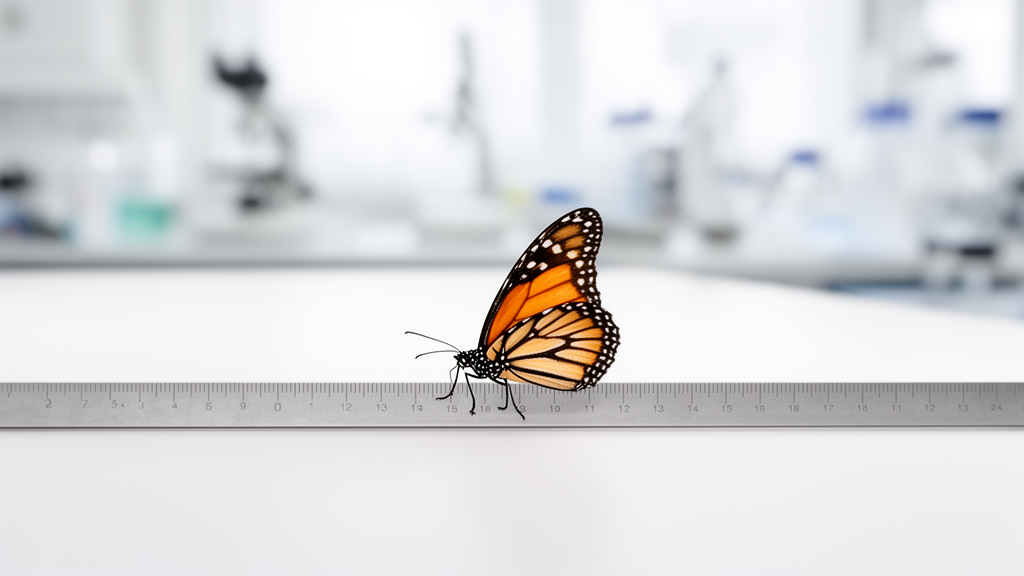
Body size is one of those deceptively simple ideas that turns out to be surprisingly slippery once you try to measure it across the staggering diversity of life. For moths and butterflies — an order with more than 160,000 described species — the problem is acute. Ecologists and evolutionary biologists need reliable estimates of how much an adult insect weighs, because body mass threads through nearly every life history question: how far an animal can fly, how much energy it needs to reach maturity, how it responds to a warming, changing world. Yet almost nobody reports body weight in field guides or monographs. What they report is forewing length or wingspan, the two measurements that happen to be easiest to take with a ruler.
A new study published in Nota Lepidopterologica by entomologist Enrique García-Barros of the Universidad Autónoma de Madrid tackles this mismatch head-on, and the results overturn a long-standing assumption. The best single predictors of dry body weight in adult male moths and butterflies turn out to be thorax length, total body length and head width — none of which is among the popular descriptors of size in this insect order. Forewing length, the metric most often published, is well correlated with body weight but is not the best linear predictor. The finding matters because researchers who want to estimate body mass from published descriptions have been working with suboptimal tools.
The scale of the new dataset is what gives the study its statistical muscle. García-Barros weighed and photographed 5,341 adult male specimens representing 2,645 species, a seven-fold increase in species sampling compared with his own earlier attempt published in 2015. Each insect was dried to constant weight at 70 degrees Celsius for 24 to 72 hours to obtain dry body weight in milligrams, then re-moistened, spread and digitized together with a metric scale. Thirteen linear measurements were taken from the digitized images using ImageJ, covering the head, thorax, abdomen, forewing, hindwing and two alternative estimates of wingspan. The largest part of the sample was deposited in the collections of the Madrid Natural History Museum, with vouchers of the Tortricidae held in Valencia.
The range of body masses covered is extraordinary. The lightest species, some Nepticulidae and Heliozelidae, weighed between 0.04 and 0.05 milligrams, and the study suggests that the tiniest known leaf-mining moths with forewings of just 1.2 to 1.3 millimeters would come in at roughly 0.017 to 0.020 milligrams. At the other extreme, some tropical Cossidae such as Xyleutes persona exceeded three grams — 3,000 milligrams — of dry weight. That means male dry body weight in known Lepidoptera spans five orders of magnitude, while forewing length spans only three. The allometric exponents recovered from the bivariate regressions fell between 1.92 and 2.96, exactly what length-to-volume scaling predicts, and every linear measurement correlated with dry body weight at R above 0.97 on logarithmically transformed values.
Eight multivariate regression models were fitted to the log-transformed species means, reflecting different combinations of measurements a researcher might realistically have available. The most complex models, based on five to seven body measurements, predicted dry body weight most accurately, with adjusted R-squared values of 0.980 and the lowest cross-validation errors. Models combining wingspan with body length performed reasonably but suboptimally, and simple models based on forewing length alone or wingspan alone were acceptable but clearly inferior. The author recommends two models in particular: one combining head width, thorax length and width, abdomen length and width, forewing length and forewing width, and another built on forewing length as the primary predictor with the residuals of the remaining variables added as supplementary terms — the latter having the advantage of near-complete linear independence among its predictors.
One of the study’s most technically interesting results concerns collinearity. Whenever more than one variable entered a regression model, the variance inflation factor climbed well above the threshold of 4 to 10 generally identified as excessive — with a single exception, the residual-based model 8, which kept minimum VIF at 1.00. High collinearity carries the risk of overprediction: species with unusual body plans not covered by the dataset could receive wildly inaccurate weight estimates. Variance partitioning of the regression residuals showed that most of the unexplained variation was attributable to morphology rather than phylogeny — the pure phylogenetic effect was virtually negligible, roughly a ten-fold smaller contribution than the shared morphology-phylogeny effect. This suggests the best models may be stable and reliable for prediction, provided the species being predicted falls within the morphological range the dataset covers.
The study also tested taxon-by-taxon approaches, fitting separate regressions for families and superfamilies, and ANCOVA-based methods that assign family-level coefficients to intercepts and slopes. The results were sobering. In the butterflies, an instructive example, three families — Lycaenidae, Riodinidae and Nymphalidae — proved homogeneous for slope and intercept, but all six families differed significantly from each other in intercept, slope, or both. That means a single family-level equation risks systematically overestimating the weight of some species and underestimating others. Because the phylogenetic structure in the residuals was so weak, García-Barros argues that clustering species on morphological grounds rather than taxonomic ones would be far preferable — a conclusion with implications for anyone building order-wide reference equations.
Two practical extensions round out the work. A limited sample of females from 362 species revealed a nearly isometric relationship between male and female dry body weight, described by the equation female DBw = 0.1574 + 0.9770(male DBw) with an adjusted R-squared of 0.953 — a clear-cut result, though the author cautions that evidence from other studies shows this relationship is not uniform across all moth and butterfly families. A subset of field-caught Spanish males, frozen shortly after capture and weighed within 24 hours, established that fresh body weight scales to dry weight with a slope close to isometry and that dry weight accounts for about 38 percent of live weight — a water content squarely within the typical range for adult insects. These conversions let field researchers translate predicted dry masses into approximate live weights, at some cost in accuracy.
The optimistic and pessimistic readings of the study are both on offer, and García-Barros presents them honestly. The pessimistic view notes that the sample represents barely more than 2 percent of described Lepidoptera species, most species contributed only one to three individuals, and female data are scarce. Yet the optimistic view is compelling: the seven-fold increase in species sampling raised the fit of the best model by merely 1 percent, suggesting that the broad morphological variation across the order is redundant enough for multivariate prediction to work well. The full dataset has been made openly available through the Dryad Data Repository, and the author argues that in the face of global change and documented insect biomass declines, publishing more standardized body size data on moths and butterflies should be actively encouraged. For a hyper-diverse group whose masses span five orders of magnitude, a ruler and the right equation may now be all that stands between a museum specimen and a usable number.
Subject of Research: A multivariate regression study of 2,645 Lepidoptera species refines estimates of adult dry body weight from thirteen linear measurements, showing that combinations of body and wing metrics outperform traditional size descriptors.
Article Title: Refining estimates of dry body weight from linear measurements in adult moths and butterflies ( Lepidoptera )
Article References: García-Barros, E. (2025). Refining estimates of dry body weight from linear measurements in adult moths and butterflies (Lepidoptera). Nota Lepidopterologica, 48, 165-184. https://doi.org/10.3897/nl.48.144747
Image Credits: AI Generated
DOI: 10.3897/nl.48.144747
Keywords: Lepidoptera, body size, allometry, dry body weight, insect ecology, moths, butterflies, morphometrics, Refining, estimates, body, weight
Cite Scienmag News
Gavin Prescott. (October 17, 2026). New Equations Weigh Moths and Butterflies From a Ruler Alone. Scienmag. https://scienmag.com/new-equations-weigh-moths-and-butterflies-from-a-ruler-alone/
Gavin Prescott. "New Equations Weigh Moths and Butterflies From a Ruler Alone." Scienmag, 17 October 2026, https://scienmag.com/new-equations-weigh-moths-and-butterflies-from-a-ruler-alone/. Accessed 17 October 2026.
Gavin Prescott. "New Equations Weigh Moths and Butterflies From a Ruler Alone." Scienmag. October 17, 2026. https://scienmag.com/new-equations-weigh-moths-and-butterflies-from-a-ruler-alone/


