


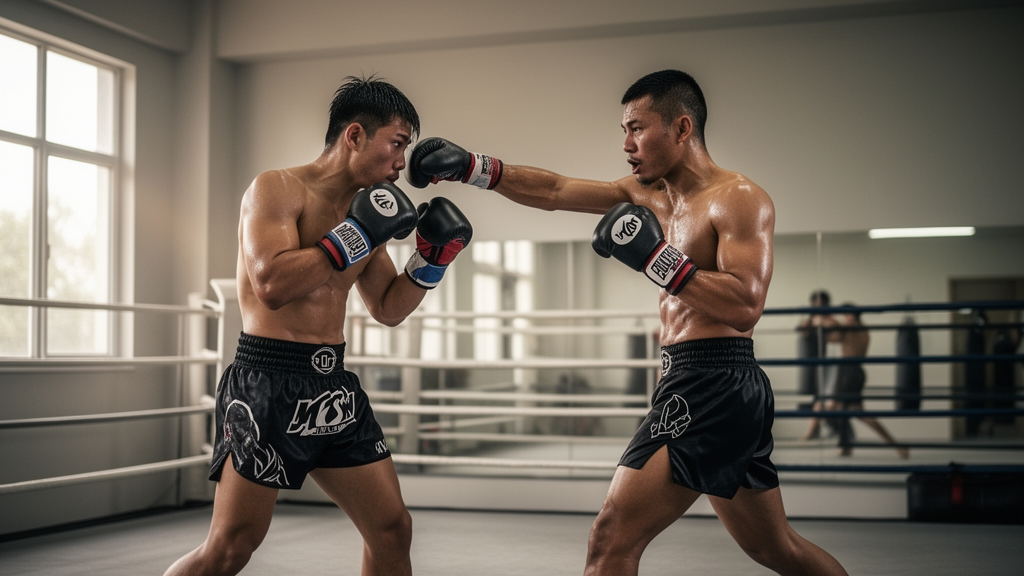
Elite Muay Thai fighters absorb hundreds of elbows, knees, and kicks to the head over their careers, yet a new study from Thailand finds that their thinking skills look remarkably similar to those of sprinters who have never taken a strike. The research, published in Frontiers in Sports and Active Living, compared 44 elite male Muay Thai athletes with 42 male sprint-athlete controls aged 15 to 25 years and found no significant differences in any of the neurocognitive measures tested. But buried within the fighter group was a subtler signal: athletes with greater estimated cumulative exposure to repetitive head impacts showed changes on specific tests of executive function and inhibitory control, a pattern the study’s author describes as hypothesis-generating rather than proof of harm.
The distinction at the heart of the study is between concussion and something far less visible. Sport-related concussion is an acute brain injury caused by biomechanical forces transmitted to the head, neck, or body, producing transient neurological dysfunction. Repetitive head impacts, by contrast, are repeated exposures that may occur with or without any immediately apparent symptoms; impacts that never trigger a clinically recognised concussion are called subconcussive exposures. In a striking sport like Muay Thai, where punches, elbows, knees, and kicks to the head are legal weapons in both training and competition, these subconcussive hits can accumulate across thousands of rounds, and researchers have long worried about what that silent accumulation might do to the brain.
Evidence from other contact sports suggests the concern is not unfounded, but the picture is stubbornly inconsistent. In amateur soccer players, greater heading exposure has been linked to lower fractional anisotropy, a measure of white-matter organisation, in temporo-occipital brain regions, and lower fractional anisotropy has in turn been associated with poorer memory performance. More recent work in adult amateur soccer players found that greater repetitive head-impact exposure was associated with an attenuated fractional-anisotropy slope at the orbitofrontal gray-white matter interface and poorer verbal learning, even though delayed recall, working memory, processing speed, and executive function showed no such association. Among former American football players, the volume of white-matter perivascular spaces was larger than in unexposed controls and correlated with estimated cumulative head-impact exposure and cognitive performance. The lesson from this literature is one of outcome specificity: head impacts may leave fingerprints on some measures while leaving others untouched, and findings from one sport or one test cannot be assumed to generalise.
Combat sports add their own complications. Resting electroencephalography in boxers has shown lower normalised power spectral density and power-law exponent values in more experienced athletes, along with frequency-dependent differences in multiscale entropy, differences interpreted as potential correlates of cumulative subconcussive exposure because the athletes were asymptomatic. Mixed martial arts athletes have shown reduced N400 event-related-potential amplitudes relative to matched controls, hinting at altered neural processing without diagnosed concussion. Yet longitudinal neuropsychological data tell a more sobering story: over two years, competitive mixed martial arts fighters showed greater declines in mental processing speed, inhibitory control, and cognitive flexibility than recreational fighters. Meanwhile, martial-arts training itself has been associated with better executive control, attention, and inhibitory processing, and regular physical activity is linked to cognitive benefits across multiple domains. That creates a fundamental attribution problem: any cognitive difference between fighters and non-fighters could reflect head impacts, the cognitive demands of training, or both.
This is precisely why the new study chose its control group with care. Rather than comparing fighters against sedentary individuals, the researcher recruited sprint athletes from athletics programmes and university sprint-training environments in the same region of Southern Thailand, selected for group-level comparability in age, education, years of structured training, and competitive level. The two groups proved nearly indistinguishable on paper: mean age was 20.23 years for the Muay Thai athletes versus 19.93 for the sprinters, training years were 4.84 versus 4.71, competition exposure was 25.00 versus 24.79 events, and education years were 13.86 versus 13.40, with no statistically significant differences on any matching variable. Both groups included athletes competing at the Thailand National Games and Thailand National Youth Games, and both contained gold, silver, and bronze medallists. Participants with neurological disorders, histories of moderate-to-severe traumatic brain injury, psychiatric or neurodevelopmental conditions requiring ongoing treatment, cognition-affecting medications, or uncorrected visual impairment were excluded through structured health screening.
The testing battery was deliberately multidimensional. Athletes completed the Rey Auditory Verbal Learning Test for verbal learning and memory, a computerised Go/No-Go task measuring inhibitory control and sustained attention, the Stroop Colour-Word Test for inhibitory control, the Trail Making Test Parts A and B for processing speed and executive flexibility, Digit Span for working memory, and the Symbol Digit Modalities Test for processing speed and visuomotor integration. The Go/No-Go task alone comprised 360 trials, 75 per cent Go trials requiring fast responses to green circles and 25 per cent No-Go trials demanding that participants withhold a response to red circles. Testing took place in quiet indoor conditions, with participants instructed to avoid strenuous exercise, alcohol, and caffeine for at least 24 hours beforehand, and scheduled rest periods built in to minimise fatigue. Beyond the raw task scores, the researcher constructed standardised composite indicators for four domains: processing speed, executive function, memory, and working memory.
The headline result was a clean null. No statistically significant between-group differences emerged on any task-specific outcome, from Trail Making completion times to Stroop interference to reaction time on the Go/No-Go task, and none on the four domain-level composites. Covariate-adjusted ANCOVA models controlling for age, education, and years of sport-specific training confirmed the pattern: no significant group effects for processing speed, executive function, memory, or working memory, with effect sizes near zero. This contradicted the study’s own hypothesis, which had predicted poorer executive-function and processing-speed performance in the fighters based on prior combat-sport literature. The author argues that the athletic-control design may partly explain the discrepancy, since earlier studies often compared contact-sport athletes against non-athletic or differently trained groups, allowing general training effects to masquerade as head-impact effects. The young age and active competitive status of the cohort may also matter, as studies of athletes with longer careers have more often reported deficits.
Within the fighter group, however, a more ambiguous picture emerged. The researcher constructed a cumulative repetitive head-impact exposure score by summing standardised z scores for three retrospective indicators: years of structured Muay Thai training, number of competitive fights, and self-reported head-injury events. On average, athletes reported 4.84 years of training, 25 competitive fights, and 0.61 self-reported head-injury events. Exploratory Spearman correlations revealed that higher exposure scores were associated with lower executive-function composite scores, with longer Stroop interference times, and, counterintuitively, with shorter completion times on both Trail Making Test parts. That directional inconsistency is striking: shorter Trail Making times indicate better performance, while longer Stroop interference indicates worse, so the associations point in opposing performance-related directions. Memory, working memory, and the processing-speed composite showed no significant associations at all, and neither did any Rey Auditory Verbal Learning Test outcome.
The author is careful about what these correlations can and cannot mean. The exposure score rests on retrospectively self-reported proxy indicators rather than direct biomechanical monitoring, making it vulnerable to recall bias and exposure misclassification, and it cannot capture the frequency, magnitude, location, or biomechanical characteristics of individual impacts. The correlations were not adjusted for multiple comparisons, inflating the risk of false positives, and the cross-sectional design precludes any temporal or causal inference. The findings, the paper concludes, should not be interpreted as evidence of generalised neurocognitive impairment, nor should any single test or the exposure score be used as a stand-alone screening, diagnostic, or return-to-play tool. What they can do is nominate candidate measures for future work.
The path forward, the study argues, requires prospective longitudinal designs with objective head-impact monitoring and repeated neurocognitive assessment, ideally in more diverse athlete samples beyond the young male competitive context studied here. Until then, the message for the roughly 44 fighters in this sample, and for the sport they represent, is a nuanced one: years of elbows and knees to the head have not yet produced measurable broad cognitive differences compared with equally trained sprinters, but the possibility that specific executive functions erode with accumulating exposure remains live, and only time, and better instruments, will tell.
Subject of Research: Neurocognitive performance and repetitive head-impact exposure in elite Muay Thai athletes compared with sprint-athlete controls
Article Title: Sport-related neurocognitive performance and repetitive head-impact exposure in elite Muay Thai athletes: a matched athletic-control study
Article References: Tengku Sulaiman, R. S. (2026). Sport-related neurocognitive performance and repetitive head-impact exposure in elite Muay Thai athletes: a matched athletic-control study. Frontiers in Sports and Active Living, 8, Article 1908733. https://doi.org/10.3389/fspor.2026.1908733
Image Credits: AI Generated
DOI: 10.3389/fspor.2026.1908733
Keywords: Muay Thai, repetitive head impacts, subconcussive exposure, neurocognitive performance, executive function, combat sports, Stroop test, Trail Making Test, athletic-control study, brain injury, sport concussion, Thailand
Cite Scienmag News
Cassandra Pierce. (October 17, 2026). Elite Muay Thai Fighters Show No Broad Cognitive Deficits Despite Years of Head Impacts. Scienmag. https://scienmag.com/elite-muay-thai-fighters-show-no-broad-cognitive-deficits-despite-years-of-head-impacts/
Cassandra Pierce. "Elite Muay Thai Fighters Show No Broad Cognitive Deficits Despite Years of Head Impacts." Scienmag, 17 October 2026, https://scienmag.com/elite-muay-thai-fighters-show-no-broad-cognitive-deficits-despite-years-of-head-impacts/. Accessed 17 October 2026.
Cassandra Pierce. "Elite Muay Thai Fighters Show No Broad Cognitive Deficits Despite Years of Head Impacts." Scienmag. October 17, 2026. https://scienmag.com/elite-muay-thai-fighters-show-no-broad-cognitive-deficits-despite-years-of-head-impacts/


