


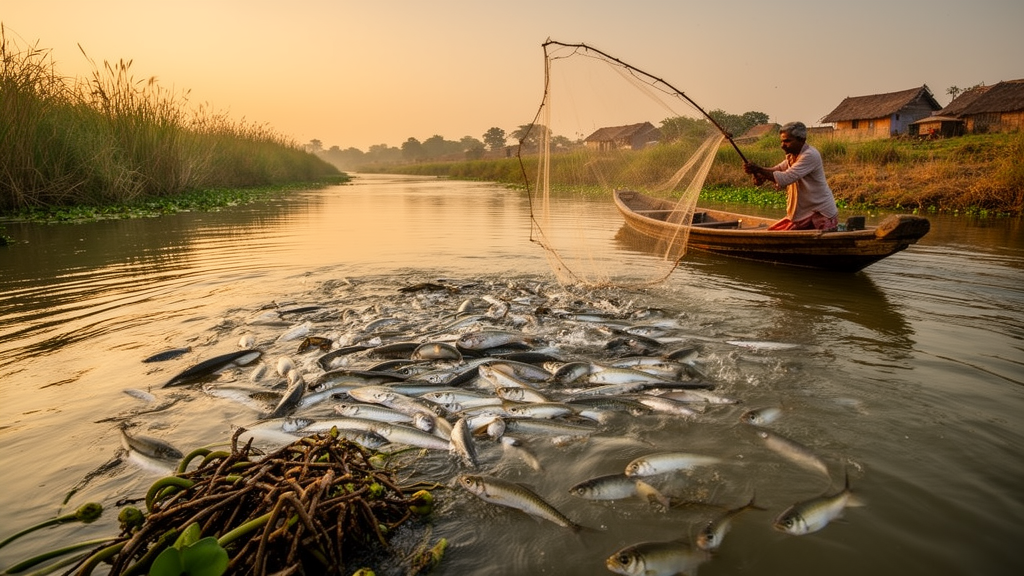
Non-native fish species have been moved by humans across the planet for centuries, and a sweeping new assessment published in the journal NeoBiota has now quantified, with unprecedented rigor, what those introductions have actually done to ecosystems and human communities. The study is the first ever to apply the complete Impact Classification for Alien Taxa framework, using all four of its tools, to any taxonomic group. Researchers focused on the 20 most widely distributed fish species that are non-native to India and compared their documented impacts in that country with their impacts across the rest of the world, revealing stark patterns in how invasion science is conducted and what it has found.
The scale of the data gap itself is one of the most striking findings. From a pool of 1,353 records derived from published literature, 911, or 67 percent, had to be scored as Not Applicable because the reports suggested impacts but provided insufficient information to determine impact magnitude under the classification criteria. Among the remaining 442 relevant impact records for the 15 species with documented impacts, detrimental environmental impacts utterly dominated, accounting for 384 records. Beneficial environmental impacts numbered just 34, detrimental socio-economic impacts 14, and beneficial socio-economic impacts 10. In other words, 87 percent of all scored records described harm to native biodiversity, a pattern consistent with global cross-taxonomic trends in which roughly 85 percent of documented environmental impacts of invasive non-native species are detrimental to nature.
The framework behind these numbers deserves explanation. The Environmental Impact Classification for Alien Taxa, known as EICAT, is an IUCN standard that scores detrimental environmental impacts on native taxa into five ordinal categories ranging from Minimal Concern to Massive, based on observed changes at the individual or population level. EICAT+ applies the same logic to beneficial environmental impacts, while the Socio-Economic Impact Classification for Alien Taxa, SEICAT, and its positive counterpart SEICAT+ measure how non-native species change human activities and well-being, from fishing and swimming to health and income. By applying all four tools simultaneously, the researchers captured both directions of impact, detrimental and beneficial, on both nature and people, something no previous study of fishes, or indeed of any taxon, had attempted.
Five of the 20 species assessed had to be classified as Data Deficient because no relevant impact records could be found: the alligator gar, three-spot cichlid, giant gouramy, vermiculated sailfin catfish and sutchi catfish. Among the 15 remaining species, two stand out for the severity of their documented harm. Brown trout and Nile tilapia were both linked to actual extinctions of native fishes, the highest possible impact score. Brown trout contributed to the global extinction of the New Zealand grayling, with predation and competition cited as frequently as all other extinction drivers combined. Nile tilapia has been linked to the extinction of the short-barbelled barb, endemic to Lake Luhondo in Rwanda, after over-exploitation and disease were ruled out as alternative explanations. Following the tilapia introduction, the lake shifted from a clear-water system with abundant submerged vegetation to a turbid state lacking submerged macrophytes, destroying the habitat structure the barb depended on.
Common carp emerged as the species with the greatest number of documented negative environmental impacts, 75 records in total, including 66 strong detrimental impacts. Introduced into 140 river basins worldwide, common carp caused local extirpation of macrophytes in most of its Major-impact records, mainly through bioturbating sediments, uprooting plants while foraging, and resuspending sediments that limit light penetration. Rainbow trout illustrates the paradox at the heart of invasion impacts: downstream of the Glen Canyon Dam in the Colorado River, introduced rainbow trout comprised up to 98 percent of the fish community by numbers, supporting a fishery that attracted an estimated 7,347 anglers in 2018 with a net value of 2.7 million US dollars in 2014, yet the same species caused local extirpation of native fishes including the Breede River redfin, Cape kurper and Cape galaxias in South Africa.
The statistical analysis delivered a clear verdict on which native groups are most vulnerable. Using binomial generalized linear mixed-effect models with species name and impacted biogeographic realm as random effects, the researchers found that non-native fishes were significantly more likely to cause strong detrimental impacts on macrophytes than on vertebrates or invertebrates. Macrophytes in the dataset were impacted by three species: the herbivorous grass carp, which reduced aquatic plants mainly through direct grazing, and the omnivorous pirapitinga and common carp, which caused impacts almost exclusively through physical disturbance, producing 37 strong impacts out of 38 records. The authors suggest prioritizing macrophytes for threat evaluation, while emphasizing that native animal groups are not free from risk, as strong impacts were documented for vertebrates and invertebrates as well, with predation being the most frequent mechanism of harm.
Perhaps the most consequential finding concerns India itself. The probability of strong detrimental environmental impacts did not differ significantly between India and the rest of the world, and this pattern held even when the analysis was restricted to the subset of species documented in both locations. Yet only eight of the 15 species with impacts had any records from India, and five of the seven species that showed no impacts in India were associated with strong impacts, including local extirpations, elsewhere. Notably, none of the impact records on macrophytes came from India, and no beneficial environmental impacts were reported in the country at all. The evidence points to a research gap rather than genuinely weaker invasions: only about 19 percent of studies in a systematic review of non-native fishes in India attempted to document impacts, compared with 32 percent in a global review of all non-native species.
Methodology also shapes what invasion science sees. The researchers classified manipulative study designs along a gradient from laboratory experiments, farthest from natural conditions, to interventions in real ecosystems, closest to natural conditions. Contrary to their hypothesis, the likelihood of detecting strong environmental impacts did not differ significantly among detection types, whether observational studies, field experiments, enclosure or exclosure experiments, or interventions. However, a higher proportion of strong impacts was observed in manipulative studies, 67 percent of 114 records, compared with 47 percent of 304 observational records. Fisher’s exact test revealed a significant association between study type and location: the odds of a study being observational in India are 6.8 times higher than in the rest of the world, reflecting the financial demands of experiments in natural ecosystems and India’s position in the Global South.
The human dimension of fish invasions proved equally bidirectional. Eight community types experienced socio-economic impacts, including commercial fishers, fish farmers, recreational fishers, river swimmers, boaters and village residents. In India, commercial fishers reported economic losses from reduced catches caused by Mozambique and Nile tilapia, and damaged nets and longer fishing hours due to the Amazon sailfin catfish. Conversely, Nile tilapia in the Halali reservoir and common carp in Lake Naivasha, Kenya supported employment and income, while mosquito fish contributed to reductions in vector-borne diseases such as Chikungunya. Most negative records involved safety, while most positive records involved material and immaterial assets. Notably, no affected community undertook any burdensome activities to mitigate the impacts of non-native fishes.
The way forward, the authors argue, requires a precautionary approach in the absence of regional impact data, with the highest documented impacts from elsewhere guiding decision making, alongside targeted impact assessments in India to rank non-native fishes for management prioritization. Higher investments in invasion research in the Global South, or funds from wealthier countries channeled into international collaborations, are needed to close the geographic research gaps that leave heavily understudied countries blind to the consequences of species introductions. As the first study to apply the complete ICAT framework to any taxonomic group, this assessment sets a template for capturing the full bidirectional spectrum of invasion impacts on biodiversity and human well-being, and for building the evidence base that management of non-native fishes in India and beyond urgently requires.
Subject of Research: Impacts of non-native fish species on biodiversity and human communities, comparing global patterns with Indian contexts
Article Title: Impacts of non-native fishes: from global patterns to Indian contexts
Article References: Kumar, L., Jeschke, J. M., Bacher, S., & Vimercati, G. (2026). Impacts of non-native fishes: from global patterns to Indian contexts. NeoBiota, 108, 171-193. https://doi.org/10.3897/neobiota.108.182031
Image Credits: AI Generated
DOI: 10.3897/neobiota.108.182031
Keywords: non-native fishes, invasive species, EICAT, SEICAT, ICAT framework, macrophytes, India, freshwater ecosystems, common carp, Nile tilapia, brown trout, biodiversity impacts
Cite Scienmag News
Patricia Pace. (October 17, 2026). Invasive Fish Are Rewriting Freshwater Ecosystems From India to the World. Scienmag. https://scienmag.com/invasive-fish-are-rewriting-freshwater-ecosystems-from-india-to-the-world/
Patricia Pace. "Invasive Fish Are Rewriting Freshwater Ecosystems From India to the World." Scienmag, 17 October 2026, https://scienmag.com/invasive-fish-are-rewriting-freshwater-ecosystems-from-india-to-the-world/. Accessed 17 October 2026.
Patricia Pace. "Invasive Fish Are Rewriting Freshwater Ecosystems From India to the World." Scienmag. October 17, 2026. https://scienmag.com/invasive-fish-are-rewriting-freshwater-ecosystems-from-india-to-the-world/


