


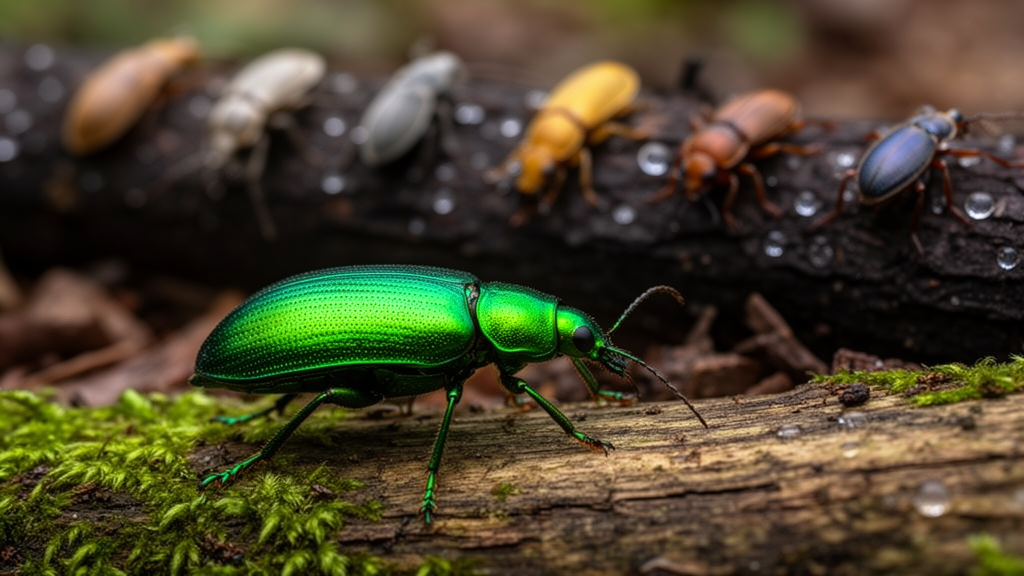
Ground beetles are everywhere. With more than 40,000 described species, the family Carabidae ranks among the largest lineages of beetles, prowling forest floors, riverbanks, and deserts on every continent. Yet for all their ecological success and scientific familiarity, the family tree of these predators has remained stubbornly tangled. A new phylogenetic analysis published in the Deutsche Entomologische Zeitschrift now untangles major branches of that tree, drawing on one of the most taxonomically dense molecular datasets ever assembled for the group and delivering a revised classification that reshapes how entomologists will organize carabid diversity for years to come.
The research team, led by Kipling W. Will of the University of California, Berkeley, together with Kojun Kanda, Alexander L. Wild, Joachim Schmidt, Wendy Moore, Kelly B. Miller, R. Antonio Gómez, and David R. Maddison, sampled 529 carabid species and 101 additional adephagan species, the broader infraorder that includes ground beetles, whirligig beetles, and diving beetles. Sequence data came from five nuclear gene fragments, a deliberately conservative choice that favors slowly evolving regions capable of resolving deep splits across hundreds of millions of years of beetle evolution. The sampling strategy targeted nearly every notable carabid lineage, including obscure and phylogenetically enigmatic genera that previous molecular studies had never touched.
The scale of the taxon sampling matters because of a persistent problem in beetle systematics. Sparse datasets can place unusual species confidently in the wrong part of the tree simply because the true relatives were never sequenced. By pulling in rare and morphologically puzzling genera, the authors gave the analysis a chance to test whether long-standing groupings reflect genuine evolutionary history or merely the accidents of earlier sampling. The results vindicated that approach repeatedly, and nowhere more dramatically than within Harpalinae, the hyperdiverse subfamily that accounts for the bulk of carabid species and has long been the family’s most problematic branch.
Among the most consequential findings are the placements of groups that had never before appeared in a molecular phylogenetic analysis. The tribes Geobaenini, Amorphomerini, and Idiomorphini, along with the subtribe-level group Agonicina, have hovered at the margins of carabid classification for decades, their affinities debated on the basis of scattered morphological characters. The new analysis places each of them with strong support, and in doing so reveals clades that no previous morphologist had recognized. These placements do more than assign labels to orphaned lineages; they clarify character evolution across the subfamily and suggest that some anatomical features long treated as diagnostic of particular tribes evolved independently in unrelated lineages.
Equally significant is what the analysis dismantled. Several traditionally recognized tribes, including Pterostichini, Morionini, and Oodini, show strong or moderate evidence of non-monophyly, meaning the species assigned to those groups do not all descend from a single common ancestor exclusive to the group. Pterostichini, one of the largest and best-known ground beetle tribes, fragments into pieces that belong elsewhere on the tree, and the same pattern holds for Morionini and Oodini. In systematics, non-monophyly at this scale is not a technical footnote; it means that the names biologists have used to talk about entire ecological guilds of beetles describe mixtures of unrelated lineages, obscuring comparisons of behavior, defense chemistry, and morphology across the family.
Acting on these results, the authors propose a revised classification of Carabidae to the tribal level, reassigning lineages so that named groups correspond to recovered evolutionary clades. Such taxonomic surgery is rarely popular, since it forces researchers to learn new names and reshuffle museum collections, but the authors argue it is the necessary consequence of a better-supported tree. A classification that contradicts phylogeny actively misleads evolutionary research, because every comparative study that treats a polyphyletic tribe as a single entity inherits the error. The revised framework is designed to be stable and testable, providing a scaffold that future studies can refine rather than repeatedly overturn.
The molecular results also prompted a renewed integration of morphology, a step that distinguishes this work from purely sequence-driven phylogenetics. The authors re-examined morphological character evidence to reassess hypotheses of character state evolution and to identify synapomorphies, shared derived features that diagnose clades on the tree. This matters especially for paleontology: fossil carabids cannot be sequenced, so their placement depends entirely on anatomical characters whose evolutionary polarity must be mapped onto a molecular backbone. By pinpointing morphological features relevant to both extant and fossil taxa, the analysis gives paleontologists a defensible basis for slotting extinct beetles into the revised tree, extending the reach of the phylogeny deep into the family’s history.
Methodologically, the study illustrates the enduring value of multilocus nuclear datasets in an era when genome-scale sequencing often dominates headlines. Five gene fragments cannot match hundreds of loci for statistical power, but the trade-off is practical: the same primers work across an enormous range of species, including rare specimens and museum material from remote regions, allowing the kind of comprehensive taxon coverage that remains difficult for whole-genome approaches when hundreds of species must be sampled. The authors’ strategy shows that dense sampling of taxa can be as important as dense sampling of loci, particularly when the goal is to place enigmatic lineages rather than to estimate divergence times with precision.
The adephagan outgroup sampling reinforces the reliability of the carabid backbone. Including 101 species from other adephagan families anchors the ingroup within its broader infraorder, reducing the risk that long-branch attraction or incomplete lineage sorting distorts relationships at the base of the tree. Well-supported placements for numerous lineages not previously included in molecular analyses mean that the new tree is not merely a reshuffling of familiar species but a genuinely expanded map of carabid diversity, one that incorporates lineages whose evolutionary positions had been pure conjecture.
For evolutionary biologists, the study delivers a foundation rather than a finale. Harpalinae alone contains a staggering array of lifestyles, from seed-eating specialists to chemically defended bombardier-like lineages, and a resolved framework of relationships within the subfamily turns that diversity into a comparative dataset. Questions about the repeated evolution of defensive glands, the origins of herbivory, and the drivers of speciation in the world’s most species-rich beetle subfamily can now be asked against a tree that reflects tested evolutionary history. The authors present their hypothesis as stable and testable, an invitation for the next generation of carabid research to build on a map that, for the first time, includes nearly all of the family’s major lineages.
Subject of Research: Phylogenetic relationships and revised classification of adephagan beetles with emphasis on the subfamily Harpalinae
Article Title: Phylogenetic analysis of Adephaga (Coleoptera) with extensive taxon sampling reveals unexpected relationships within the hyperdiverse beetle subfamily Harpalinae (Carabidae)
Article References: Will, K. W., Kanda, K., Wild, A. L., Schmidt, J., Moore, W., Miller, K. B., Gómez, R. A., & Maddison, D. R. (2026). Phylogenetic analysis of Adephaga (Coleoptera) with extensive taxon sampling reveals unexpected relationships within the hyperdiverse beetle subfamily Harpalinae (Carabidae). Deutsche Entomologische Zeitschrift, 73(1), 193–254. https://doi.org/10.3897/dez.73.189689
Image Credits: AI Generated
Keywords: phylogenetics, Carabidae, Harpalinae, Adephaga, Coleoptera, molecular systematics, ground beetles, taxonomy, non-monophyly, morphological synapomorphies, Deutsche Entomologische Zeitschrift, beetle evolution
Cite Scienmag News
Gavin Prescott. (October 17, 2026). Massive Beetle Family Tree Rewritten as Ground Beetles Reveal Surprising Evolutionary Alliances. Scienmag. https://scienmag.com/massive-beetle-family-tree-rewritten-as-ground-beetles-reveal-surprising-evolutionary-alliances/
Gavin Prescott. "Massive Beetle Family Tree Rewritten as Ground Beetles Reveal Surprising Evolutionary Alliances." Scienmag, 17 October 2026, https://scienmag.com/massive-beetle-family-tree-rewritten-as-ground-beetles-reveal-surprising-evolutionary-alliances/. Accessed 17 October 2026.
Gavin Prescott. "Massive Beetle Family Tree Rewritten as Ground Beetles Reveal Surprising Evolutionary Alliances." Scienmag. October 17, 2026. https://scienmag.com/massive-beetle-family-tree-rewritten-as-ground-beetles-reveal-surprising-evolutionary-alliances/


