


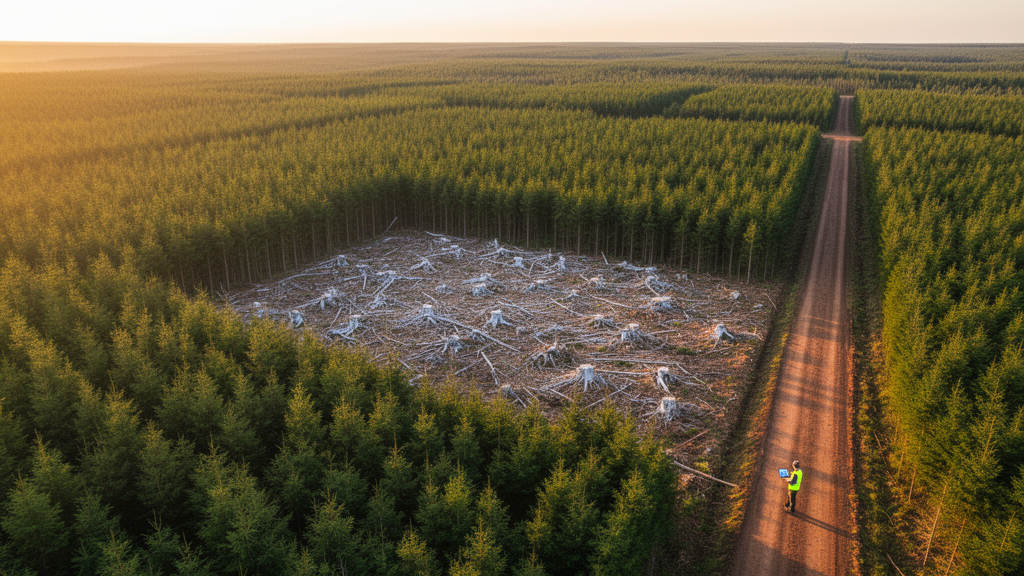
When a wildfire burns through a forest, when a government tightens logging rules, or when demand for timber suddenly surges, how long does the disturbance echo through that country’s forest ecosystem? A new study argues that the answer depends not only on which country you ask, but also on which clock you use to measure time. By combining wavelet decomposition with stationarity tests, researchers have produced the first frequency-domain assessment of forest ecological balance across nine of the world’s major forest product producers, and their findings challenge the idea that forest sustainability follows a single, uniform pattern anywhere on Earth.
The research, published in Frontiers in Forests and Global Change, examines Austria, Brazil, Canada, China, Finland, France, Germany, Sweden, and the United States over the period from 1961 to 2022, using 62 annual observations per country drawn from the Global Footprint Network. The team, led by İlkay Güler of Ankara Haci Bayram Veli University together with colleagues from Bingöl University, Arkin University of Creative Arts and Design, Tarsus University, and Artvin Coruh University, focused on a measure called forest ecological balance, or FEB. This indicator is calculated as forest biocapacity minus the forest product footprint, capturing both the supply side, meaning the regenerative capacity of a nation’s forests, and the demand side, meaning the pressure that annual consumption of forest products places on those forests.
The choice of indicator matters. Most previous work on the stochastic properties of environmental indicators has concentrated on carbon dioxide emissions or aggregate ecological footprint, leaving forest-specific conditions comparatively underexplored. Forests underpin the United Nations’ Sustainable Development Goal 15, Life on Land, but they also feed into goals on food security, clean water, and climate action. Roughly 1.6 billion people depend directly or indirectly on forests for their livelihoods, and forest resources can account for around 22 percent of household income in some tropical developing countries. Understanding whether damage to these systems fades away or lingers is therefore far more than an academic exercise.
The statistical logic at the heart of the study is deceptively simple. If an environmental indicator is stationary, it fluctuates around a constant mean, and the effects of any shock, whether a policy change, a drought, or a market disruption, eventually dissipate as the series returns toward its long-term equilibrium. If the series is non-stationary, containing what statisticians call a unit root, shocks can have permanent consequences, and the system may drift to a new state rather than recover. For policymakers, this distinction determines whether an intervention produces a temporary correction or a lasting transformation, and whether uniform international frameworks can plausibly deliver comparable outcomes across different national contexts.
To probe these properties, the researchers applied two complementary tests. The conventional KPSS test, introduced by Kwiatkowski and colleagues in 1992, treats stationarity as the null hypothesis and decomposes a series into a deterministic trend, a random walk, and a stationary error term. Its weakness is that it ignores structural breaks, which can bias results toward rejecting stationarity. The Fourier KPSS test addresses this by incorporating sine and cosine functions that flexibly capture smooth, unknown, and multiple structural changes in the data. When the trigonometric terms prove statistically significant, the Fourier version provides the more reliable reading. Lag lengths in both tests were selected automatically using the Newey-West bandwidth with a Bartlett kernel to handle serial correlation and heteroskedasticity in the residuals.
The second pillar of the methodology is the maximal overlap discrete wavelet transform, or MODWT, which splits each country’s forest ecological balance series into short-term components spanning two to eight years, medium-term components spanning eight to thirty-two years, and long-term components beyond thirty-two years. The team used the Daubechies Least Asymmetric filter of length eight, known as LA8, together with a reflection boundary condition to preserve sample size and minimize information loss at the edges of the data. The authors preferred MODWT over the classical discrete wavelet transform because it is phase-independent, accommodates arbitrary data lengths, and retains outlying observations, making it better suited to relatively short annual samples.
The headline results reveal striking heterogeneity. For the original, undecomposed series, the conventional KPSS test found non-stationarity in every country, but the Fourier KPSS test, after accounting for smooth structural changes, identified stationary behavior in China, Germany, and the United States. The remaining six countries, Austria, Brazil, Canada, Finland, France, and Sweden, showed non-stationary dynamics, meaning shocks there may leave more persistent marks. The authors attribute China’s apparent stability to roughly three decades of large-scale reforestation and ecological restoration programs, Germany’s to long-standing institutionalized sustainable forest management aligned with European Union environmental goals, and the United States’ to pioneering anti-pollution policies, advanced forest monitoring systems including the Forest Inventory and Analysis program, and the ecosystem services approach.
The frequency-domain analysis adds a crucial layer of nuance. In the short run, most countries displayed non-stationary behavior, with only Finland and France showing mean-reverting dynamics, suggesting that short-term disturbances in those two countries dissipate more rapidly. In the medium run, the picture changed dramatically: both KPSS and Fourier KPSS tests supported stationarity for all nine countries once structural breaks were considered, indicating that medium-term forest ecological balance is generally resistant to persistent shocks regardless of national governance differences. The long run was the most heterogeneous of all. Fourier KPSS results flagged persistent, non-stationary behavior in China and Finland, while the other seven countries, Austria, Brazil, Canada, France, Germany, Sweden, and the United States, exhibited stationary long-run components where policy shocks would prove only temporary.
These findings carry a pointed message for forest policy. Because persistence varies by both country and time horizon, uniform forest-policy frameworks are unlikely to generate comparable outcomes across major forest-producing economies. The authors recommend short-term measures such as enforcing existing forest laws, cracking down on illegal logging, deploying rangers, drones, and satellite monitoring, and rapid reforestation, alongside long-term strategies including restoration of degraded areas, institutional capacity building, and conservation incentives. Country-specific recommendations range from Brazil’s need for stricter enforcement against illegal logging and protection of Indigenous land rights, to Canada’s focus on wildfire prevention and Indigenous co-governance, to Sweden’s push to reduce intensive clear-cutting in sensitive areas. The authors caution that their evidence concerns temporal persistence rather than causal effects, and that stationarity alone should not be read as proof of ecological resilience. Still, by showing that the same forest indicator can behave differently at different frequencies, the study offers an empirical foundation for forest management strategies tailored to both the nation and the timescale, a combination that one-size-fits-all policy has long overlooked.
Subject of Research: Frequency-dependent persistence of forest ecological balance in major forest product-producing countries
Article Title: Assessing forest ecological sustainability through wavelet decomposition and stationarity tests: a comparative analysis of major forest product producers
Article References: Güler, İ., Naimoğlu, M., Özbek, S., Adalı, Z., & Şimşek, O. (2026). Assessing forest ecological sustainability through wavelet decomposition and stationarity tests: a comparative analysis of major forest product producers. Frontiers in Forests and Global Change, 9, Article 1622811. https://doi.org/10.3389/ffgc.2026.1622811
Image Credits: AI Generated
DOI: 10.3389/ffgc.2026.1622811
Keywords: forest ecological balance, wavelet decomposition, stationarity tests, Fourier KPSS, forest biocapacity, ecological footprint, forest sustainability, MODWT, forest policy, structural breaks, timber production, mean reversion
Cite Scienmag News
Sloane Callahan. (October 17, 2026). Wavelet Analysis Reveals Forest Sustainability Shocks Linger Differently Across Nine Major Timber Producers. Scienmag. https://scienmag.com/wavelet-analysis-reveals-forest-sustainability-shocks-linger-differently-across-nine-major-timber-producers/
Sloane Callahan. "Wavelet Analysis Reveals Forest Sustainability Shocks Linger Differently Across Nine Major Timber Producers." Scienmag, 17 October 2026, https://scienmag.com/wavelet-analysis-reveals-forest-sustainability-shocks-linger-differently-across-nine-major-timber-producers/. Accessed 17 October 2026.
Sloane Callahan. "Wavelet Analysis Reveals Forest Sustainability Shocks Linger Differently Across Nine Major Timber Producers." Scienmag. October 17, 2026. https://scienmag.com/wavelet-analysis-reveals-forest-sustainability-shocks-linger-differently-across-nine-major-timber-producers/


