


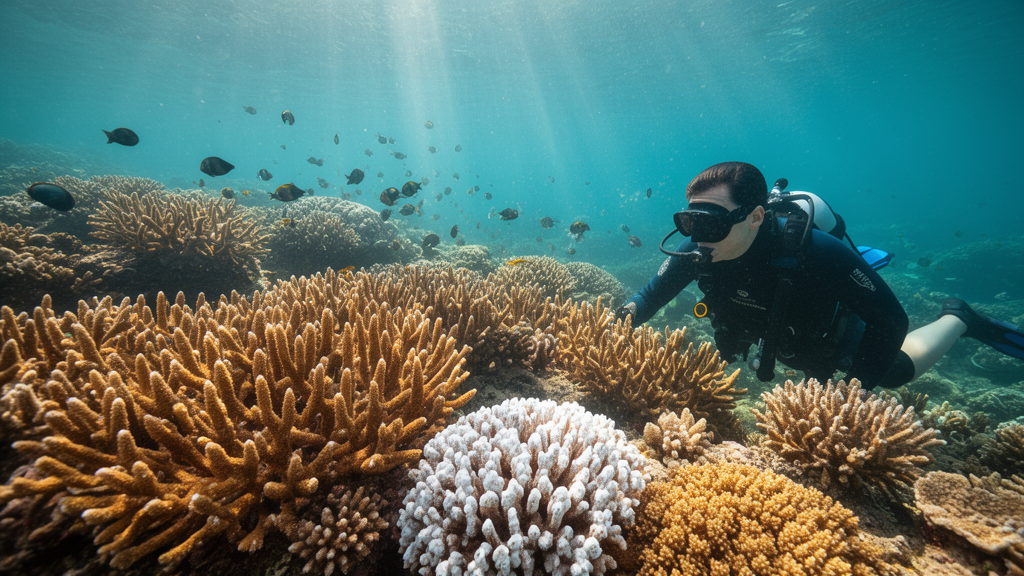
Coral reefs are being rewritten by heat. Across the tropics, marine heatwaves now arrive with a frequency and intensity that no historical baseline can prepare them for, and they interact with local pressures such as sedimentation, overfishing and pollution in ways that make each reef’s trajectory unique. A new collection of studies published in Frontiers in Conservation Science argues that this uniqueness is not a footnote to reef science but its central lesson. The Research Topic, assembled by Sammy Wambua of Pwani University and the University of Glasgow and David Glassom of the University of KwaZulu-Natal, gathers seven contributions spanning cellular physiology, ecological reorganisation, satellite-era monitoring technology and active intervention. Its editorial distils three recurring messages: resilience is strongly context dependent; structural change on a reef does not translate straightforwardly into functional loss; and intervention is most defensible when it is paired with rigorous monitoring and explicit attention to ecological risk.
The first theme concerns how individual corals respond to thermal stress, and how misleading it can be to generalise from any single response. Boodraj and colleagues examined two coral species from intertidal and subtidal habitats on the east coast of South Africa and subjected them to prolonged experimental warming. The results revealed a double layer of context. Intertidal corals, which already endure daily exposure to air, high irradiance and temperature swings, were generally more tolerant than their subtidal counterparts of the same species. And across habitats, the massive Anomastraea irregularis tolerated heat better than the branching Pocillopora verrucosa. Growth form, habitat of origin and species identity all shaped the outcome. Most strikingly, several physiological variables remained impaired two months after the thermal stress had ended, underscoring a distinction that conservation planning often overlooks: surviving a heat event is not the same as recovering physiological homeostasis. A colony that looks intact weeks after bleaching may still be operating well below its functional baseline.
A companion study tempers enthusiasm for quick-fix interventions. Appeldorn and colleagues tested manganese supplementation during simulated warming, a mechanistically plausible idea because the trace element can support antioxidant defences that corals deploy under heat stress. At the concentrations tested, manganese did not mitigate heat stress, and responses differed between hard and soft corals. Taken together, the two studies caution against treating resilience as a fixed species attribute or assuming that an intervention which works in one taxon or environmental history will transfer predictably to another. The message for practitioners is uncomfortable but clarifying: there is no universal resilience treatment waiting to be discovered, only conditional tools whose value must be demonstrated case by case.
That framing sets up the collection’s most operationally interesting contribution. Hendrickson and colleagues found that moderate, variable shading generated by seawater fogging reduced bleaching and mortality in two coral species during experimental heat stress, with benefits extending into the recovery period. The approach targets irradiance as an interacting component of bleaching stress rather than temperature itself, which gives it a degree of operational flexibility during heatwaves: fogging systems could, in principle, be deployed or adjusted as conditions change. The authors and the editorial are careful, however, to note that the technique’s value ultimately depends on field-scale feasibility and on its ecological side effects. Fogging a lagoon changes light, humidity and possibly local chemistry for every organism in the plume, not just the target corals.
At a different biological scale, Chemutai and colleagues review the prospects for harnessing algal and bacterial symbionts in coral restoration. The coral holobiont, the integrated unit of host, photosynthetic dinoflagellate symbionts and microbial community, is increasingly seen as a lever for thermal tolerance, since some symbiont types confer greater heat resistance than others. The review proposes a staged pathway: context-specific profiling of symbiont communities, candidate selection, functional validation, testing in nurseries or mesocosms, monitored deployment and, finally, governance. That last step is not decorative. Deliberately introducing or reshuffling symbionts is an ecological intervention with potential non-target effects, and the editorial stresses that such tools should complement, rather than substitute for, action on the climatic and local drivers of reef decline. A reef cooled by shading but still smothered by sediment is being treated, not cured.
The second major theme asks what resilience looks like beyond the individual colony, and the answer is reshaping how scientists read reef landscapes. Landers and colleagues show that post-disturbance reef condition at Aldabra Atoll, one of the most pristine coral systems in the western Indian Ocean, cannot be adequately represented by coral cover alone. Benthic composition and spatial organisation varied across depth and substrate conditions, indicating that environmental filtering, the sorting of species by their tolerance of local conditions, strongly influences the structure and functional composition of reef assemblages. Two reefs with the same percentage of live coral may therefore differ substantially in spatial configuration, habitat complexity and likely recovery trajectory. Cover, the workhorse metric of four decades of reef monitoring, turns out to be a summary statistic that hides the very information recovery depends on.
Fish tell a parallel story. Lomax and Osuka-Edeye examined reef fishes across a coral-to-rubble gradient in the Pemba Channel, Tanzania, focusing on two detritivorous Naso surgeonfish species. The two species differed in how their abundances responded to habitat condition, even though broader behavioural patterns remained comparatively stable. The finding cuts two ways. It cautions against assuming uniform responses within functional groups, the ecological categories into which managers often lump species for convenience. At the same time, it suggests that some ecological functions, such as detritivory, which recycles energy trapped in algal and detrital mats, may persist even as the species performing them are redistributed across degraded habitats. Function, in other words, can be more durable than the particular assemblage delivering it.
The monitoring implication is direct: indicators of resilience should capture composition, spatial organisation and ecological function rather than simply the amount of live coral. Bouchelaghem and colleagues demonstrate how rapidly advancing observation technology can close that gap. By combining airborne Fluid Lensing imagery, which corrects for the optical distortion of the water surface, with field validation, citizen-science annotations and deep learning, they produced centimetre-scale habitat maps across Tumon Bay, Guam, before and after Typhoon Mawar. The resulting change maps resolved substantial shifts in benthic habitat, including declines in massive coral and fore-reef habitat and increases in algal cover. Such approaches do not replace taxonomically detailed field surveys, but they provide the spatial context, repeatability and change-detection capacity needed to target field observations and evaluate disturbance or restoration at scales that diver surveys alone cannot achieve. For the first time, managers can watch a reef reorganise itself after a typhoon with near-metre resolution, and direct limited field resources to the places where change is fastest.
Across the collection, a broader view of coral reef resilience emerges. Resilience is not a fixed attribute of a coral species, nor can it be inferred from coral cover or survival alone. It is produced through interactions among environmental history, host traits, symbiotic partners, habitat structure, associated organisms and the spatial configuration of the reef. Conservation strategies consequently need to work across these levels simultaneously: reducing avoidable local stressors, identifying naturally tolerant populations and habitats, protecting ecological functions and connectivity, improving the resolution of monitoring, and cautiously testing interventions where benefits can be demonstrated against ecological risk. This systems perspective echoes the long-standing call by Bellwood, Hughes and colleagues to manage reefs for ecological processes and functional resilience rather than static states, while recognising, as Duarte and colleagues argued in their 2020 blueprint for rebuilding marine life, that active restoration can contribute meaningfully when the major drivers of degradation are also addressed.
The collection is also candid about what remains missing. Although the Research Topic set out to connect the ecological and social dimensions of reef conservation, the published contributions are weighted toward biological, ecological and technological questions. This imbalance reflects a persistent disciplinary separation between the ecological and social sciences, and the editorial calls for greater convergence within shared research agendas. Stronger integration would connect changes in reef structure and function to the things people actually depend on: fisheries, coastal protection, livelihoods, governance, and the distribution of restoration benefits and risks among communities. Equally important is stronger validation of interventions across regions, taxa and realistic environmental settings, particularly in data-limited reef systems where conservation need is high but baseline information and monitoring capacity are constrained. The central message, then, is not that a single pathway to resilience has emerged, but that effective reef conservation under global change requires integration across scales. Understanding physiological tolerance without ecosystem context is insufficient; documenting ecological change without mechanisms limits prediction; and deploying interventions without monitoring and governance risks solving one problem while creating another. The challenge ahead is to connect these layers into adaptive conservation systems capable of learning from disturbance, targeting action more precisely, and safeguarding not only corals but the ecological functions and human benefits that reefs sustain.
Subject of Research: Integrative approaches to coral reef resilience and conservation under global change
Article Title: Editorial: Integrative approaches to coral reef resilience and conservation under global change
Article References: Wambua, S., & Glassom, D. (2026). Editorial: Integrative approaches to coral reef resilience and conservation under global change. Frontiers in Conservation Science, 7, Article 2013026. https://doi.org/10.3389/fcosc.2026.2013026
Image Credits: AI Generated
DOI: 10.3389/fcosc.2026.2013026
Keywords: coral reefs, resilience, climate change, marine heatwaves, thermal stress, coral bleaching, reef monitoring, restoration, symbiosis, reef fish, remote sensing, conservation
Cite Scienmag News
Margaret Porter. (October 17, 2026). Coral Reef Resilience Is Context, Not Cover: New Research Reshapes Conservation. Scienmag. https://scienmag.com/coral-reef-resilience-is-context-not-cover-new-research-reshapes-conservation/
Margaret Porter. "Coral Reef Resilience Is Context, Not Cover: New Research Reshapes Conservation." Scienmag, 17 October 2026, https://scienmag.com/coral-reef-resilience-is-context-not-cover-new-research-reshapes-conservation/. Accessed 17 October 2026.
Margaret Porter. "Coral Reef Resilience Is Context, Not Cover: New Research Reshapes Conservation." Scienmag. October 17, 2026. https://scienmag.com/coral-reef-resilience-is-context-not-cover-new-research-reshapes-conservation/


