


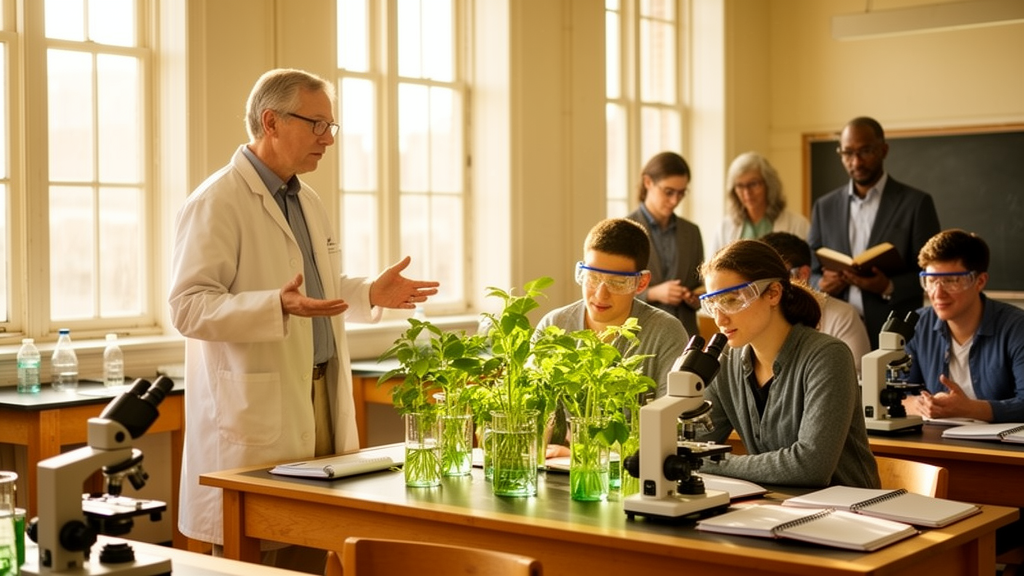
A five-year, $2 million initiative funded by the U.S. National Science Foundation is set to reshape how science, technology, engineering, and mathematics are taught across the State University of New York, and a biology professor at SUNY Geneseo is playing a central role in the effort. Suann Yang, PhD, has received a $228,000 NSF grant to support professional development workshops for SUNY faculty across western New York, part of a statewide collaboration designed to spread teaching practices that are demonstrably better at helping students learn, persist, and succeed in STEM fields.
The broader project, titled “Collaborative Research: Translating research on how people learn, and organizations change to accelerate adoption of high-impact practices throughout a state university system,” is led by Michelle Withers, associate professor of biological sciences at Binghamton University. The collaboration brings together SUNY Geneseo, Stony Brook University, Yale University, and the National Center for Science and Civic Engagement, pairing expertise in the learning sciences with organizational research on how large institutions actually change. Rather than targeting individual courses in isolation, the project treats the entire SUNY system as the unit of transformation, aiming to move evidence-based instruction from scattered pockets of innovation to system-wide practice.
“We aim to transform STEM education across all SUNY campuses by helping faculty, administrators, and institutions adopt evidence-based teaching practices that give students more authentic and engaging learning experiences,” Yang said. “Evidence-based teaching practices tell us traditional lecture sessions are not the best way for everybody to learn. Evidence has shown that more students do better with learner-centered methods, regardless of their backgrounds.”
That evidence base is substantial. Decades of discipline-based education research, including landmark studies published in major scientific journals, have shown that students in traditional lecture-based courses are significantly more likely to fail than students taught through active-learning approaches, and that the gap is often widest for first-generation students, students from underrepresented groups, and others whom conventional instruction has historically underserved. Learner-centered methods, which ask students to grapple with problems, discuss ideas, and construct knowledge rather than passively receive it, produce measurable gains in conceptual understanding and retention. The challenge the SUNY project addresses is not whether these methods work, but how to get them adopted at scale across a university system with dozens of campuses and thousands of faculty.
Geneseo will host one of the first workshops in 2027. The session will be an integrated Mobile Summer Institutes on Scientific Teaching, or MoSI, combined with Science Education for New Civic Engagements and Responsibilities, known as SENCER, one of 17 such integrated MoSI-SENCER workshops planned across New York State. The institutes target faculty who teach STEM within the SUNY system but are open to participants from all disciplines, reflecting a recognition that pedagogical innovation in the sciences often benefits from cross-disciplinary exchange. MoSI workshops follow the scientific-teaching model, in which faculty apply the same rigor to their teaching that they apply to their research: defining learning objectives, designing assessments, gathering evidence of student learning, and iterating on instruction based on results.
The SENCER component connects scientific content to real-world civic questions, an approach built on the idea that students engage more deeply with science when they see its relevance to issues that matter to their communities, from public health to environmental policy. By integrating this framework into the summer institutes, the project aims to produce faculty who not only teach actively but also design courses that make the societal stakes of STEM disciplines visible to students, a strategy associated with stronger recruitment and retention in the sciences.
The workshops are only one strand of a comprehensive training program. The project team will also provide instruction in vertically integrated projects, a structure in which teams of undergraduate students, graduate students, and faculty collaborate on long-term projects spanning research, design, innovation, and entrepreneurship. This model gives undergraduates authentic research experience early in their academic careers, embeds them in working scientific teams, and creates mentoring chains that extend from faculty through graduate students to the newest members of the lab. Sustained research experience of this kind is among the strongest predictors of undergraduate persistence in STEM majors and progression to graduate study.
Course-based undergraduate research experiences, or CUREs, form another pillar of the initiative. Unlike traditional laboratory courses that guide students through exercises with known outcomes, CUREs involve entire classes in genuine research questions where the answers are not yet known, giving students the intellectual experience of discovery while generating data that can contribute to real scientific projects. Faculty will also receive workshops on using artificial intelligence and online learning tools, reflecting the rapid changes reshaping higher education, and the project will establish faculty mentoring networks to support participants after the workshops end, addressing a well-documented weakness of one-off professional development, in which gains fade without ongoing peer reinforcement.
The emphasis on mentoring networks and institutional support reflects the organizational-science half of the project’s title. Research on how organizations change has shown that individual faculty who adopt new teaching methods often revert to familiar practices when they return to departments that reward traditional lecturing, and that durable change requires alignment among faculty, administrators, and institutional incentives. By engaging administrators alongside instructors and building communities of practice that persist beyond the workshops, the project is designed to make learner-centered teaching the norm rather than the exception across SUNY.
Yang said the team hopes the project will enable a shift toward more learner-centered teaching across the wider SUNY system, and that this shift would ultimately help build a strong, globally competitive workforce in STEM fields. The stakes extend well beyond New York. National projections continue to show demand for STEM professionals outpacing supply, and the students lost to attrition from STEM majors represent both individual unrealized potential and a measurable drag on the innovation economy. If the SUNY collaboration succeeds in accelerating the adoption of proven teaching methods across a statewide university system, it could serve as a template for how large public higher-education systems elsewhere translate the science of learning into the practice of teaching, turning a $2 million investment into a system-wide change in how the next generation of scientists, engineers, and technologists is educated.
Subject of Research: NSF-funded SUNY collaboration brings evidence-based STEM teaching practices to faculty statewide
Article Title: Biology professor earns $228K grant for STEM teaching
Article References: Biology professor earns $228K grant for STEM teaching. Original publication (Bibliographic details unavailable.)
Image Credits: AI Generated
DOI: Not provided
Keywords: NSF, STEM education, SUNY, Suann Yang, active learning, higher education, teaching workshops, Binghamton University, Geneseo, faculty development, Biology, professor
Cite Scienmag News
Reid Dalton. (October 17, 2026). Biology professor earns $228K NSF grant to bring evidence-based STEM teaching to SUNY faculty. Scienmag. https://scienmag.com/biology-professor-earns-228k-nsf-grant-to-bring-evidence-based-stem-teaching-to-suny-faculty/
Reid Dalton. "Biology professor earns $228K NSF grant to bring evidence-based STEM teaching to SUNY faculty." Scienmag, 17 October 2026, https://scienmag.com/biology-professor-earns-228k-nsf-grant-to-bring-evidence-based-stem-teaching-to-suny-faculty/. Accessed 17 October 2026.
Reid Dalton. "Biology professor earns $228K NSF grant to bring evidence-based STEM teaching to SUNY faculty." Scienmag. October 17, 2026. https://scienmag.com/biology-professor-earns-228k-nsf-grant-to-bring-evidence-based-stem-teaching-to-suny-faculty/


