


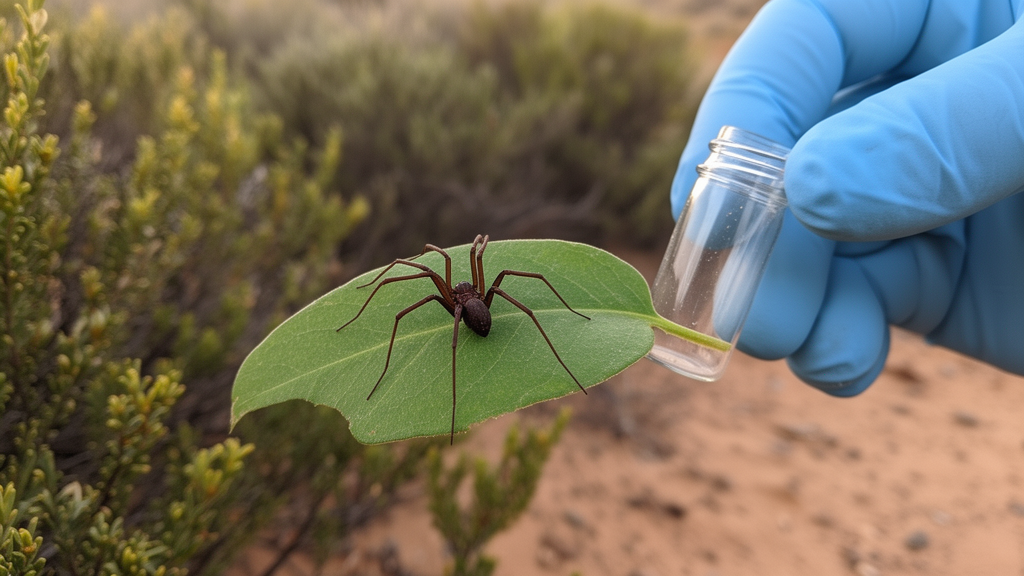
Deep in the grasslands, fynbos and arid dunes of southern Africa, a family of small, unassuming spiders is quietly rewriting the map of global biodiversity. A new study published in African Invertebrates describes four entirely new genera of dark sac spiders, Trachelidae, from South Africa and Zimbabwe, bringing the total number of Afrotropical trachelid genera to 20 and the regional species count to 107. That makes the Afrotropical biogeographical realm the richest in the world for this family, a remarkable turnaround for a group that had only five known genera and 24 species at the end of the last century.
The new genera, Foordana, Mushimane, Namaquella and Rukuluk, were described as part of ongoing revisions of the Afrotropical Trachelidae. Foordana, named in honour of the late Stefan Foord in recognition of his contribution to African arachnology, is the most species-rich of the four, with three new species from South Africa, Foordana distincta, Foordana flavipoda and Foordana kasouga, plus a fourth undescribed species from Zimbabwe. Mushimane is monotypic, represented by a single species, Mushimane tswibilinki, from KwaZulu-Natal. Namaquella, named after the arid Namaqualand region of western South Africa, includes Namaquella arida from the Northern Cape and Namaquella samanthae from the Western Cape. Rukuluk, an arbitrary combination of letters, is known from Rukuluk gramineus in the Northern Cape and a second species from KwaZulu-Natal represented only by juveniles.
What makes these discoveries particularly striking is the sheer pace of taxonomic progress on dark sac spiders worldwide. More than 68 percent of trachelid genera, 17 of them, and 43 percent of global species richness, 124 species, have been described in just the last two decades. In the Afrotropical Region alone, eight new genera of trachelids have been described from southern Africa during this period, with four other genera more widespread in the region also described. The current contribution adds four more, each represented by no more than four species, suggesting that the true diversity of the family in the region remains far from exhausted.
Much of this resurgence can be attributed to sustained sampling in South Africa over the last three decades as part of the South African National Survey of Arachnida. Many new spider taxa have been discovered, particularly in historically poorly sampled areas. Contributing to these discoveries has been the application of sampling methods rarely used in the past, such as canopy fogging, litter sifting and hand collecting in a range of microhabitats including grass tussocks, termitaria and tree bark. Mushimane tswibilinki, for example, was collected by canopy fogging of Commiphora neglecta trees at Ndumo Game Reserve in northeastern KwaZulu-Natal, while Rukuluk gramineus was found in grass tussocks on sand dunes at Witsand Nature Reserve in the Northern Cape.
The morphology of the new genera was examined in meticulous detail. Specimens were observed in 70 percent ethanol using a stereomicroscope, and the epigynes of female paratypes were dissected with insect pins and cleared overnight by maceration in a pancreatin solution before illustration. For the type species of all four new genera, material for scanning electron microscopy was dehydrated overnight in 100 percent ethanol, critical point dried in liquid carbon dioxide and mounted onto aluminium stubs. The samples were sputter coated three times with iridium for two minutes each in an argon chamber and then studied using a JEOL JSM-IT200 scanning electron microscope at 5 kV. Digital images of somatic characters were stacked using CombineZM imaging software to increase depth of field, with between five and 30 images taken per structure.
These techniques revealed a wealth of diagnostic characters. Foordana, for instance, is superficially similar to the genus Afroceto in size and to Thysanina in the lack of leg spines, but can be recognised by the heavily scopulate tibiae, metatarsi and tarsi of the anterior legs, the paired subtriangular retrolateral tibial apophyses on the male palps, and the heavily sclerotized female epigyne with central paired curved atria. Mushimane, possibly the smallest known trachelids at only about 1.8 millimetres in total length, is distinguished by a unique spiralling loop in the distal section of the sperm duct of the male palp, close to the base of the short, spike-like embolus, and by a broad diamond-shaped epigynal atrium in females. Namaquella males have an oval tegulum with a simple, slightly curved distal embolus, while females have a weakly sclerotized epigyne with a central heart-shaped atrium formed by two convex ridges. Rukuluk males possess retrolateral grooves in the cymbium that correspond to the retrolateral tibial apophysis and the distal section of the embolus, and a long membranous basal section of the embolus that gradually narrows to a long, whip-like tip.
To evaluate the relationships of the four new genera, the study used mitochondrial cytochrome oxidase c subunit I, or COI, sequence data. Representative species of each genus of Afrotropical Trachelidae currently available on the Barcode of Life Data system in the SPIZA project were selected for the analysis. DNA extraction, PCR and Sanger sequencing were performed at the Canadian Centre of DNA Barcoding using standard protocols. The phylogenetic analysis was performed on the BOLD platform using the Kimura 2 Parameter distance model, the neighbour-joining algorithm and a minimum overall overlap of 200 base pairs between sequences, with sequences aligned using Muscle. The tree was rooted with Moggridgea loistata, a member of the family Migidae from South Africa, as the outgroup.
The COI analysis placed Mushimane basally within a large clade containing most trachelid terminals, Rukuluk as sister to the genus Fuchiba, and Foordana and Namaquella within a clade containing two species of Thysanina sensu stricto. Planochelas haddadi was placed as sister to all other Trachelidae, and the relationships of this genus remain puzzling. Orthobula and Capobula together form a basal clade in Trachelidae sensu stricto. Notably, the analysis supports previous indications that Thysanina is polyphyletic, which may in fact comprise three different genera based on differences in genitalic morphology, leg spination and the occurrence of ventral cusps and scopulae on the legs. Clarifying the relationships of Thysanina to Foordana and Namaquella would require a more comprehensive set of terminals representing all three genera.
The study also acknowledged some limitations. A Foordana distincta individual consistently grouped together with Capobula infima in the analysis, so was assumed to be a contaminated sequence and removed from the final analysis. The holotype male of Namaquella samanthae was submitted for sequencing but was unsuccessful, so this species could not be included. The placement of Foordana flavipoda within the genus is tentative, as the lack of leg cusps in males, the position of the sperm duct in the male palpal tegulum and the presence of a small hood in the female epigyne differ from the type species, and the type material is somewhat damaged. Finding fresh material and incorporating sequence data into future analyses will be an essential step in resolving its placement.
Despite these advances, the phylogenetic relationships of the family remain poorly understood, although recent analyses based on the COI gene have provided some preliminary indications. The current contribution takes the diversity of Afrotropical trachelid genera and species to 20 and 107 respectively, making the Afrotropical realm the biogeographical realm with the richest diversity for the family. With continuous sampling ongoing in South Africa and other parts of the region, and with many historically poorly sampled areas still to be explored, it seems certain that more new genera and species of dark sac spiders will continue to emerge from southern Africa in the years ahead.
Subject of Research: Taxonomy and biodiversity of Afrotropical dark sac spiders
Article Title: And they just keep coming: four new genera of dark sac spiders from southern Africa ( Araneae , Trachelidae )
Article References: Haddad, C. R. (2025). And they just keep coming: four new genera of dark sac spiders from southern Africa (Araneae, Trachelidae). African Invertebrates, 66(1), 19-64. https://doi.org/10.3897/afrinvertebr.66.139299
Image Credits: AI Generated
DOI: 10.3897/AfrInvertebr.66.139299
Keywords: Trachelidae, dark sac spiders, new genera, southern Africa, taxonomy, spiders, African Invertebrates, biodiversity, they, just, keep, coming
Cite Scienmag News
Gavin Prescott. (October 17, 2026). Four new genera of dark sac spiders revealed in southern Africa. Scienmag. https://scienmag.com/four-new-genera-of-dark-sac-spiders-revealed-in-southern-africa/
Gavin Prescott. "Four new genera of dark sac spiders revealed in southern Africa." Scienmag, 17 October 2026, https://scienmag.com/four-new-genera-of-dark-sac-spiders-revealed-in-southern-africa/. Accessed 17 October 2026.
Gavin Prescott. "Four new genera of dark sac spiders revealed in southern Africa." Scienmag. October 17, 2026. https://scienmag.com/four-new-genera-of-dark-sac-spiders-revealed-in-southern-africa/


