


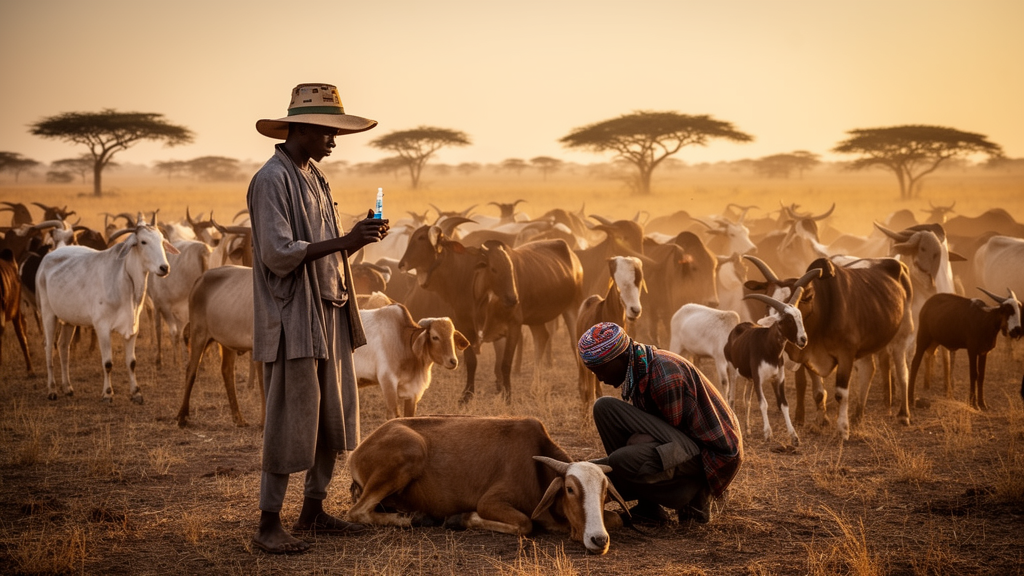
In the sun-scorched rangelands of Kaffrine, central Senegal, virtually every herder surveyed is giving antibiotics to their animals — often without trained supervision, often at the wrong dose, and often without waiting long enough before the meat or milk reaches the market. A new cross-sectional study of 220 pastoralists, published in the journal Pastoralism, offers one of the most detailed pictures yet of how antibiotics flow through a food system that supplies much of the animal-source food consumed in Senegal’s cities, and the findings suggest that the pipeline from pasture to plate is riddled with practices that can breed antibiotic resistance.
The research team, led by Mouhamadou Moustapha Sow of Gaston Berger University in Saint-Louis, Senegal, conducted face-to-face interviews between March and April 2023 using an adapted CGIAR AMUSE Livestock questionnaire translated into Wolof and Pular. Participants were selected using Schwartz’ formula to determine the minimum sample size, and data were analysed descriptively with R Studio. The survey area was deliberately chosen: Kaffrine is one of the largest pastoral zones supplying meat and milk to major Senegalese cities, and during the dry season between February and June, when fodder becomes scarce, it serves as a place of refuge and transit for large-scale herders and their animals.
The respondents were predominantly men, at 86.8 percent, reflecting gender roles in rural Senegal, and 81 percent had never attended the formal government school system, having instead received education through Koranic schools. More than 60 percent of the herders had over 20 years of experience in pastoral livestock farming. Together, the surveyed households owned a herd of 13,856 animals, dominated by sheep at 37 percent and goats at 35 percent, followed by cattle at 20 percent, equines at 5 percent, and local poultry at just 3 percent. Small ruminants predominate because they adapt well to the mobility requirements of pastoral systems and serve as readily accessible economic capital that households can mobilize when needed.
Animal health pressures in the region are substantial. The most frequently reported disease was Plague of small ruminants, cited by 52.7 percent of respondents, followed by Lumpy skin disease at 39 percent, Pasteurellosis at 28.1 percent, Botulism at 24 percent, and Foot-and-mouth disease at 3.1 percent. This profile reflects the epidemiological conditions typical of Sahelian pastoral systems, where high animal densities and frequent herd movements facilitate the spread of highly transmissible viral diseases. The researchers note a troubling technical wrinkle: antibiotics are ineffective against viral infections, yet the occurrence of these viral diseases may indirectly drive increased antibiotic use for the prevention or treatment of secondary bacterial infections and disease-related complications.
Antibiotic use was generalized, with all surveyed livestock farmers reporting antibiotic use in their herds. The class profile was heavily skewed: 88.6 percent of farmers used tetracyclines, 10.4 percent used penicillins, and less than 1 percent used macrolides. The purposes were equally revealing. The vast majority, 94 percent, used antibiotics to treat sick animals, 42.7 percent used them prophylactically to prevent disease, and 33 percent used them as growth promoters. When disease broke out in a herd, 15.4 percent of owners administered antibiotics to prevent other symptoms from appearing and other animals from falling ill.
Who actually administers the drugs is a central concern for the study’s authors. In most cases, 50.9 percent, antibiotics were given by veterinary assistants with an intermediate level of training in animal health. In contrast, 45.9 percent of treatments were administered by animal health auxiliaries with no formal academic training, and only 26.8 percent of farmers consulted a veterinary surgeon. Self-medication remains widespread: antibiotics were administered directly by livestock owners in 40.5 percent of cases and by a family member in 4.5 percent of cases. The researchers attribute this to limited availability of animal health professionals and the unregulated circulation of antibiotics, which are commonly sold in the two largest weekly markets of Birkilane and Missira.
The survey also probed the practices that expose the food system most directly. Antibiotics were administered to lactating females whose milk is intended for human consumption by 65.5 percent of the farmers surveyed. Only 55 percent observed withdrawal periods before slaughter, with an estimated average duration of just 4 days, and the average treatment period for animals was estimated at 3 days. Non-compliance, inadequate dosages, and treatment interruptions were frequent. When no improvement was observed, 61 percent of farmers systematically stopped administering antibiotics, while 31 percent increased the dose and 30 percent continued treatment with the same antibiotic. Farmers’ reasons for stopping treatment were the ineffectiveness of antibiotics at 38 percent, the recovery of sick animals at 35 percent, and the high cost of antibiotics at 27 percent.
Knowledge about antibiotic resistance, strikingly, is not the problem. Overall, 63.6 percent of respondents could identify antibiotics available in the study area by their generic names, likely stemming from training courses and animal health initiatives carried out as part of livestock farming projects in the region. Moreover, 65.5 percent of livestock farmers recognised antibiotic resistance as an issue that could affect public health and the economy through loss of productivity, mortality due to bacterial diseases, and food safety. Yet only 28.2 percent remained sceptical about the harmful effects of resistant bacteria, and this awareness did not translate into more judicious use: only 5.5 percent of farmers reported implementing strategies to reduce antibiotic use, mainly improving vaccination coverage through annual campaigns organised by government veterinary services. Nineteen percent reported using traditional remedies, though they often lacked knowledge of appropriate dosages. Notably, none of the surveyed farmers implemented biosecurity improvement measures, and improved hygiene practices were generally not used as a means of preventing disease.
The study situates these findings within a broader One Health context. Antibiotic resistance was responsible for an estimated 1 million deaths worldwide in 2021 and sits on the World Health Organisation’s list of ten global health threats. Resistant bacteria exist in humans, animals, food and the environment, with limited barriers to the transmission of resistance genes across bacterial species and compartments. In Senegal, more than 80 percent of meat and milk production and sale is informal, and nearly 80 percent of the urban population eats at informal food markets that are affordable and easily accessible. Previous studies in Senegal have found products containing antibiotic residues being sold in Dakar, including milk, meat, and poultry products, and research elsewhere in Africa shows that communication and awareness-raising initiatives alone are not sufficient to reduce inappropriate antibiotic use.
The authors argue that expanding access to veterinary services, strengthening vaccination programmes, and enhancing antibiotic stewardship through an increased number of veterinary drug inspectors and adequate financial resources for effective monitoring and regulatory oversight are critical to mitigating antibiotic resistance and safeguarding sustainable food systems. Senegal’s 2018–2022 national action plan on antimicrobial resistance, implemented with support from partners such as the Food and Agriculture Organization of the United Nations, has improved knowledge of the issue among the general population and livestock farmers, and the survey results align with that observation. But the gap between knowing and doing remains the study’s most sobering message. Until herders in Kaffrine and beyond have real alternatives — accessible professionals, reliable vaccines, and enforced withdrawal periods — the tetracyclines will keep flowing, and the resistance genes they select will keep travelling along the farm-to-fork chain toward the dinner tables of Dakar.
Subject of Research: Antibiotic use practices in food systems in Senegal: a cross-sectional survey of pastoral livestock farming in Kaffrine
Article Title: Antibiotic use practices in food systems in Senegal: a cross-sectional survey of pastoral livestock farming in Kaffrine
Article References: Sow, M. M., Barry, K., Diamanka, A., Seck, R. M. N., Sow, A. I., Ly, C., Fall, A. G., Diouf, N. D., Dia, N. M., & Ciss, M. (2026). Antibiotic use practices in food systems in Senegal: a cross-sectional survey of pastoral livestock farming in Kaffrine. Pastoralism: Research, Policy and Practice, 16, Article 16798. https://doi.org/10.3389/past.2026.16798
Image Credits: AI Generated
Keywords: antibiotic resistance, One Health, pastoralism, Senegal, food safety, veterinary medicine, public health, Antibiotic, practices, food, systems, cross-sectional
Cite Scienmag News
William Thompson. (October 17, 2026). Antibiotic misuse runs deep in Senegal’s pastoral herds, survey of 220 herders reveals. Scienmag. https://scienmag.com/antibiotic-misuse-runs-deep-in-senegals-pastoral-herds-survey-of-220-herders-reveals/
William Thompson. "Antibiotic misuse runs deep in Senegal’s pastoral herds, survey of 220 herders reveals." Scienmag, 17 October 2026, https://scienmag.com/antibiotic-misuse-runs-deep-in-senegals-pastoral-herds-survey-of-220-herders-reveals/. Accessed 17 October 2026.
William Thompson. "Antibiotic misuse runs deep in Senegal’s pastoral herds, survey of 220 herders reveals." Scienmag. October 17, 2026. https://scienmag.com/antibiotic-misuse-runs-deep-in-senegals-pastoral-herds-survey-of-220-herders-reveals/


