


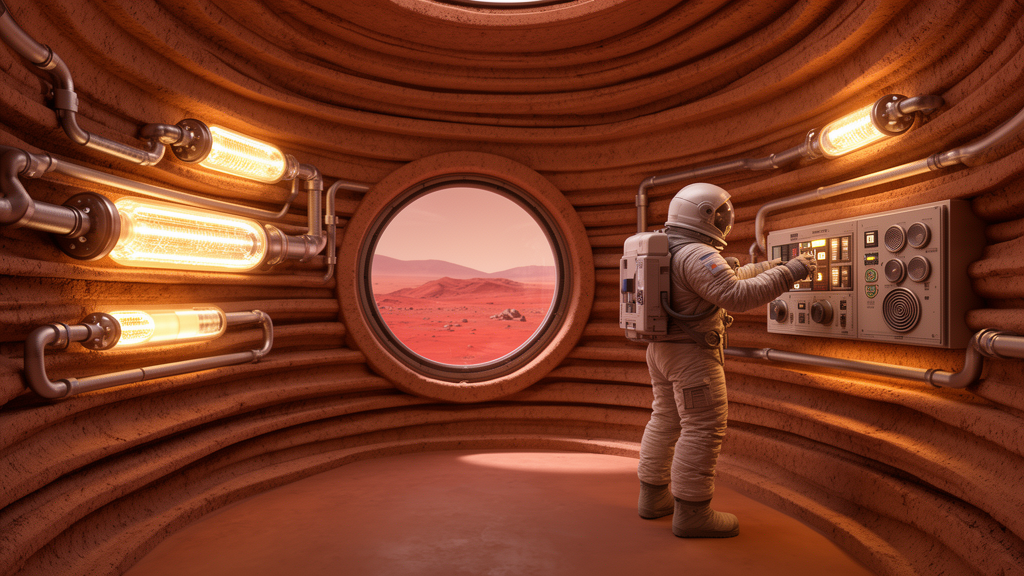
Building a home on Mars is one of the most daunting engineering challenges humanity has ever faced. The red planet offers no breathable atmosphere, no meaningful atmospheric pressure, extreme temperature swings between day and night, and relentless radiation from the Sun and cosmic rays. Now, researchers at TU Delft have unveiled a bold new approach that could make Martian habitation not only possible but genuinely livable — by weaving the very systems that keep humans alive directly into the walls of the habitat itself. The project, called Rhizome 2.0, is co-funded by the European Space Agency and demonstrates how 3D-printed building envelopes can be structurally optimized to house life support infrastructure without compromising safety or stability.
The Rhizome 2.0 concept places a Martian habitat inside a lava tube, a natural underground tunnel formed by ancient volcanic activity. This location provides critical passive shielding from radiation, micrometeoroid impacts, and the brutal temperature fluctuations that characterize the Martian surface. But even within such a sheltered environment, humans still need a fully functional Life Support System, or LSS, to regulate the atmosphere, manage water, and handle waste. These are the systems that scrub carbon dioxide, replenish oxygen, recover moisture from the air, filter wastewater to potable standards, and process everything from human waste to industrial byproducts. Without them, survival on Mars is simply impossible.
What makes Rhizome 2.0 remarkable is its approach to integrating these vital systems. Rather than bolting life support equipment onto interior surfaces — which creates a cluttered, psychologically oppressive environment — the researchers embed the LSS conduits directly within the building envelope itself. This envelope is approximately 1.5 meters thick and constructed from prefabricated 3D-printed components based on a Voronoi geometric pattern. These components interlock with one another and are assembled on-site by a swarm of autonomous rovers, with human assistance where cognitive tasks exceed current robotic capabilities. The result is a habitat that is not just a shell but a living, breathing structure with its own circulatory system.
The components themselves are printed within a temporary pressurized environment, allowing atmospheric conditions during fabrication to be carefully controlled. Each piece ranges from 500 to 1,500 millimeters in length, with thicknesses between 250 and 500 millimeters. Smaller components can be handled by a single rover, while larger pieces require coordinated lifting and placement by two rovers working in tandem. The Voronoi-based optimization increases cell density in high-stress regions and decreases it in lower-stress areas, maintaining a consistent minimum envelope thickness of 1.5 meters — a critical constraint for the robotic assembly process. The building skin’s overhang angles are constrained to 45 degrees relative to the foundation, eliminating the need for support structures during construction.
The real breakthrough lies in how the researchers determine where to place the life support conduits within the envelope. The team, led by A. J. Hidding, H. H. Bier, and F. Alsaggaf from TU Delft’s Robotic Building Lab, developed an automated workflow that begins with a structural analysis of the habitat envelope using Finite Element Analysis. This generates a three-dimensional point cloud of stress data, where each point in the geometry carries information about local stress concentrations. The analysis was implemented in Karamba, a Grasshopper plugin, which calculated stress densities based on the self-weight of the structure. The envelope fragment was modeled as a boundary representation and meshed into over 22,000 vertices and nearly 23,000 faces — a resolution the team found to be an acceptable balance between accuracy and computation time.
With the stress point cloud established, the researchers then employed a single-objective evolutionary optimizer called Galapagos to determine the optimal routing paths for the LSS conduits. The algorithm seeks to minimize a combined fitness function that penalizes both high stress exposure along the routing path and excessive path length. Control points on the routing curves are displaced within local two-dimensional planes oriented normal to the path, with candidate positions constrained to remain within the wall fragment geometry. The start and end points of each path remain fixed throughout optimization, preserving connectivity between adjacent building fragments. The evolutionary solver was configured with 50 iterations, a population size of 200 individuals, and specific parameters to balance exploration of the solution space with exploitation of high-performing solutions.
The results are striking. Across three analyzed fragments of the building envelope, the optimized routing paths consistently shifted toward regions of lower structural stress, reducing average stress exposure by approximately 30 to 43 percent compared to the initial configurations. This improvement came at the cost of increased path length — between 17 and nearly 62 percent longer than the original routes — reflecting a deliberate trade-off between structural performance and routing efficiency. In one fragment, the optimized path achieved a 43.4 percent reduction in average stress, demonstrating the method’s potential to significantly enhance the structural integrity of the habitat while accommodating essential life support infrastructure.
The optimized paths are then modeled as branching negative spaces within the building skin — essentially carved-out cavities of varying sizes that house the LSS conduits, equipment, cables, and piping. These spaces range from a minimum of 50 millimeters for electrical routing up to room-scale voids that accommodate centralized technical systems and provide maintenance access. Access is critical: in the event of system failures, crew members must be able to rapidly reach technical spaces and service conduits. The researchers specify that inspection channels should be dimensioned to a minimum of 800 millimeters for human entry and 300 millimeters for robotic access, with slope angles that facilitate both human movement and automated robotic inspection.
The approach draws on decades of life support research, including NASA’s Advanced Life Support program, ESA’s MELiSSA — a regenerative life support system for long-term missions — and Russia’s BIOS-3 experiments. However, these efforts largely investigated isolated bioregenerative or physicochemical subsystems rather than integrated, mission-ready architectures. By treating the LSS as part of a tightly coupled ecological-technological network and embedding it within the initial habitat layout, Rhizome 2.0 prioritizes efficiency, accessibility, maintainability, and crew safety. The researchers note that decentralizing life support systems increases redundancy, improves spatial efficiency, and enhances crew survival probability — a critical consideration for long-duration missions where system failure could be catastrophic.
The team acknowledges several limitations in this proof-of-concept study. The structural models are simplified, the single-objective formulation uses fixed weighting, and the analysis covers only a limited number of envelope fragments. Material properties were approximated using predefined concrete parameters, and the loading conditions were rough approximations of actual Martian conditions. Future work will incorporate additional stresses from temperature fluctuations, internal atmospheric pressure, seismic activity, and variable loads from internal use. The researchers also plan to develop a full-scale prototype of a building skin fragment with physically 3D-printed components to test the interlocking logic and LSS integration, and to investigate how the Martian environment affects material properties over time. Nevertheless, the demonstration represents a significant step toward automated, structurally informed integration of life support systems within extraterrestrial building envelopes — a methodology that could fundamentally change how humanity builds beyond Earth.
Subject of Research: Integrating life support systems into 3D-printed extra-terrestrial habitat envelopes
Article Title: Integrating life support systems into 3D-printed extra-terrestrial habitat envelopes
Article References: Hidding, A. J., Bier, H. H., & Alsaggaf, F. (2026). Integrating life support systems into 3D-printed extra-terrestrial habitat envelopes. Frontiers in Space Technologies, 7, Article 1798391. https://doi.org/10.3389/frspt.2026.1798391
Image Credits: AI Generated
DOI: 10.3389/frspt.2026.1798391
Keywords: Integrating, life, support, systems, D-printed, extra-terrestrial, habitat, envelopes, scientific research
Cite Scienmag News
Denise Maddox. (October 17, 2026). Martian Homes Get Smarter: Life Support Systems Built Into 3D-Printed Habitat Walls. Scienmag. https://scienmag.com/martian-homes-get-smarter-life-support-systems-built-into-3d-printed-habitat-walls/
Denise Maddox. "Martian Homes Get Smarter: Life Support Systems Built Into 3D-Printed Habitat Walls." Scienmag, 17 October 2026, https://scienmag.com/martian-homes-get-smarter-life-support-systems-built-into-3d-printed-habitat-walls/. Accessed 17 October 2026.
Denise Maddox. "Martian Homes Get Smarter: Life Support Systems Built Into 3D-Printed Habitat Walls." Scienmag. October 17, 2026. https://scienmag.com/martian-homes-get-smarter-life-support-systems-built-into-3d-printed-habitat-walls/


