


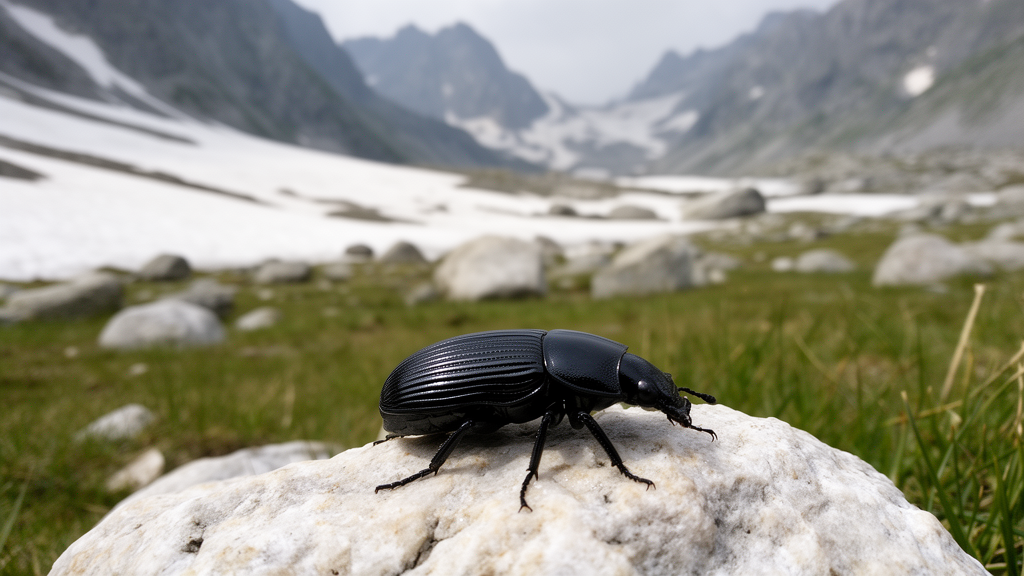
High in the mountains of the Western Balkans, a flightless ground beetle has been quietly recording millions of years of climate history in its genome. A new study of Calosoma pentheri, a predaceous beetle endemic to the region’s high peaks, reveals that what was long treated as a single species with two subspecies is actually two distinct species whose separation was triggered by climatic swings in the Late Miocene and Pliocene, long before the ice ages began. The research, published in Frontiers of Biogeography, combines museum specimens with freshly collected material and a newly sequenced reference genome to reconstruct the evolutionary history of this little-known alpine lineage.
Calosoma pentheri is a remarkable creature. It lives above 2,000 meters in mountain pastures with low vegetation, emerging briefly in spring just after snowcaps melt before the habitat becomes too arid. Its wings are significantly reduced, rendering it flightless, which means its populations cannot easily disperse between mountain ranges. This low dispersal capacity, combined with its disjunct geographic distribution across the Western Balkans, makes it an ideal system for studying how past climates shaped genomic structure and population dynamics in rugged mountain landscapes.
The Western Balkans are one of the main centers of endemism in the Palearctic region, shaped by rugged mountains, extensive karst systems, and complex water drainages. During the Miocene, major tectonic and climatic changes in the Eastern and Central Paratethys region drastically reshaped the peninsula, fragmenting populations and triggering geographic and genetic structuring. Unlike northern Palearctic regions covered by large ice sheets, the Western Balkans had smaller, topographically restricted ice caps, allowing regional populations to survive glacial periods rather than face local extinction. This created a dense network of microrefugia that helped maintain genetic diversity over time.
To investigate the evolutionary history of Calosoma pentheri, the research team sampled all major known populations across the Western Balkans, collecting 10 specimens of the northern lineage Calosoma pentheri pentheri and 54 specimens of the southern lineage Calosoma pentheri relictum. Fieldwork took place across Albania and North Macedonia between 2003 and 2022. Historical specimens were borrowed from natural history collections in Geneva, Munich, Basel, and Vienna, demonstrating that museum specimens can provide robust genomic data for phylogeographic analyses.
The team generated a high-quality reference genome from a freshly collected specimen of Calosoma pentheri relictum from Šar Planina in North Macedonia. PacBio HiFi sequencing produced an assembly of 214.8 Mb with 98.6% genome completeness based on the universal single-copy ortholog gene set for Insecta. They then used a hybridization capture approach called hyRAD, which employs RAD probes synthesized from high-quality DNA samples, to generate genomic data from both fresh and historical specimens. After mapping captured reads against an in silico reference catalog built from the reference genome, they recovered 10,794 single nucleotide polymorphisms and 2,278 loci for downstream analyses.
Population genomic analyses revealed clear genetic differentiation between the two lineages. Principal components analysis showed complete separation between Calosoma pentheri pentheri and Calosoma pentheri relictum, while STRUCTURE analyses supported two evolutionarily independent lineages with no signal of recent hybridization between them. Fixation indices indicated strong differentiation between the two lineages (Fst’ = 0.474) and moderate population structure within Calosoma pentheri relictum (Fst’ = 0.176). Within the southern lineage, populations from Bistra, Tetovo, and Ljuboten were distinct from the rest, while Korab and Dešat showed evidence of admixture between clusters.
Phylogenomic analyses recovered both lineages as reciprocally monophyletic with strong branch support across all datasets, whether historical samples were included or not. Divergence time estimation using 300 clock-like loci in BEAST recovered an origin of Calosoma pentheri sensu lato in the Late Miocene, with the two modern lineages splitting approximately 6 million years ago (95% credibility interval: 5.15–7.18 Ma). This indicates that the separation between the two lineages largely predated the onset of Quaternary glaciations around 2.6 million years ago.
The evolutionary scenario proposed by the researchers is shaped by climatic shifts in the Neogene. They hypothesize that the ancestor of both species likely occupied the entire range currently inhabited by both lineages during the Late Miocene, when progressive global cooling around 7 million years ago allowed a wider ancestral distribution across mid-elevation mountain ranges. As global climate warmed progressively between the Late Miocene and the Pliocene Thermal Maximum, these ephemeral refugia became too warm and both lineages dispersed to higher elevations on each side of the ancestral range. These alpine refugia functioned as isolated mountain ranges, or sky islands, with no opportunity for dispersal in flightless species.
During Pleistocene glacial periods, secondary contact between the two species may have occurred in mid-elevation glacial refugia, but this time without gene flow due to complete genetic sorting. The absence of evidence of recent admixture between the two species suggests that gene flow ceased long before the onset of Quaternary glaciations. Within each lineage, however, climatic oscillations during Quaternary ice ages triggered admixture between populations of each massif. In Calosoma pentheri pentheri, one admixture event was inferred between the ancestors of Rosni, Čakor, and Greben localities. In Calosoma pentheri relictum, two admixture events were inferred: one between Ljuboten and Korab, and another between Korab and Dešat.
The researchers conclude that both species should be regarded as bona species, in line with the morphological studies of Jeannel (1940) and Obydov (2002). Since Bruschi (2013) did not formally synonymize the two species, there is no nomenclatural act to be performed, but future work should regard Calosoma pentheri and Calosoma relictum as distinct species. The fine-scale biogeographic processes observed for these beetles likely occur in other endemic lineages of the Western Balkans. Given the pace of global climate change, the same processes of range contraction that drove these evolutionary patterns could now result in the extinction of flora and fauna in sky island archipelagoes. Many of the sampled localities are at or near the altitudinal limits of these mountains, and further range contraction fueled by global warming would lead to the unequivocal extinction of many sky island lineages in the long term.
Subject of Research: Evolutionary biology
Article Title: Climatic swings triggered incipient postglacial speciation of flightless Calosoma beetles in Western Balkan sky islands
Article References: Cardenas, C. R., Gauthier, J., Mottaz, H., Bilat, J., Hristovski, S., & Toussaint, E. F. A. (2026). Climatic swings triggered incipient postglacial speciation of flightless Calosoma beetles in Western Balkan sky islands. Frontiers of Biogeography, 19, Article e181379. https://doi.org/10.21425/fob.19.181379
Image Credits: AI Generated
Keywords: Calosoma, speciation, phylogeography, sky islands, Western Balkans, museomics, climate change, hyRAD, Climatic, swings, triggered, incipient
Cite Scienmag News
Gavin Prescott. (October 17, 2026). Climatic swings triggered incipient postglacial speciation of flightless Calosoma beetles in Western Balkan sky islands. Scienmag. https://scienmag.com/climatic-swings-triggered-incipient-postglacial-speciation-of-flightless-calosoma-beetles-in-western-balkan-sky-islands/
Gavin Prescott. "Climatic swings triggered incipient postglacial speciation of flightless Calosoma beetles in Western Balkan sky islands." Scienmag, 17 October 2026, https://scienmag.com/climatic-swings-triggered-incipient-postglacial-speciation-of-flightless-calosoma-beetles-in-western-balkan-sky-islands/. Accessed 17 October 2026.
Gavin Prescott. "Climatic swings triggered incipient postglacial speciation of flightless Calosoma beetles in Western Balkan sky islands." Scienmag. October 17, 2026. https://scienmag.com/climatic-swings-triggered-incipient-postglacial-speciation-of-flightless-calosoma-beetles-in-western-balkan-sky-islands/


