


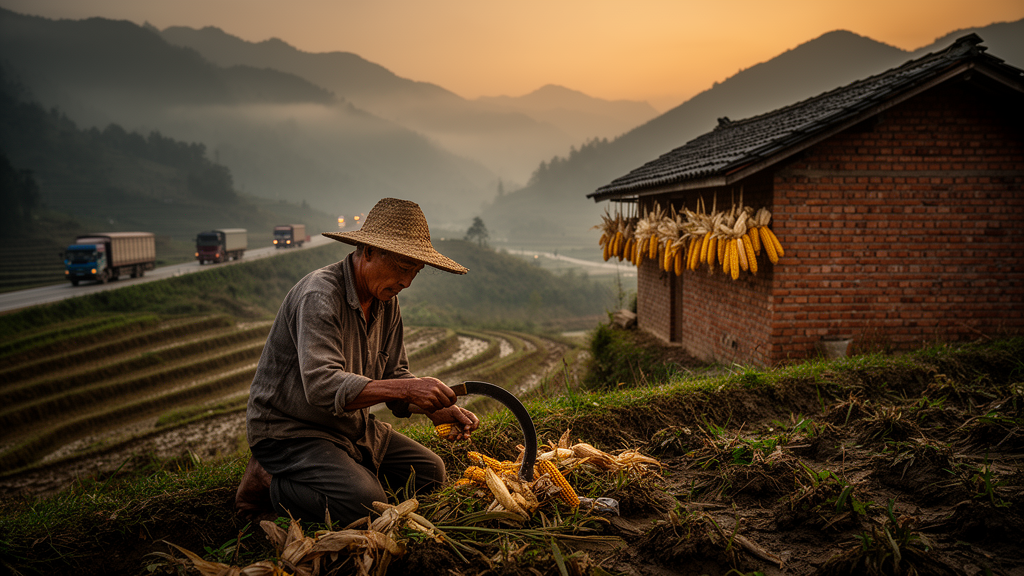
On China’s Southeast Asian frontier, the fight against narcotics has long been told as a story of borders, seizures, and supply chains. A new opinion article argues that this narrative misses half the picture: the quiet, measurable damage that drug abuse inflicts on the farming households of the consumer side. Writing in Advances in Drug and Alcohol Research, Xiaobo Hua of China Agricultural University proposes a typology that classifies villagers with drug abuse experience and the households they belong to, offering researchers and policymakers a structured way to understand how illicit drug flows transform rural livelihoods long after the drugs themselves have crossed the border.
The geographic setting is critical. China’s Yunnan and Guangxi provinces abut the infamous Golden Triangle, one of the world’s major illicit opium-producing regions, and the area carries a long history of opium and heroin production, consumption, and trade. Cross-border drug trafficking and associated crime occur at high frequency along these frontiers, and studies have documented the pivotal role of Burmese injecting drug users in cross-border HIV-1 transmission in the China-Myanmar border region. Scholars such as van Schendel and Abraham have argued that borders are places of extreme anxiety for the modern state, partly because the notion of illegality is poorly understood there. The Chinese government has invested heavily in drug control, yet transnational illicit flows continue to pose major challenges, making the borderlands a persistent receiving frontier for narcotics.
What makes Hua’s argument distinctive is its focus on the demand side. Much of the existing debate concerns how to control supply, while far less is known about how narcotic drug problems affect or change the livelihoods of drug users and their societies after abuse or cessation. This gap matters because many drug users in the region live in rural areas and work in agriculture. Unlike non-traditional security threats such as climate change or serious diseases, which affect whole communities, drug abuse strikes only certain or targeted villagers, and among these, some recover after medical treatment. Recovery, however, is not the end of the story: those who recover may not have completely stopped abusing drugs, and relapse remains possible. Drug users are also difficult to locate and apprehend because of their high mobility and ability to hide, complicating both research and governance.
The article’s technical core lies in reconsidering the characteristics of drug users as a distinct rural population category. Conventional livelihood analyses sort villagers by gender, age, or wealth, but drug users carry specific attributes that cut across these categories. Apart from those still abusing drugs, the majority of former users require medical treatment to recover. Physiologically, drug users normally lose the physical feeling of addiction once forced to stay in a rehabilitation center, and can fully recover after roughly one month of continuous professional treatment. Compulsory punishment is a different matter: recovered addicts released after compulsory penalties are very likely to relapse, for reasons the article enumerates. Physical and mental dependence results from physiological damage after addiction, and a single episode of heroin addiction can produce strong mental dependence. Recovered users are easily affected by items associated with drug abuse, such as syringes and aluminum foil, which may encourage renewed use. Widespread discrimination from families and society can trigger relapse, and former users are easily disappointed in themselves when re-entering society proves difficult and they struggle to thrive.
From this complicated context, Hua draws a methodological conclusion: agrarian livelihoods affected by narcotic drugs must be understood on their own terms rather than benchmarked against villagers who have never abused drugs. Comparing affected and unaffected households would be far more complicated, because overlapping factors confound any simple contrast. Some villagers may rent out their farmland not only because drug abuse or disease has diminished their labor capacity, but also because of the costs and benefits of farming activities or their role as land tenants. These factors may overlap, and the article argues such situations should be clarified and discussed in future research rather than collapsed into a single explanatory variable.
The proposed typology classifies villagers with drug abuse experience into four groups. The first group comprises villagers who passed away due to drug addiction. The second consists of villagers currently abusing drugs. These two groups are very difficult to access and interview because of practical and ethical considerations. The third group includes villagers under treatment in drug addiction treatment centers, typically long-term users who have been sent for treatment. The fourth and last group consists of villagers who have stopped using narcotic drugs after treatment and returned to lead normal lives. Nevertheless, the article stresses that relapse remains possible among villagers under treatment or those who have completed it, because of their strong mental and physical dependence on narcotics. In general, there is a high possibility of recurrence and uncertainty among the last three groups, which means any livelihood assessment must treat recovery as provisional rather than permanent.
These four villager groups generally form two types of households, and this is where the typology becomes a tool for rural analysis. The first type is the member-lacking household, abbreviated MHH, in which the previous and normal household structure has been affected and some family members have left because of drug addiction. In an MHH, some members may have passed away, some may still be abusing drugs, some may be in treatment, or some may have left treatment to seek non-agricultural opportunities. The absent family member creates a potential labor shortage at home and may no longer directly contribute to the household’s operation. Member-lacking households are further divided into two sub-types: MHHs-I, representing households whose members experienced drug abuse and cannot contribute to the household, and MHHs-II, referring to households whose members are drug abusers but who work as agricultural or non-agricultural laborers. The second type is the opposite: the full-member household, or FHH, which may include members who are still abusing drugs and living with their families, or members who quit drug addiction several years ago and mainly make a living through agricultural activities or local work.
The typology engages directly with established findings in rural livelihood research. Many studies have shown that labor capacity, education, and health levels have a positive impact on off-farm employment or engagement in non-agricultural work. What remains unclear, and what Hua flags as an open research question, is whether these same factors contribute to the ability of former drug users to participate in non-agricultural work. The distinction between MHHs-I and MHHs-II captures precisely this uncertainty: within the same category of labor-short households, some affected members remain economically inactive while others continue working in agriculture or beyond it, and the factors determining which path a recovered user takes are not yet established. This heterogeneity is the article’s central empirical claim about how narcotics reshape agrarian society.
The practical implications extend beyond drug policy into governance, poverty alleviation, and sustainable rural development. Hua argues that drug abuse in China’s Southeast Asian borderlands is not merely a drug issue but an urgent social and cultural agenda, one that has significantly affected rural society on the Chinese side as a receiving frontier for illicit flows. The proposed typology is relevant to the existing literature on rural livelihoods and to policies for governance and poverty alleviation under the influence of narcotics, both in the borderlands and in other regions facing similar challenges. It also highlights methodological caution: studying the impact of narcotic drug problems on local livelihoods is difficult, and researchers must be careful of interviewees’ feelings when asking about drug addiction in the household, because such questions could easily make interviewees feel ashamed, embarrassed, or sad.
For a field that has long measured the narcotics problem in seizures and hectares of eradicated opium, the typological perspective offers a different metric: the structure and resilience of the households left behind. By classifying villagers into four groups and households into member-lacking and full-member types, the framework makes visible the labor shortages, provisional recoveries, and overlapping land-rental decisions that conventional comparisons obscure. As cross-border illicit flows persist along the Golden Triangle frontier, understanding agrarian livelihoods on their own terms may prove as important to sustainable rural development as any supply-side intervention, and the article’s framework gives researchers a starting point for that task. The research was conducted with financial support from the National Natural Science Foundation of China (No. 42201108).
Subject of Research: Rethinking agrarian livelihoods affected by narcotic drug abuse on China’s Southeast Asian borders: a typological perspective
Article Title: Rethinking agrarian livelihoods affected by narcotic drug abuse on China’s Southeast Asian borders: a typological perspective
Article References: Hua, X. (2024). Rethinking agrarian livelihoods affected by narcotic drug abuse on China’s Southeast Asian borders: a typological perspective. Advances in Drug and Alcohol Research, 4, Article 12693. https://doi.org/10.3389/adar.2024.12693
Image Credits: AI Generated
Keywords: Rethinking, agrarian, livelihoods, affected, narcotic, drug, abuse, China, Southeast, Asian, borders, typological
Cite Scienmag News
Glenn Wilkins. (October 17, 2026). How Narcotics Reshape Farming Households on China’s Drug Border. Scienmag. https://scienmag.com/how-narcotics-reshape-farming-households-on-chinas-drug-border/
Glenn Wilkins. "How Narcotics Reshape Farming Households on China’s Drug Border." Scienmag, 17 October 2026, https://scienmag.com/how-narcotics-reshape-farming-households-on-chinas-drug-border/. Accessed 17 October 2026.
Glenn Wilkins. "How Narcotics Reshape Farming Households on China’s Drug Border." Scienmag. October 17, 2026. https://scienmag.com/how-narcotics-reshape-farming-households-on-chinas-drug-border/


