


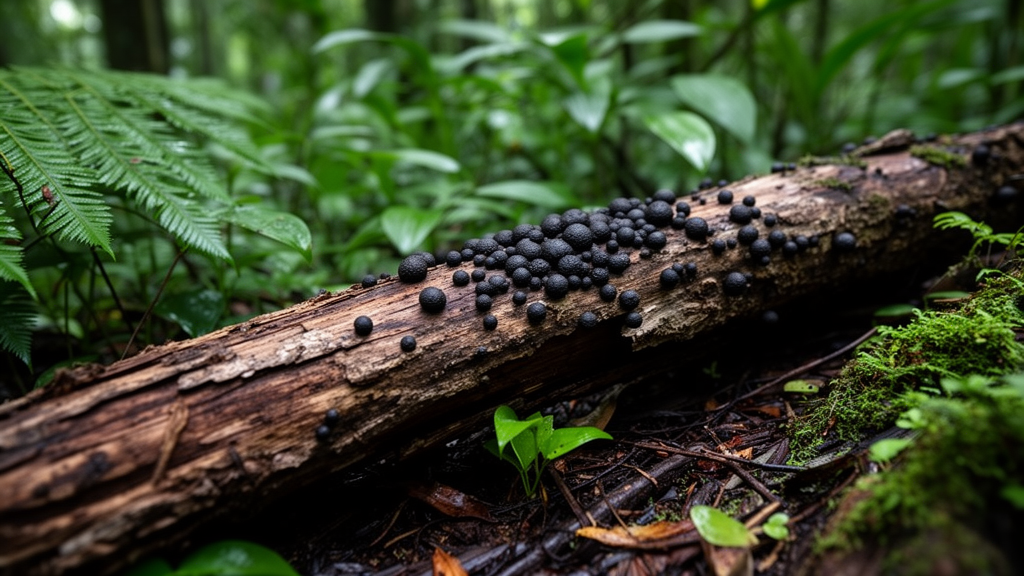
Deep in the tropical rainforests of Hainan, an island province at the southern edge of China, two fungi have been quietly growing on dead branches, unnoticed by science until now. A survey of wood-inhabiting macrofungi in Hainan Tropical Rainforest National Park has revealed two new species of the genus Biscogniauxia, named Biscogniauxia diaoluoshanensis and Biscogniauxia jianfengensis after the two mountain branches of the park where they were found. The discovery, published in the journal MycoKeys, was based on a combination of detailed morphological study and molecular phylogenetic analysis, and it offers a rare glimpse into the poorly documented fungal diversity of tropical Asia.
Biscogniauxia belongs to the family Graphostromataceae within the order Xylariales, a group of ascomycete fungi known for their dark, carbonaceous fruiting bodies called stromata. The genus was established in 1891 with Biscogniauxia nummularia as its type species and is characterized by corticolous, bipartite stromata that develop beneath the bark of host trees and break open when mature. These fungi produce unitunicate asci with an amyloid apical apparatus and ellipsoid brown ascospores bearing germ slits, usually without slimy sheaths or appendages. For decades the genus was assigned to the family Xylariaceae based purely on morphology, but multigene phylogenetic analyses by Wendt and colleagues in 2018 segregated it into Graphostromataceae alongside genera such as Graphostroma, Camillea, Obolarina and Vivantia.
Today Biscogniauxia is the largest genus in Graphostromataceae, with more than 65 widely accepted species recorded across North America, Africa, Europe, Asia and Oceania. Most species are saprobes that decompose dead wood, but some are plant pathogens capable of causing diseases in a wide range of dicotyledonous angiosperm trees, including hosts as diverse as Eucalyptus, Quercus, Prunus, Fagus and Acer. Others live as endophytes inside healthy plant tissues, waiting until their hosts become old or stressed before turning pathogenic. Some species are also notable producers of novel bioactive compounds and secondary metabolites, making the genus of considerable ecological and economic interest.
Despite this broad distribution, the species diversity of Graphostromataceae in tropical regions remains poorly understood. China has documented 17 species and 4 varieties of Biscogniauxia, but collections from the country’s tropical areas are few, and many undescribed novel species are expected to exist. The Hainan Tropical Rainforest National Park, located in south-central Hainan Province between roughly 18°33’N and 19°14’N, harbours 4,367 higher plant species across 1,368 genera and 289 families under a tropical monsoon climate. Only three species of Graphostromataceae had previously been documented from the entire island, underscoring how little explored this fungal lineage is in tropical China.
The research team collected dead branches bearing fungal stromata from the park and deposited the dried specimens in the Fungarium of the Institute of Tropical Bioscience and Biotechnology at the Chinese Academy of Tropical Agricultural Sciences. Macroscopic features were documented with field photographs and examined under a Keyence VHX-6000 3D microscope, while microscopic structures were observed with an Olympus IX73 inverted fluorescence microscope using a 100x oil immersion objective. Sections were mounted in water, Melzer’s reagent and potassium hydroxide to reveal diagnostic characters. At least 30 asci and 50 ascospores from each specimen were measured randomly, with 5 percent of measurements excluded from each end of the reported size ranges to reflect natural variation.
For the molecular work, genomic DNA was extracted from the dried specimens and three genetic loci were amplified: the internal transcribed spacer region of nuclear ribosomal DNA, a portion of the beta-tubulin gene, and a segment of the RNA polymerase II second largest subunit gene. These three markers, abbreviated ITS, TUB2 and RPB2, are standard tools in fungal systematics because they evolve at different rates and together provide enough resolution to distinguish closely related species. The newly generated sequences were uploaded to NCBI GenBank and combined with publicly available data from 61 strains representing 43 species, including relatives in Camillea, Cryptostroma, Graphostroma and Obolarina, with Jackrogersella cohaerens and Hypoxylon rubiginosum serving as outgroups.
The combined dataset contained 3,233 aligned characters, of which 1,683 were constant, 1,326 were phylogenetically informative and 224 were variable but uninformative. Maximum likelihood analysis using the RAxML GUI software with the GTRGAMMA model and 1,000 rapid bootstrap replicates, along with Bayesian inference using MrBayes with jModelTest-selected substitution models run for 3,000,000 generations, produced highly similar tree topologies. The results confirmed that both new species belong to Biscogniauxia but occupy clearly separate positions within the genus. Biscogniauxia jianfengensis grouped with Biscogniauxia philippinensis var. microspora with maximum support, while Biscogniauxia diaoluoshanensis resolved as a basal lineage of the other Biscogniauxia taxa included in the study.
Morphologically, the two species are readily distinguishable. Biscogniauxia diaoluoshanensis produces applanate, orbicular to irregularly lobed stromata measuring 4 to 12 centimetres across, with shiny black surfaces and conspicuous depressions. Its perithecia are ovoid to pyriform, frequently flattened laterally and basally, and its ascospores are light brown to brown, ellipsoid and almost equilateral, with a conspicuous straight germ slit that runs almost the full length of the spore. Biscogniauxia jianfengensis, by contrast, forms applanate to slightly pulvinate stromata that coalesce into widely effused compound structures with dull black, matte surfaces. Its perithecia are tubular to short-tubular, and its dark brown to blackish brown ascospores are inequilateral, bearing an inconspicuous unilateral germ slit on the most convex side and, remarkably, an opaque thick-walled cellular appendage on one side, a feature that sets it apart from most of its congeners.
Sequence divergence comparisons further reinforced the distinctness of the new species. Biscogniauxia nummularia, the type species of the genus, differs from B. diaoluoshanensis by 168 base pairs in the TUB2 alignment, representing 11.52 percent of the aligned region, while strain CBS 969.70 of the same species shows 95- and 164-base-pair divergences in RPB2 and TUB2 respectively. Biscogniauxia capnodes differs by 83 base pairs in RPB2, and for other congeneric species sequence similarity to the new taxon falls below 91 percent for both RPB2 and TUB2, with ITS similarity below 86 percent for all previously known species. Unfortunately, no molecular sequences are available for Biscogniauxia philippinensis, so nucleotide comparisons with that tropical relative could not be performed, though its larger ascospores of 22 to 27 by 11.5 to 13 micrometres distinguish it morphologically from B. jianfengensis.
The phylogenetic analyses also confirmed that Biscogniauxia is polyphyletic, consistent with several previous studies, with species distributed across six separate clades and Camillea species nesting within the Biscogniauxia clade. This finding suggests that the generic classification remains ambiguous and that further studies with expanded sampling across broader geographic regions are needed. The researchers also proposed a dichotomous identification key to the Biscogniauxia taxa known from China, incorporating the two new species. Given how sparse records of Graphostromataceae remain across tropical Asia, the team expects that continued surveys across the diverse forest types of Hainan will yield additional new species, adding to a growing catalogue of fungal life emerging from one of China’s richest tropical ecosystems.
Subject of Research: Two new Biscogniauxia fungal species from Hainan Tropical Rainforest National Park are described using morphology and ITS, RPB2 and TUB2 phylogenetics.
Article Title: Phylogenetic analyses and morphological studies reveal two new species of Biscogniauxia ( Xylariales , Ascomycota ) from Hainan Tropical Rainforest National Park, China
Article References: Ma, S.-Y., Liu, S., Qu, Z., Jiang, H., Zhu, A.-H., & Ma, H.-X. (2026). Phylogenetic analyses and morphological studies reveal two new species of Biscogniauxia (Xylariales, Ascomycota) from Hainan Tropical Rainforest National Park, China. MycoKeys, 140, 241-259. https://doi.org/10.3897/mycokeys.140.206566
Image Credits: AI Generated
DOI: 10.3897/mycokeys.140.206566
Keywords: Phylogenetic, analyses, morphological, studies, reveal, species, Biscogniauxia, Xylariales, Ascomycota, Hainan, Tropical, Rainforest
Cite Scienmag News
Roger Howard. (October 17, 2026). Two new fungi from Hainan rainforest expand the hidden diversity of Biscogniauxia. Scienmag. https://scienmag.com/two-new-fungi-from-hainan-rainforest-expand-the-hidden-diversity-of-biscogniauxia/
Roger Howard. "Two new fungi from Hainan rainforest expand the hidden diversity of Biscogniauxia." Scienmag, 17 October 2026, https://scienmag.com/two-new-fungi-from-hainan-rainforest-expand-the-hidden-diversity-of-biscogniauxia/. Accessed 17 October 2026.
Roger Howard. "Two new fungi from Hainan rainforest expand the hidden diversity of Biscogniauxia." Scienmag. October 17, 2026. https://scienmag.com/two-new-fungi-from-hainan-rainforest-expand-the-hidden-diversity-of-biscogniauxia/


