


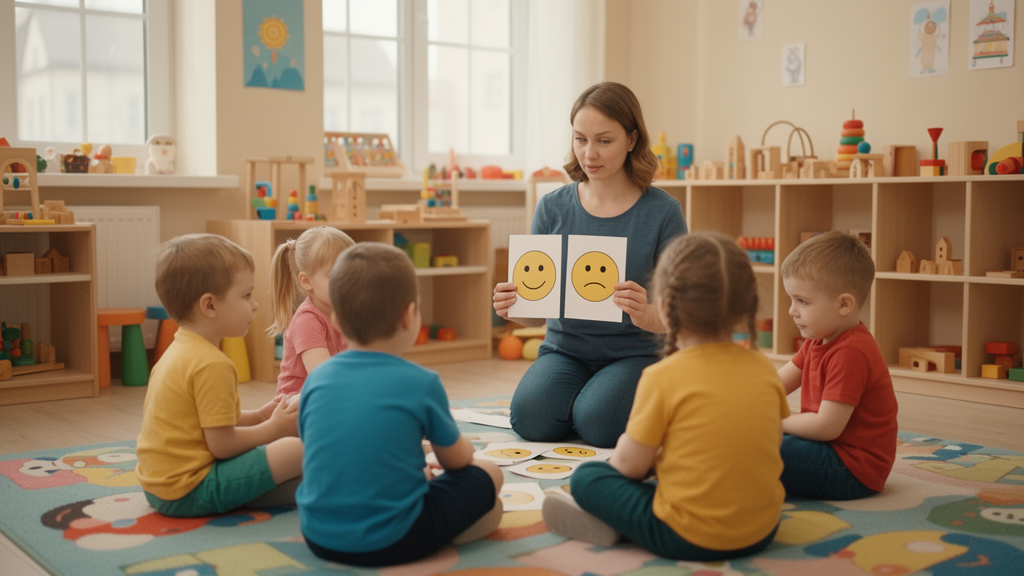
When Russia sealed its preschools in March 2020, …
The study’s design deserves particular attention because it offers something rare in pandemic-era developmental research: a matched comparison group drawn from the same city, the same preschools, and the same socioeconomic stratum as the affected cohort. By matching children on age, sex, non-verbal intelligence as measured by the Raven matrices, and mother tongue, the researchers reduced the likelihood that pre-existing differences between groups could account for the divergence in emotional development. This matters because children’s emotion understanding is known to be shaped by a wide array of cognitive and social variables, including language ability, executive function, and family conversational practices. When those variables are held roughly constant across groups, the remaining difference in developmental trajectories becomes more plausibly attributable to the experience itself — in this case, the six-month total lockdown that the Pandemic sample endured and the Control sample did not.
The Test of Emotion Comprehension, administered in its Russian version at both assessment points, is well suited to capturing the layered structure of emotional development described in four decades of research. Rather than measuring a single skill, the instrument probes a hierarchy of components that children typically master in sequence. Younger children first grasp the external facets of emotion: recognizing happiness, anger, fear, and sadness in faces, bodies, and voices, and understanding how situations and desires give rise to feelings. Between roughly five and seven years of age, the mental components come online, as children realize that beliefs and memories can color emotions and that feelings can be hidden behind a composed exterior. Later, between seven and nine, reflective components emerge, including the use of cognitive strategies to regulate emotion, the appreciation of moral emotions such as pride, shame, and guilt, and the recognition that mixed feelings can coexist. The children in this study, assessed at five and a half and again at six and a half, were positioned precisely at the threshold of the mental stage, a period when development is typically brisk. That the Pandemic sample’s gains over the year were minimal and nearly stagnant, while the Control sample advanced substantially along the expected trajectory, suggests the lockdown may have interrupted progress at a particularly sensitive juncture.
The theoretical framing offered by the authors draws on a long tradition in developmental psychology that views emotion understanding as the emotional counterpart of theory of mind — the declarative dimension of what is sometimes called emotional competence or emotional intelligence. On this view, understanding emotions is not a purely internal cognitive achievement but the product of a circular exchange: children’s growing understanding shapes how they experience and express emotions, and those experiences in turn refine their understanding. Social interactions fuel this exchange. Conversations about feelings at home, sensitive and responsive caregiving, secure attachment relationships, and — crucially — interactions with peers and adults outside the immediate family all provide the material from which children build their models of how emotions work. These interactions help children explore what Vygotskian theory would call their zone of proximal development, the space between what they can grasp alone and what they can achieve with the scaffolding of more capable partners.
The lockdown, the authors argue, severed or at least severely narrowed this circle. With preschools closed and movement restricted, children’s social world contracted to the immediate household. Interactions within the family became predominant, while those beyond it — with playmates, teachers, extended relatives, and the broader community — were sharply reduced. The hypothesis that follows is that extra-familial social interaction plays a protective role in the development of emotion understanding, and that its prolonged absence constitutes a risk factor. This hypothesis gains additional weight in a collectivistic society such as contemporary Russia, where cultural values and practices place particular emphasis on group belonging, shared norms, and relationships extending well beyond the nuclear family. In such a context, the range of social partners a child regularly encounters may carry an especially rich load of emotional information: differing perspectives, obligations, and displays that challenge and refine a child’s grasp of how inner states relate to outward behavior. Restricting a child to a single household dramatically narrows that informational landscape, and the authors suggest the effect may be particularly consequential precisely where collectivistic practices make the wider social circle so central to daily life.
The study also makes a methodological and conceptual contribution by foregrounding history as a dimension of culture that developmental research has largely overlooked. Cultural influences on emotion understanding have typically been studied by comparing contemporary societies with one another — individualistic versus collectivistic orientations, for example — as though each culture were a stable snapshot. The authors, invoking the geographer Élisée Reclus’s observation that geography is history in space while history is geography in time, argue that cultures must be understood as evolving through historical events and periods. The COVID-19 pandemic and its accompanying near-total lockdown offered an unplanned natural experiment in this respect: a dramatic, shared historical event that abruptly transformed the social practices through which culture is transmitted and lived. Examining its effects on children in a Eurasian collectivistic society extends the predominantly Western evidence base and demonstrates that historical shocks can leave measurable traces in developmental trajectories.
Several nuances qualify the findings. Both samples did make gains over the year, so the lockdown did not reverse development but rather flattened its slope; the Pandemic children’s progress was minimal relative to what typical trajectories would predict. The samples were community samples of five- to six-year-olds from middle-SES families in a single city, which strengthens internal comparability but limits generalization to other ages, socioeconomic strata, and regions. Notably, the bulk of prior research, conducted largely in Western contexts, has generally not found significant gender differences in preschool and school-age children’s emotion understanding, and the matching on sex in this design reflects the field’s understanding that individual differences — typical and atypical alike — often rival developmental differences in magnitude. Children with conditions such as autism spectrum disorder, hearing difficulties, or Down syndrome show distinct profiles, but the present community samples speak to the typical range of variation.
The authors themselves flag directions for future work that would sharpen the causal interpretation. A long-term follow-up would reveal whether the stagnation observed during the lockdown years persists, compensates as social life resumes, or produces lasting differences in emotional competence. Direct measures of cultural values and practices, rather than inferring them from societal context, would test the hypothesis that collectivistic orientations amplify the impact of restricted social interaction. Detailed records of children’s actual social contact during and after the lockdown — with whom, how often, and in what activities — would connect the proposed mechanism to observable behavior. Family-level variables, such as the emotional climate of the household and the frequency of conversations about feelings during confinement, could explain why some children weathered the restriction better than others.
For practitioners and policymakers, the findings carry a practical implication: the social world beyond the family is not a luxury in emotional development but a structural support. Preschool closures, however necessary they may have been for public health, removed a developmental resource that the household alone could not fully replace. If extra-familial interaction indeed protects the growth of emotion understanding, then future disruptions — pandemics, but also conflicts, displacement, or prolonged institutional closures — should be evaluated not only for their educational and economic costs but for their emotional-developmental ones, particularly in societies where the collective dimension of social life is central. The study stands as an early empirical marker of how a singular historical event can bend, at least temporarily, the developmental curve of a fundamental human capacity.
Subject of Research: Impact of the COVID-19 lockdown on preschoolers' emotion understanding in Russia
Article Title: Impact of the COVID-19 lockdown on the development of emotion understanding of children living in a Eurasian collectivistic society (Russia)
Article References: Pons, F., Gavrilova, M., & Veraksa, A. (2026). Impact of the COVID-19 lockdown on the development of emotion understanding of children living in a Eurasian collectivistic society (Russia). Frontiers in Developmental Psychology, 4, Article 1956317. https://doi.org/10.3389/fdpys.2026.1956317
Image Credits: AI Generated
DOI: 10.3389/fdpys.2026.1956317
Keywords: COVID-19 lockdown, emotion understanding, child development, collectivism, Russia, preschoolers, Test of Emotion Comprehension, social interaction, developmental psychology, peer interaction, Impact, COVID-19
Cite Scienmag News
Glenn Wilkins. (October 17, 2026). COVID Lockdown Slowed Emotion Understanding in Russian Preschoolers. Scienmag. https://scienmag.com/covid-lockdown-slowed-emotion-understanding-in-russian-preschoolers/
Glenn Wilkins. "COVID Lockdown Slowed Emotion Understanding in Russian Preschoolers." Scienmag, 17 October 2026, https://scienmag.com/covid-lockdown-slowed-emotion-understanding-in-russian-preschoolers/. Accessed 17 October 2026.
Glenn Wilkins. "COVID Lockdown Slowed Emotion Understanding in Russian Preschoolers." Scienmag. October 17, 2026. https://scienmag.com/covid-lockdown-slowed-emotion-understanding-in-russian-preschoolers/


