


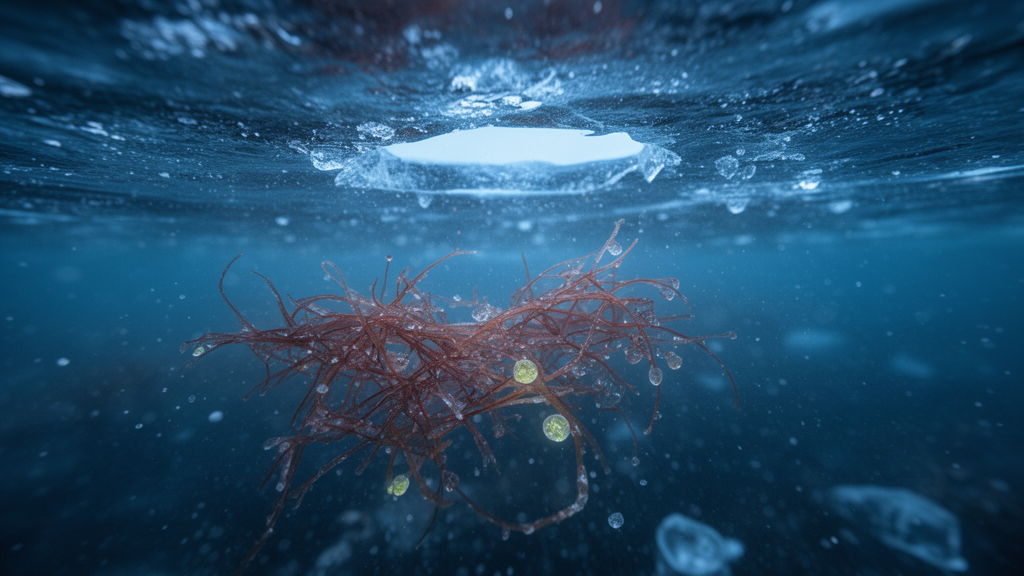
Beneath the ice of the polar oceans, sunlight is a scarce and stuttering commodity. Snow cover, sea ice, and the low angle of the winter sun strip away almost all of the light that phytoplankton need to live, and what little remains arrives in a trickle so faint that individual photons strike the photosynthetic machinery of each cell seconds apart. Yet field studies in the Arctic and Antarctic keep revealing something remarkable: microscopic algae are not merely surviving this darkness, they are photosynthesizing in it, at light levels once thought impossible. A new study published in Frontiers in Photobiology by researchers at the University of Ottawa, Mount Allison University, and the Takuvik Joint International Laboratory now offers a mechanistic explanation, tracing the phenomenon to a subtle property of Photosystem II, the molecular engine that splits water and releases the oxygen we breathe.
The research team, led by Mackenzie Poirier, Marina Cvetkovska, and Douglas Campbell, set out to test a deceptively simple hypothesis. When light is extremely scarce, the sequential arrivals of photons at any given Photosystem II complex are separated by long intervals of time. During those gaps, the charge separations that photosynthesis depends on can quietly fall apart through recombination reactions, undoing the chemical work that a photon just accomplished. The researchers suspected that polar algae, having evolved in perpetual cold and near-darkness, might have found ways to suppress these wasteful photochemical misses, allowing them to squeeze productive electron transport out of photons that arrive seconds apart.
To understand why this matters, it helps to picture how Photosystem II actually works. Each complex contains a reaction center, P680, that absorbs excitation energy funneled in from light-harvesting pigments. When excited, P680 hands an electron down a chain of acceptors, ultimately passing it to a mobile quinone carrier, while a tyrosine residue extracts a replacement electron from a manganese-calcium-oxygen cluster known as the Oxygen Evolving Complex. Four consecutive charge separations drive this cluster through four increasingly oxidized states, labeled S0 through S3, before it can strip four electrons from two water molecules and release a single molecule of oxygen. The entire water-splitting cycle therefore demands four photons delivered in sequence to the same Photosystem II, a feat that becomes extraordinarily difficult when photons arrive seconds apart and the intermediates must persist through the intervening darkness.
Those persisted intermediates are precisely where the trouble begins. Charge recombination reactions, in which the separated electron and hole fall back together, are energetically wasteful steps backward in the S-state cycle. Worse, some recombinations generate chlorophyll triplets that react with molecular oxygen to produce singlet oxygen, a highly reactive and damaging molecule that can destroy the photosynthetic machinery itself. The probability of these recombinations depends on temperature, because each pathway has a characteristic activation energy. As temperatures fall below those thresholds, recombinations become less likely, which means that cold, counterintuitively, can actually stabilize the charge separations that photosynthesis needs to function.
Testing this idea required a clever experimental design. The researchers grew nine taxa of diatoms and green algae, some isolated from polar habitats and others from temperate waters, under controlled conditions of temperature, light, and salinity. They then dark-adapted each culture, allowing the Oxygen Evolving Complexes to relax predominantly to the S1 state, which synchronizes the entire population of Photosystem II complexes. From that synchronized starting point, they fired a series of twenty to thirty-two short, saturating flashes of blue light centered at 445 nanometers, each flash delivering a photon to every Photosystem II in the sample. Because each S-state has a slightly different intrinsic fluorescence yield, the sequential flashes produced a characteristic four-step oscillation in the maximum quantum yield of photochemistry, which the team tracked using a fast repetition rate fluorometer.
As the flashes continued, however, the oscillations inevitably decayed. Each photochemical miss, whether from a recombination or a double hit, knocked one Photosystem II out of step with its neighbors, scrambling the population-level signal toward an averaged value. The researchers quantified this decay using wavelet analysis, a mathematical technique that decomposes a time series into its constituent frequencies without assuming that statistical properties remain constant over time. By comparing the observed wavelet power at a periodicity of four against a white noise model, they could determine how many flashes occurred before the synchronized S-state cycling dropped below statistical significance. They called this measure the damping index, and it served as a direct readout of how many successive photochemical charge separations the population could sustain before misses overwhelmed the signal.
The results were striking. Across all taxa, the damping index declined as the spacing between flashes widened, which the team converted into equivalent effective light levels ranging from roughly 0.02 to 1 micromole photons per square meter per second, several orders of magnitude below full sunlight and well beneath the traditional threshold for the bottom of the photic zone. It also declined as measurement temperature rose. But the polar taxa, including the sea-ice diatom Fragilariopsis cylindrus and the Antarctic green algae Chlamydomonas priscui, Chlamydomonas malina, and Chlamydomonas ICE-MDV, maintained synchronized S-state cycling over far wider ranges of conditions than their temperate counterparts. The temperate diatom Thalassiosira pseudonana and the freshwater green alga Chlamydomonas reinhardtii lost their four-step oscillations entirely at measurement temperatures near or above their growth optima, while the polar species kept cycling even at the lowest light levels tested.
Perhaps the most intriguing finding emerged when the researchers compared peak performance. Both polar and temperate taxa achieved maximum damping indices of roughly ten to twelve flashes, suggesting that the intrinsic capacity of Photosystem II to maintain synchronized S-state cycling is fundamentally similar across lineages. The difference lies not in the machinery itself but in the temperatures at which each taxon can grow. Polar algae, adapted to thrive at temperatures near zero, naturally operate in the regime where recombination probabilities are suppressed and charge separations persist. Temperate species, growing at warmer temperatures, never access that regime. When the researchers measured both Chlamydomonas priscui and Chlamydomonas reinhardtii at a common temperature of 12 degrees Celsius, their wavelet power patterns became remarkably similar, confirming that the sustained synchronization in the polar species reflects its ability to grow cold rather than any intrinsic difference in Photosystem II architecture.
The study also probed the role of salinity, which varies dramatically across polar habitats and fluctuates with freezing and thawing cycles. Previous work had shown that high salinity induces restructuring of Photosystem I supercomplexes in Antarctic Chlamydomonas species, increasing cyclic electron flow and nonphotochemical quenching as photoprotective mechanisms. In the new experiments, salinity showed a statistically significant influence on damping indices when analyzed across all Chlamydomonas taxa, but within individual species only Chlamydomonas priscui, which tolerates the widest range of growth salinities, showed a direct effect. This suggests that the apparent salinity signal across taxa largely reflects differences in how each species responds to its native salinity rather than a universal direct influence of salt on Photosystem II synchronization.
The broader implications reach into one of the most consequential questions in polar ecology: how spring blooms will respond to a warming Arctic. Field observations have shown that net photosynthetic accumulation can begin very early in the season under ice, at photon fluxes that push the boundaries of photobiological knowledge. These winter survivors seed the massive spring blooms that dominate annual primary production in polar regions. The new findings suggest that low growth temperature itself is a key enabler, allowing polar phytoplankton to exploit extreme low light by suppressing the wasteful recombinations that would otherwise drain their photosynthetic energy. As climate change thins sea ice and extends the window of light available under it, the species best equipped to photosynthesize at low temperatures and low light may gain a decisive competitive advantage, capturing nutrients first and shaping the entire food web that depends on them. In the polar night, it turns out, being cold is not a liability but a strategy.
Subject of Research: Photosystem II efficiency and photochemical miss suppression in polar versus temperate phytoplankton under extreme low light and low temperature
Article Title: Photosystem II function under extreme low light and low temperatures; polar vs. temperate phytoplankton
Article References: Poirier, M., Ryan, N. M., Osmers, P., Plassart, A., Guérin, S., Babin, M., Berthold, M., Savoie, M., Cvetkovska, M., & Campbell, D. A. (2026). Photosystem II function under extreme low light and low temperatures; polar vs. temperate phytoplankton. Frontiers in Photobiology, 4, Article 1787189. https://doi.org/10.3389/fphbi.2026.1787189
Image Credits: AI Generated
DOI: 10.3389/fphbi.2026.1787189
Keywords: Photosystem II, phytoplankton, polar algae, psychrophiles, chlorophyll fluorescence, S-state cycling, charge recombination, low light photosynthesis, sea ice diatoms, Chlamydomonas, polar night, spring bloom
Cite Scienmag News
Drew Townsend. (October 17, 2026). How Polar Algae Keep Photosynthesis Alive in Near-Darkness and Deep Cold. Scienmag. https://scienmag.com/how-polar-algae-keep-photosynthesis-alive-in-near-darkness-and-deep-cold/
Drew Townsend. "How Polar Algae Keep Photosynthesis Alive in Near-Darkness and Deep Cold." Scienmag, 17 October 2026, https://scienmag.com/how-polar-algae-keep-photosynthesis-alive-in-near-darkness-and-deep-cold/. Accessed 17 October 2026.
Drew Townsend. "How Polar Algae Keep Photosynthesis Alive in Near-Darkness and Deep Cold." Scienmag. October 17, 2026. https://scienmag.com/how-polar-algae-keep-photosynthesis-alive-in-near-darkness-and-deep-cold/


