


When humanity finally plants permanent settlements on the Moon or Mars, the defining biological question may not be how to keep adults alive, but how to make babies. A sweeping new review published in Frontiers in Space Technologies argues that no human conception or pregnancy has ever occurred during spaceflight, and that the feasibility of sustaining healthy multigenerational human reproduction beyond Earth remains entirely unknown. The paper, by Marta Ferraz and Laurensz Moeharram of Echoes of the Cosmos in Amsterdam, integrates developmental space biology, artificial intelligence, reproductive biotechnology, and cybernetics into a provocative conceptual framework suggesting that prenatal and early postnatal development may constitute critical biological windows for long-term adaptation to space. If the authors are right, the first extraterrestrial children could become active drivers of human evolution rather than passive passengers in it.
The challenges begin with the environment itself. Space exposes biological systems to ionizing radiation, altered gravity, circadian disruption, atmospheric variation, and isolation, all of which may profoundly affect gametogenesis, fertilization, embryogenesis, pregnancy, and postnatal development. Among these factors, radiation and gravity stand out as the two most important determinants of reproductive and developmental success. Ionizing radiation can induce DNA damage, oxidative stress, genomic instability, and developmental abnormalities, while altered gravity may disrupt cellular organization, mechanobiological signaling, tissue formation, and physiological regulation. Sustaining healthy reproduction under these conditions, the review concludes, may represent one of the most complex biomedical challenges associated with humanity’s long-term expansion into the cosmos.
Decades of animal experiments paint a mixed and sometimes contradictory picture. Sea urchins, fish, frogs, newts, and birds have all achieved fertilization and embryonic development in orbit, though minor developmental anomalies have been reported. Medaka fish were the first vertebrates to successfully reproduce in space during a 15-day Space Shuttle mission, producing fertilization rates comparable to Earth-based controls. Rodent studies tell a more complicated story. The uncrewed biosatellite Cosmos 1129, launched in 1979, allowed rats to mate in flight, and two of five females showed signs of early pregnancy with resorption upon return. Later missions, including Cosmos 1514 in 1983 and the NIH.R1 and NIH.R2 flights of 1994 and 1995, produced viable offspring after late-gestational exposure, though litter size and neonatal weight varied. Missions involving nursing mothers and pups, such as NIH.R3 in 1996 and Neurolab in 1998, encountered high infant mortality and feeding difficulties that required astronaut intervention.
Embryonic resilience appears partial at best. In a landmark 2023 experiment aboard the International Space Station, astronauts thawed and cultured frozen two-cell mouse embryos for four days, exposing them to a radiation dose of 4.29 mGy. The embryos developed into blastocysts at rates comparable to a simulated 1 g environment, with no clear increase in DNA damage. Yet other studies reveal significant vulnerabilities. Work using a 3D clinostat demonstrated that while in vitro fertilization rates under simulated microgravity reached 84 percent, matching controls, subsequent preimplantation development was impaired, with live birth rates dropping to 35 percent versus 63 percent for 1 g controls. Blastocyst formation fell to 30 percent versus 57 percent, and immunostaining showed slower development and reduced trophectoderm cell numbers. The SJ-10 satellite mission in 2016 found that blastocyst rates and quality were lower in orbit due to DNA damage and global hypomethylation, primarily caused by radiation rather than microgravity alone.
Gravity, it turns out, is not merely a physical force but a mechanobiological signal. Reviews of microgravity effects on mouse embryonic stem cells indicate that microgravity influences development through cytoskeletal alterations and modulation of key signaling pathways including WNT, Cadherin, and Nitric Oxide, which coordinate cell proliferation, differentiation, adhesion, and vascular development. Microgravity encourages differentiation into mesoderm and endoderm, essential for tissue and organ formation, though effects on ectodermal differentiation, crucial for skin and nervous system, remain unclear. Radiation exposure during gestation is particularly harmful, potentially leading to structural malformations such as microcephaly and central nervous system defects resulting in cognitive impairments. Prenatal exposure to microgravity also delays gravistatic responses and alters vestibular system morphology, with only partial postnatal recovery reported.
Reproductive health in both sexes suffers under space conditions. Microgravity reduces rat testosterone levels, sperm counts, and testicular weight, while disrupting estrous cycling and follicle development in females. Oocyte maturation rates plummet under simulated microgravity, falling to 8.94 percent versus 73.0 percent in controls, suggesting gravity plays a critical role in meiotic spindle formation. A 37-day ISS study found estrous cycles and ovarian estrogen levels remained similar to controls, though progesterone levels were lower. Freeze-dried mouse spermatozoa stored on the ISS for nine months showed slightly increased DNA damage, yet fertilization and birth rates remained comparable to controls, with all offspring developing to adulthood with normal fertility. Intriguingly, hypergravity appears to have a greater and faster impact on sperm motility than microgravity, and blocking the anaphase-promoting complex has been shown to improve oocyte quality under simulated microgravity, hinting that targeted interventions could mitigate some reproductive challenges.
Human data remains sparse but suggestive. Systematic reviews indicate that microgravity and ionizing radiation adversely affect male reproductive parameters, including decreased sperm motility, sperm DNA fragmentation, and decreased hormone levels that can cause testicular dysfunction by disrupting the hypothalamic-pituitary-gonadal axis. Female astronauts may face increased risks including thromboembolism in combined oral contraceptive users, decreased decidualization, functional insufficiency of the corpus luteum, and decreased progesterone and LH levels. Cosmic radiation, particularly high-charge and energy particles, has been linked to depletion of the ovarian reserve and premature ovarian failure in rodents. The physiological deconditioning of microgravity, including skeletal muscle atrophy, bone mineral loss, cardiac atrophy, and reduced plasma volume, could interfere with the maternal cardiovascular adaptations required for pregnancy, potentially impairing uteroplacental circulation and increasing risks of fetal growth restriction, placental dysfunction, miscarriage, or preterm birth.
Against this backdrop, the review proposes three complementary pathways for enabling human reproduction beyond Earth. The first involves modifying extraterrestrial environments to recreate Earth-like physiological conditions through artificial-gravity systems and advanced habitat engineering. Rotating habitats, first proposed by Konstantin Tsiolkovsky in 1895 and 1903 and later developed by Hermann Noordung, Wernher von Braun, and Gerard O’Neill, could generate centrifugal acceleration capable of simulating Earth, lunar, Martian, or custom gravity levels. Yet artificial gravity remains physiologically distinct from natural terrestrial gravity, generating gravity gradients, Coriolis forces, and vestibular disturbances. A NASA study using Drosophila melanogaster aboard the ISS found that artificial gravity partially mitigated neurological deficits but did not fully prevent cellular stress responses or oxidative damage. The effects of partial gravity environments such as lunar 0.16 g or Martian 0.38 g on reproduction remain almost entirely unknown.
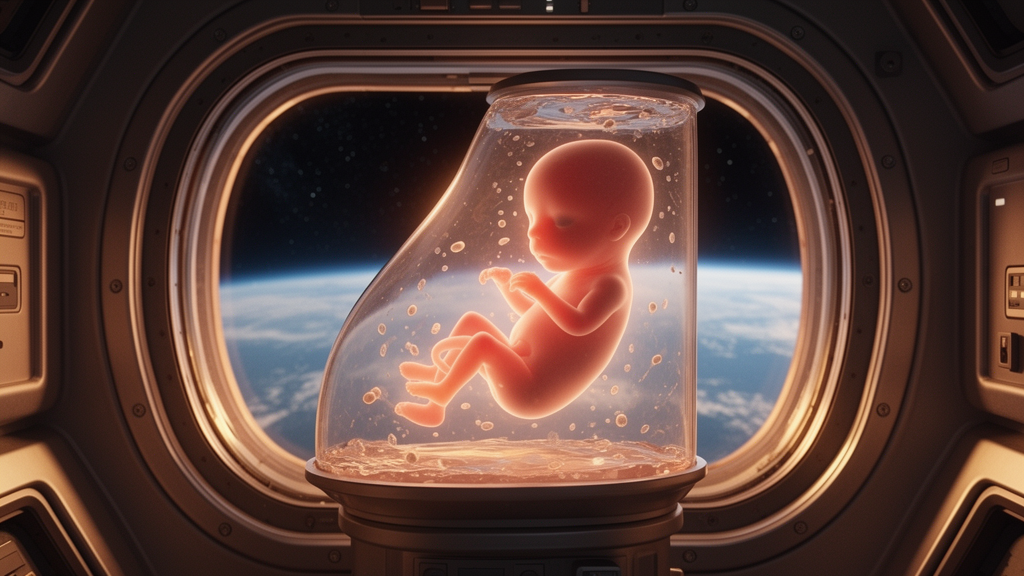
The second pathway involves advanced cybernetic technologies, culminating in what the authors designate as Synthetic Reproductive Adaptive Enhancement Technology, or SRAET. This speculative closed-loop framework would integrate autonomous reproductive biotechnology, artificial-womb ectogenetic systems, physiological-exchange subsystems, adaptive environmental regulation, biosensor networks, and AI-assisted physiological control architectures designed to maintain prenatal developmental homeostasis in space. The system could begin with a biomimetic reproductive platform recreating ovarian, tubal, and uterine microenvironments, then transition seamlessly to ectogenetic gestation within an integrated artificial-womb chamber. Embedded biosensing systems and AI-assisted image analysis would continuously monitor gamete quality, fertilization dynamics, and embryonic progression while regulating oxygen, pH, nutrients, hormones, and temperature. The developmental chamber could incorporate multilayered adaptive membranes with integrated shielding materials including hydrogen-rich composites and high-density polyethylene, dynamically adjusting radiation protection in real time based on detected oxidative stress or inflammatory biomarkers.
The third pathway involves directly modifying human biology through synthetic biology and genetic modification. Somatic interventions could target genes associated with antioxidant protection, DNA repair, radiation resistance, immune regulation, and metabolic adaptation, building on clinical successes such as AAV-based gene therapy for spinal muscular atrophy. Germline modifications could theoretically establish inheritable baseline adaptations for long-term resilience, though such interventions remain highly controversial due to pleiotropy, mosaicism, off-target mutations, and multigenerational unpredictability. The authors emphasize that adaptation would emerge through continuous interactions among controlled environmental exposure, developmental plasticity, cybernetic regulation, and targeted biological modification rather than through any single approach. Drawing on evolutionary developmental biology, they argue that early developmental stages exhibit elevated biological plasticity, allowing environmental conditions to influence developmental trajectories and long-term adaptive potential. Over sufficiently long timescales, such interactions could contribute to the emergence of biologically distinct human populations progressively adapted to diverse space environments. The greatest challenge of human expansion beyond Earth, the review concludes, may not be transporting humans into space, but understanding how life itself can develop, adapt, and evolve under space conditions.
Subject of Research: Space Biology
Article Title: Past, present and future of human reproduction and development in space
Article References: Ferraz, M., & Moeharram, L. (2026). Past, present and future of human reproduction and development in space. Frontiers in Space Technologies, 7, Article 1917547. https://doi.org/10.3389/frspt.2026.1917547
Image Credits: AI Generated
DOI: 10.3389/frspt.2026.1917547
Keywords: space reproduction, artificial gravity, developmental space biology, SRAET, space radiation, human evolution, space settlement, Past, present, future, human, reproduction
Cite Scienmag News
Gavin Prescott. (October 17, 2026). Babies Beyond Earth: Why the First Space Pregnancy May Redefine Human Evolution. Scienmag. https://scienmag.com/babies-beyond-earth-why-the-first-space-pregnancy-may-redefine-human-evolution/
Gavin Prescott. "Babies Beyond Earth: Why the First Space Pregnancy May Redefine Human Evolution." Scienmag, 17 October 2026, https://scienmag.com/babies-beyond-earth-why-the-first-space-pregnancy-may-redefine-human-evolution/. Accessed 17 October 2026.
Gavin Prescott. "Babies Beyond Earth: Why the First Space Pregnancy May Redefine Human Evolution." Scienmag. October 17, 2026. https://scienmag.com/babies-beyond-earth-why-the-first-space-pregnancy-may-redefine-human-evolution/


