


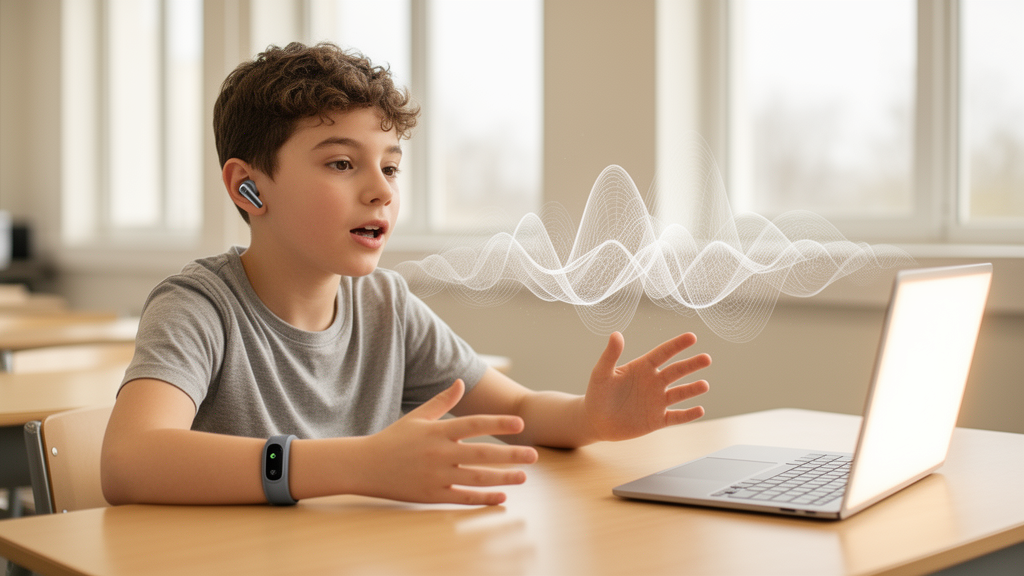
Imagine a language tutor that never blinks, never gets tired, and notices everything: the slight tremor in your voice when a grammar rule slips away, the way your hands freeze mid-gesture when comprehension collapses, the micro-expressions that betray frustration before you have said a single word of complaint. That vision moved a step closer to reality with a new study published in Frontiers in Neurorobotics, in which researcher Yao Tang of Jinshen College, Nanjing Audit University, presents a machine-learning framework called the Affective-Cognitive Gated Cross-modal Transformer, or ACG-CMT. The system fuses three streams of information about a learner—speech, body movement, and emotional signals—and uses them to decide, within milliseconds, what kind of feedback a struggling English student needs next.
The motivation behind the work lies in a long-standing gap between what language-learning software can measure and what actually happens in a learner’s mind and body. Most computer-assisted pronunciation and grammar tools evaluate linguistic output alone: phoneme accuracy, error counts, fluency scores. Yet second-language acquisition is a deeply embodied process. Speech rate fluctuates under stress, hesitation patterns reveal working-memory strain, gestures and posture shifts signal engagement or confusion, and emotions such as anxiety and enjoyment measurably influence fluency and persistence. A system that hears only the words misses most of the story. Tang’s framework is built on the premise that linguistic output, bodily behavior, and affective responses form a single, intertwined signal that must be modeled together.
Technically, ACG-CMT begins with three parallel encoding branches. The speech encoder does not receive polished pronunciation scores; instead it learns from raw acoustic-prosodic material—Mel-spectral patterns, energy contours, pitch and prosodic rhythm, and temporal features such as pauses—using a Mel-spectrum transform, one-dimensional convolutions, and bidirectional gated recurrent units. The gesture branch applies a spatiotemporal graph convolutional network to body-keypoint trajectories extracted from video, treating joints as graph nodes and their connections as edges, so that gesture amplitude, posture stability, and movement continuity become learnable features. The affective encoder combines facial action units captured by OpenFace with vocal-emotion cues, mapping both into a shared emotional latent space. Crucially, the study enforces a strict separation between predictor inputs and the variables used to construct supervision labels, reducing the risk that the model simply reconstructs its own targets.
Because speech, motion, and facial signals arrive at different sampling rates and evolve on different timescales, the framework next performs temporal alignment. All three encoded streams are resampled onto a fixed-length time window with positional encoding, preserving each modality’s internal order while placing corresponding behaviors on the same temporal axis. A cross-modal transformer then applies attention between modalities: the speech stream can query gesture and affect streams and vice versa, allowing a pause in speech to be linked with a simultaneous drop in gesture activity or a spike in negative vocal affect. Attention analysis of the trained model revealed non-uniform patterns—speech-driven attention to gesture and affect was locally concentrated, while gesture-to-affect attention spread across wider temporal ranges—suggesting the model captures genuinely structured cross-modal relationships rather than averaging everything together.
The architectural centerpiece is the affective-cognitive gate. Conventional multimodal fusion typically assigns fixed weights to each modality after training, but the importance of speech versus gesture versus emotion changes from moment to moment. When a learner mispronounces a word, acoustic features matter most; when comprehension breaks down, facial and vocal affect carry more diagnostic weight; when engagement collapses, posture and gesture become the key evidence. The gating unit generates normalized weights for the three modalities conditioned on latent affective and cognitive context and on pre-decision task context—all computed from information available at inference time, with no access to ground-truth labels. The resulting fused representation feeds a multi-task decision head that simultaneously performs learning-state recognition, affective-cognitive load estimation, and feedback-policy matching.
The empirical evaluation involved 96 non-English-major undergraduates aged 18 to 23, each with at least six years of English study. In a controlled indoor setting, a headset microphone recorded speech at 16 kHz while a front-facing camera captured video at 30 frames per second; interaction logs recorded task types, response times, and feedback events. From 3,840 task segments, the researchers generated 12,864 synchronized five-second analysis windows with 50 percent overlap. Human annotators labeled five learning states—normal, pronunciation deviation, hesitation, comprehension difficulty, and low participation—with strong inter-rater agreement (Cohen’s kappa of 0.824). English teachers independently assigned feedback labels across five categories: error correction, prompting, pacing adjustment, difficulty adjustment, and emotional support. Data were split at the learner level into training, validation, and test sets in a 7:1:2 ratio to prevent overlapping windows from leaking between sets.
The results are striking. ACG-CMT achieved 0.892 accuracy, 0.884 macro-F1, 0.941 AUC, and 0.877 difficult-state F1 for learning-state recognition, outperforming traditional machine-learning baselines such as XGBoost (0.768 accuracy), single-modal deep models, and even recent multimodal transformers (0.876 accuracy for the strongest competitor). For the operational affective-cognitive load reference index—a composite built from NASA-TLX workload ratings, reaction time, pause ratio, and task difficulty—the model reached an R-squared of 0.836 with RMSE of 0.084 and MAE of 0.068. Feedback-policy matching hit 0.861 with an average latency of just 438 milliseconds, fast enough for genuinely interactive tutoring. Ablation experiments underscored the design: removing cross-modal attention cost the most performance (macro-F1 dropping to 0.801), followed by removing the affective-cognitive gate (0.812), while removing the feedback module mainly degraded policy matching rather than state recognition.
Perhaps the most intriguing findings concern interpretability. The gating weights shifted systematically across learning states: under normal expression the three modalities stayed balanced between roughly 0.32 and 0.35; pronunciation-deviation samples shifted weight toward speech; comprehension-difficulty samples shifted toward affect; and low-engagement samples leaned on gesture and emotional information. Precursor signals also emerged before feedback events: in the five seconds preceding a feedback trigger, the pause ratio climbed from 0.214 to 0.414 and the load-risk estimate rose from 0.341 to 0.721. Feedback delivered within a 300-to-500-millisecond window produced the highest state-recovery gain (0.231), compared with 0.148 for faster responses and a meager 0.079 when feedback arrived after 900 milliseconds—evidence that timing, not just content, shapes the effectiveness of adaptive tutoring.
Tang is careful about what these patterns do and do not prove. The gating trajectories and attention maps are described as model-level associations, not causal explanations of human cognition, and the composite load index is explicitly framed as an operational reference rather than a validated physiological measure of cognitive load—no neurophysiological signals such as pupillometry were collected. The overlapping windows mean the 12,864 samples are not statistically independent, and the participant pool of Chinese undergraduates limits generalizability. Still, the study marks a meaningful shift from outcome-oriented assessment toward process-level perception: a tutoring system that reads the whole learner, not just the transcript. Future work, the author notes, should test the framework with more diverse populations, in open-ended and longitudinal learning environments, and against independent physiological measures—steps that will determine whether emotionally and bodily aware AI tutors can move from the laboratory into the classroom.
Subject of Research: Embodied multimodal human-computer interaction using speech, gesture, and affective signals for adaptive English language learning
Article Title: Embodied multimodal human-computer interaction for English language learning: integrating speech, gestures, emotion, and adaptive feedback
Article References: Tang, Y. (2026). Embodied multimodal human-computer interaction for English language learning: integrating speech, gestures, emotion, and adaptive feedback. Frontiers in Neurorobotics, 20, Article 1920739. https://doi.org/10.3389/fnbot.2026.1920739
Image Credits: AI Generated
DOI: 10.3389/fnbot.2026.1920739
Keywords: multimodal AI, affective computing, cross-modal transformer, English language learning, embodied cognition, adaptive feedback, cognitive load, gesture recognition, speech prosody, learning-state recognition, human-computer interaction, neurorobotics
Cite Scienmag News
Cassandra Pierce. (October 17, 2026). AI That Watches, Listens and Feels: New Transformer Reads Learners’ Speech, Gestures and Emotions in Real Time. Scienmag. https://scienmag.com/ai-that-watches-listens-and-feels-new-transformer-reads-learners-speech-gestures-and-emotions-in-real-time/
Cassandra Pierce. "AI That Watches, Listens and Feels: New Transformer Reads Learners’ Speech, Gestures and Emotions in Real Time." Scienmag, 17 October 2026, https://scienmag.com/ai-that-watches-listens-and-feels-new-transformer-reads-learners-speech-gestures-and-emotions-in-real-time/. Accessed 17 October 2026.
Cassandra Pierce. "AI That Watches, Listens and Feels: New Transformer Reads Learners’ Speech, Gestures and Emotions in Real Time." Scienmag. October 17, 2026. https://scienmag.com/ai-that-watches-listens-and-feels-new-transformer-reads-learners-speech-gestures-and-emotions-in-real-time/


