


…
The findings from Odesa add to a growing body of surgical literature examining how best to reconstruct the abdominal wall after damage control surgery, but they also highlight how different this patient population is from the elective hernia cohorts in which most operative techniques have been validated. Damage control surgery, originally developed for critically injured trauma patients, deliberately stages abdominal reconstruction: the initial operation controls bleeding and contamination, temporary abdominal closure protects viscera during physiological recovery, and definitive fascial closure is attempted once the patient is stable. When primary closure fails or is not attempted, the resulting loss of abdominal wall domain leaves patients with hernia defects that are frequently classified as W3 under the European Hernia Society system, meaning widths of ten centimetres or greater. Defects of this size are associated with substantially higher recurrence rates and complication profiles than smaller incisional hernias, and they often require advanced reconstructive strategies such as component separation or tissue expansion in civilian practice.
The anatomical challenges confronting surgeons in this cohort deserve particular emphasis. Repeated laparotomies, open abdominal management, and secondary wound healing produce dense adhesions between the bowel and the abdominal wall, obliterate the preperitoneal fat planes, and may destroy the posterior rectus sheath entirely. The retromuscular plane, which many hernia specialists consider the ideal space for mesh placement because it allows wide overlap, mechanical reinforcement of the midline, and shielding of the mesh from intraperitoneal contents, may simply no longer exist in these patients. This explains why, in the present study, sub-lay repair could be completed in only twenty-five of the forty-six patients allocated to open surgery, with the remainder requiring on-lay mesh placement in a plane that is generally regarded as biomechanically inferior and more prone to wound complications. The fact that the retromuscular approach was abandoned in more than forty percent of the open group illustrates the practical limits of conventional reconstructive doctrine after damage control surgery.
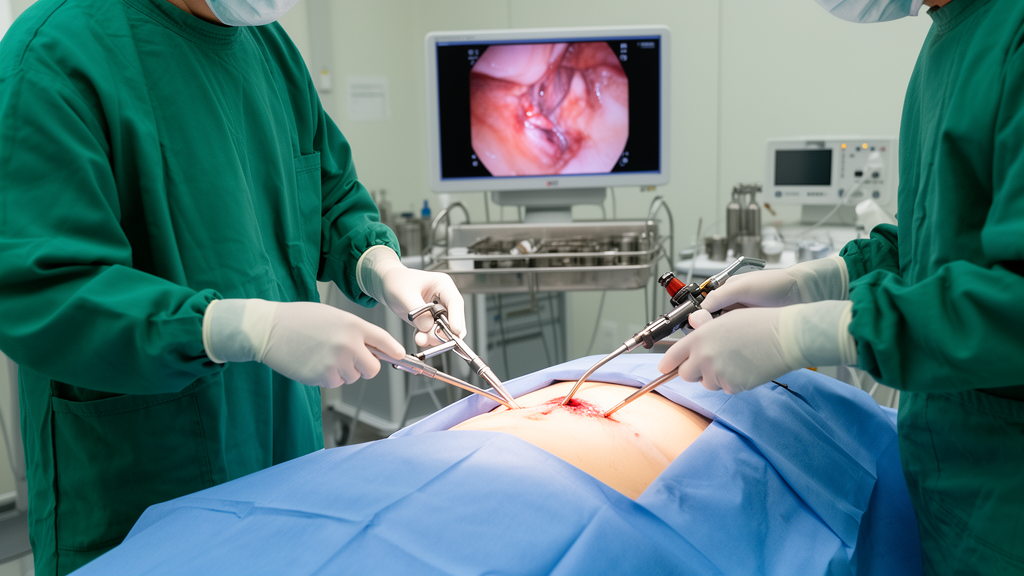
Laparoscopic intraperitoneal on-lay mesh repair with primary fascial closure, often abbreviated IPOM plus, differs from the classic IPOM technique in one crucial respect: the fascial defect is closed before mesh placement. Closing the defect restores, at least partially, the normal anatomy of the abdominal wall and reduces the size of the interface between the mesh and the viscera. In elective hernia surgery, this hybrid approach has been associated with lower rates of seroma formation and bulging compared with bridge repairs, in which the mesh spans an unclosed defect and functions as a permanent substitute for missing fascia. The physiological rationale is straightforward: a closed midline distributes intra-abdominal pressure across the repaired fascia rather than concentrating it on the mesh, and the restored line of action of the abdominal muscles may improve core function. The present study extends this concept to a population in which the fascial edges, although scarred and distorted, could still be approximated laparoscopically in every case.
The early recovery advantages observed in the laparoscopic group align with well-established principles of minimally invasive surgery. Smaller incisions cause less tissue trauma, less denervation of the abdominal wall musculature, and less disruption of the subcutaneous microcirculation, all of which contribute to reduced pain and faster mobilisation. Earlier return of bowel function, which was statistically significant in this cohort, is particularly relevant for patients who have already endured multiple laparotomies, because prolonged postoperative ileus is a common and troublesome problem after reoperative abdominal surgery. A shorter hospital stay carries additional importance in a military healthcare system operating under wartime constraints, where bed capacity, nursing resources, and the flow of newly wounded patients place a premium on efficient turnover of surgical wards. Reducing length of stay by even a few days per patient can meaningfully expand the system’s capacity to treat subsequent casualties.
The absence of surgical site infections, reoperations, and readmissions in both groups is noteworthy given the historical reputation of combat-related abdominal wounds as infection-prone. Several features of the study design may have contributed to this favourable profile. The minimum interval of six months between injury and hernia repair allowed acute inflammation, contamination, and wound healing processes to resolve completely before reconstruction. The exclusion of patients with diabetes mellitus, chronic cardiopulmonary disease, chronic kidney or liver disease, and chronic pain syndromes created an unusually homogeneous and physiologically robust cohort, dominated by young men with a mean age under forty years and a mean body mass index in the normal range. Smoking, although common and equally distributed between the groups, was the only significant modifiable risk factor retained in the population. These selection criteria, while valuable for isolating the effect of surgical technique, also limit the generalisability of the findings to older patients, obese patients, and those with multiple comorbidities, who constitute a large share of civilian ventral hernia populations.
The retrospective design and the temporal sequence of the two approaches introduce additional considerations when interpreting the results. Patients treated with open repair were operated on between September 2023 and August 2025, whereas laparoscopic repairs were performed exclusively between October and December 2025, after the technique had been introduced into clinical practice at the centre. This chronological separation means that the comparison is not randomised, and it is possible that secular changes in perioperative care, analgesia protocols, or rehabilitation pathways contributed to some of the observed differences in recovery. The surgical team’s growing experience with this challenging population over the study period may also have influenced outcomes independently of the approach used. The authors’ prior experience with laparoscopic IPOM plus in elective non-trauma patients before its adoption for post-traumatic reconstruction is an important detail, because it suggests that the technique was not learned de novo in this high-stakes setting, a point that other centres considering adoption should bear in mind.
The statistical findings warrant careful reading. Hospital stay, early pain scores on postoperative days one and two, and time to recovery of bowel function all favoured the laparoscopic group with conventional thresholds of significance. Complication rates, including seroma formation, trended in the same direction but did not reach statistical significance, a pattern that may reflect the modest sample size of thirty-three patients in the laparoscopic arm rather than a true absence of difference. With cohorts of this size, only large effects can be detected reliably, and the study was not powered to identify rarer events such as mesh-related complications, bowel injury during adhesiolysis, or late recurrence. Operative time, which did not differ significantly between groups, is a practically important observation, because it suggests that the laparoscopic approach did not impose a time penalty even in abdomens with complex post-traumatic anatomy, although adhesiolysis in such patients can be time-consuming and technically hazardous.
The choice of mesh and its placement in the intraperitoneal position raises questions that only long-term follow-up can answer. Intraperitoneal on-lay mesh must resist adhesion formation to the bowel, and coated or composite meshes are typically used for this purpose to reduce the risk of adhesions, fistula formation, and chronic pain. In young patients with an expected lifespan of several decades, the durability of the repair and the behaviour of the mesh over ten to twenty years are critical considerations that a ninety-day follow-up window cannot address. Recurrence after ventral hernia repair tends to accumulate over time, and the true test of any technique in this population will be whether the restored abdominal wall remains intact as patients return to physical activity, including the demanding physical requirements of military service. Similarly, the long-term functional outcomes, including chronic pain, abdominal wall strength, and quality of life, remain to be characterised.
The context of the study also merits attention. All patients sustained combat-related shrapnel injuries with small bowel involvement, and a substantial minority had associated liver injuries, reflecting the wound patterns seen in contemporary conflicts where explosive munitions produce multiple penetrating fragments. The exclusion of patients with major vascular or biliary tract injuries means that the cohort represents the subset of survivors whose initial damage control surgery was successful and whose injuries, although serious, did not involve the most lethal structures. The concentration of male patients reflects the demographics of combat casualties but further narrows the applicability of the findings to women, in whom abdominal wall anatomy, rectus diastasis, and pregnancy-related considerations may influence both the surgical approach and the outcomes of reconstruction.
From a broader perspective, the study contributes to an evolving conversation about whether minimally invasive techniques can be extended to increasingly complex hernia populations. Historically, large post-traumatic ventral hernias were considered the domain of open reconstruction, often involving component separation techniques such as posterior component separation with transversus abdominis release, which provides wide retromuscular mesh overlap but requires substantial dissection. The present findings suggest that, in selected patients whose fascial edges can be approximated laparoscopically, the retromuscular plane may not be a prerequisite for a sound repair, provided that the midline is restored and the mesh is positioned with adequate overlap. Whether this holds true for patients with larger defects, loss of domain, or more extensive adhesions remains an open question.
The authors’ call for prospective studies with long-term follow-up is well founded. A randomised comparison in this population would be challenging to conduct given the urgency and variability of wartime casualties, but prospective registries, standardised outcome measures, and multi-institutional collaborations among military medical centres could accumulate the evidence needed to define the role of laparoscopic IPOM plus repair more precisely. Key questions include the optimal timing of reconstruction after damage control surgery, the influence of mesh selection on long-term intraperitoneal outcomes, the effect of prehabilitation and smoking cessation on wound healing, and the functional recovery of the abdominal wall in young, active patients. Until such evidence accumulates, the present study offers a valuable signal that, in carefully selected survivors of combat abdominal trauma, laparoscopic reconstruction can achieve fascial closure reliably while sparing patients much of the morbidity associated with open reoperative surgery.
For clinicians managing similar patients, the practical implications are cautiously encouraging. The demonstration that primary fascial closure was achieved laparoscopically in every case, despite the anatomical devastation typical of post-damage control abdomens, suggests that the scarred fascial edges in these patients retain enough integrity to be approximated when the interval since injury has been sufficient. The combination of shorter hospitalisation, reduced early pain, and faster return of bowel function, achieved without an apparent increase in short-term complications, supports the consideration of laparoscopic IPOM plus repair as a legitimate option alongside open techniques. At the same time, the single-centre nature of the study, the homogeneity of the cohort, the limited follow-up, and the non-randomised design all counsel against extrapolating these results uncritically to broader populations. As with many innovations in trauma surgery, the findings from this Ukrainian military centre will need replication in larger, more diverse cohorts before they can reshape practice guidelines, but they represent a meaningful step toward expanding the reconstructive options available to patients whose survival was purchased at the cost of a disrupted abdominal wall.
Subject of Research: Surgical management of large ventral hernias following damage control surgery
Article Title: Surgical management of large ventral hernias following damage control surgery: a retrospective comparison of laparoscopic IPOM plus and open repair techniques
Article References: Smirnova, M., Herasymenko, O., Koshikov, M., Haida, Y., & Ulukhanov, A. (2026). Surgical management of large ventral hernias following damage control surgery: a retrospective comparison of laparoscopic IPOM plus and open repair techniques. Journal of Abdominal Wall Surgery, 5, Article 16917. https://doi.org/10.3389/jaws.2026.16917
Image Credits: AI Generated
Keywords: damage control surgery, ventral hernia, IPOM plus, laparoscopic repair, abdominal wall reconstruction, combat trauma, hernia repair, Surgical, management, large, ventral, hernias
Cite Scienmag News
Ophelia Keating. (October 17, 2026). Laparoscopic IPOM Plus Shows Early Advantages for Large Ventral Hernias After Damage Control Surgery. Scienmag. https://scienmag.com/laparoscopic-ipom-plus-shows-early-advantages-for-large-ventral-hernias-after-damage-control-surgery/
Ophelia Keating. "Laparoscopic IPOM Plus Shows Early Advantages for Large Ventral Hernias After Damage Control Surgery." Scienmag, 17 October 2026, https://scienmag.com/laparoscopic-ipom-plus-shows-early-advantages-for-large-ventral-hernias-after-damage-control-surgery/. Accessed 17 October 2026.
Ophelia Keating. "Laparoscopic IPOM Plus Shows Early Advantages for Large Ventral Hernias After Damage Control Surgery." Scienmag. October 17, 2026. https://scienmag.com/laparoscopic-ipom-plus-shows-early-advantages-for-large-ventral-hernias-after-damage-control-surgery/


