


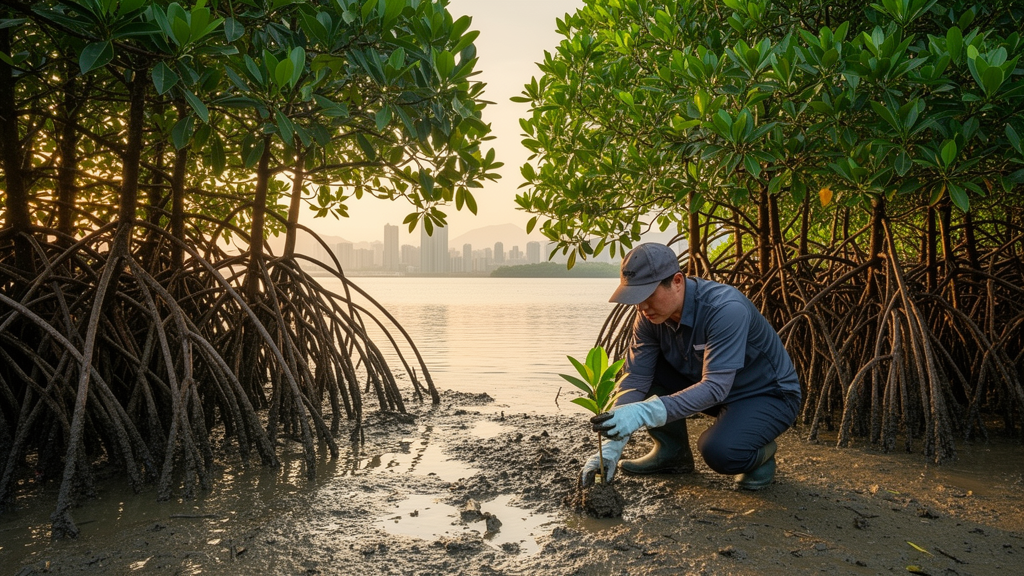
Deep in Hong Kong’s Deep Bay, where skyscrapers give way to tidal mudflats and the rustle of 60,000 migratory birds, the Mai Po Marshes have long been celebrated as one of the world’s most successful urban conservation stories. Managed by WWF Hong Kong since 1983 and protected under the Ramsar Convention, the 380-hectare reserve — 130 hectares of natural mangrove and 250 hectares of traditional tidal shrimp ponds known as gei wai — has survived the relentless pressure of one of the planet’s most densely built coastlines. But a new study published in the journal Estuarine Management and Technologies asks an uncomfortable question: is Mai Po actually regenerating itself, or is it simply being kept alive by a steady drip of institutional money and human expertise?
The answer, according to researchers who applied a novel diagnostic framework to one of the most thoroughly studied wetlands in Asia, is that Mai Po is conserved but not regenerated. The reserve’s remarkable ecological productivity — among the highest of any coastal wetland ever measured — is sustained not by ecological self-sufficiency but by what the authors call a partial monetary counterflow: money generated by the ecosystem flows back into the system, but almost none of it returns directly to the mangrove forest that produces the wealth in the first place.
To reach this conclusion, the research team turned to a method that most conservation finance discussions have ignored for decades: emergy analysis. Developed by systems ecologist Howard Odum, emergy accounting converts every flow entering an ecosystem — sunlight, rainfall, waves, tides, sediments, human labor, infrastructure, government budgets, tourism revenue — into a single common unit called the solar emjoule (sej). This allows scientists to compare the true productive capacity of nature with the economic value humans extract from it, something conventional market-based valuations systematically fail to do because they cannot price non-market services like carbon sequestration, pollutant filtration, or the biogeochemical cycles that quietly underpin everything else.
Applying this framework to Mai Po using the only comprehensive emergy evaluation of the site, conducted by Qin and colleagues in 2000, the study confirmed extraordinary figures. The total emergy flowing through the system is 26.39 × 10¹⁷ sej per year, with an emergy density of 6.94 × 10¹¹ sej per square meter per year — placing Mai Po among the most energetically intensive coastal wetlands on Earth. The Investment Ratio, which measures how much economic input is needed relative to free natural flows, came in at just 0.48, meaning nature does most of the heavy lifting. The Environmental Loading Ratio, which reflects anthropogenic stress, stood at 1.03 — moderate but nonzero, a reminder that even a protected urban wetland carries the fingerprints of the city around it.
But the most striking finding was not about mangroves at all. It was about people. When the researchers quantified the reserve’s educational function — the guided tours, the research programs, the visitor center, the environmental outreach — they found its emergy value reached 125.65 × 10¹⁷ sej per year, nearly five times the emergy of the natural system itself. And within that educational function, a staggering 92 percent of the emergy investment — 99.26 × 10¹⁷ sej per year — was attributed not to buildings or equipment but to the accumulated knowledge, training, and experience of just 17 reserve staff members. In other words, the single most valuable regenerative asset at Mai Po is not a tree, a sediment bank, or a hydrological channel. It is human expertise.
This is where the study introduces its central conceptual innovation: the monetary counterflow model. Building on Odum’s observation that economic flows tend to move in the opposite direction to energy flows, the researchers added a normative twist — true sustainability, they argue, requires that money not merely oppose the flow of energy but return proportionally and directly to the ecological source that generated it. To operationalize this idea, they proposed a new diagnostic indicator called the Net Monetary Flow Rate, or NMFR, which subtracts the estimated cost of environmental degradation from the amount of money actually reinvested in conservation. Crucially, the model distinguishes between direct regenerative reinvestment — mangrove replanting, sediment replenishment, hydrological restoration — and indirect support such as salaries, infrastructure, and education programs. Only the former counts as a true counterflow to natural capital.
Running the numbers, the study found that Mai Po’s NMFR is positive: approximately +634,000 US dollars per year, based on reinvestment flows of about 834,000 US dollars annually against an estimated environmental degradation cost of roughly 200,000 US dollars. On the surface, this looks like good news — the system receives more money than it loses to environmental pressure. But the destination of that money tells a different story. The financial return flows overwhelmingly to reserve management, staff payments, infrastructure, and environmental education programs. Only a small fraction ever reaches the mangrove forest itself as active ecological restoration. The energy flows from sun and tide into mangrove, from mangrove into birdlife and fisheries, from the ecosystem into the visitor center. The money flows back from tourists and government into the visitor center, into management, into education. The loop between ecological production and ecological regeneration is never closed.
The researchers describe this as a system that is
Subject of Research: The monetary counterflow. A regenerative model for estuarine ecosystems
Article Title: The monetary counterflow. A regenerative model for estuarine ecosystems
Article References: Carvalho Junior, O. (2025). The monetary counterflow. A regenerative model for estuarine ecosystems. Estuarine Management and Technologies, 2, 87-100. https://doi.org/10.3897/emt.2.169780
Image Credits: AI Generated
DOI: 10.3897/emt.2.169780
Keywords: monetary, counterflow, regenerative, model, estuarine, ecosystems, scientific research
Cite Scienmag News
Denise Maddox. (October 17, 2026). Money Flows Backward: Why Hong Kong’s Mangroves Survive on Stewardship, Not Self-Renewal. Scienmag. https://scienmag.com/money-flows-backward-why-hong-kongs-mangroves-survive-on-stewardship-not-self-renewal/
Denise Maddox. "Money Flows Backward: Why Hong Kong’s Mangroves Survive on Stewardship, Not Self-Renewal." Scienmag, 17 October 2026, https://scienmag.com/money-flows-backward-why-hong-kongs-mangroves-survive-on-stewardship-not-self-renewal/. Accessed 17 October 2026.
Denise Maddox. "Money Flows Backward: Why Hong Kong’s Mangroves Survive on Stewardship, Not Self-Renewal." Scienmag. October 17, 2026. https://scienmag.com/money-flows-backward-why-hong-kongs-mangroves-survive-on-stewardship-not-self-renewal/


