


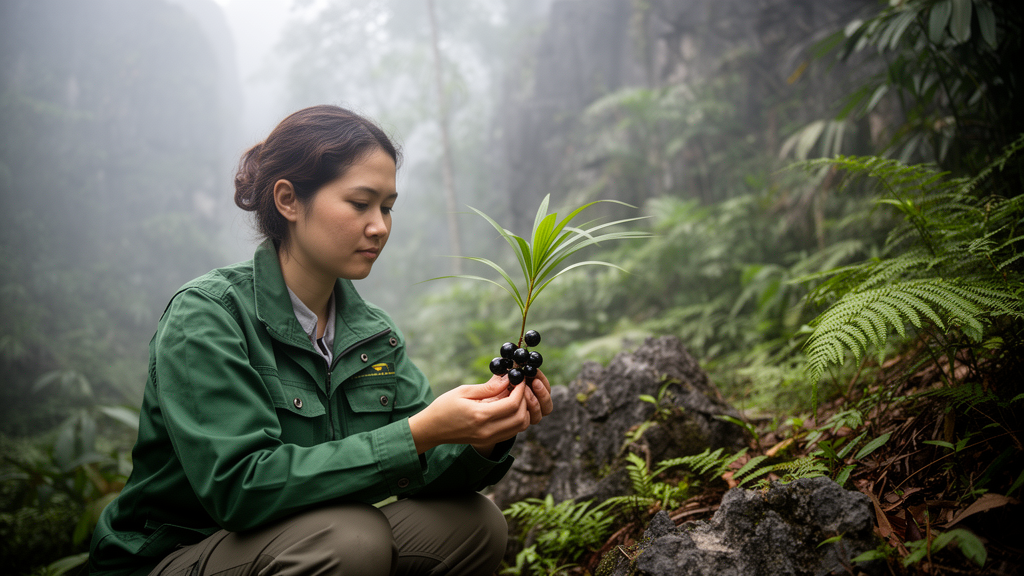
Deep in the primary evergreen broad-leaved forests of Lao Cai Province in northern Vietnam, botanists have identified a palm so unusual that its discovery required both field surveys across the China–Vietnam border region and a full molecular workup in the laboratory. The new species, named Lanonia nhatii in honor of its first discoverer, Mr. Trieu Van Nhat, is described in the journal PhytoKeys together with a significant range extension for another recently published palm, Lanonia yangchunensis, now recorded roughly 400 kilometers from its original locality in Guangxi Zhuang Autonomous Region, southwestern China. Together, the two findings reshape what scientists know about one of Asia’s most distinctive understory palm genera.
Lanonia belongs to the palm family Arecaceae, subfamily Coryphoideae, subtribe Livistoninae, and currently comprises 21 species distributed across China, Vietnam, Laos, and Indonesia. The genus was carved out of the once-broad genus Licuala in 2011, when a molecular phylogenetic study by Henderson and Bacon showed that species formerly placed in Licuala did not form a single monophyletic lineage; eight of them were segregated to constitute Lanonia. Recent phylogenomic analyses have reinforced that separation, demonstrating that Lanonia and Licuala are only distantly related despite sharing wedge-shaped leaf segments with reduplicate margins. Lanonia can usually be told apart by its dioecious sexual system, dimorphic inflorescences, leaves whose central segment splits to the apex of the costa, and a costa bearing an abaxial pulvinus, although exceptions to nearly every one of these characters have now been documented.
That is precisely what makes L. nhatii so remarkable. The species stands apart from all of its congeners by two diagnostic features: an extremely short costa, the main axis of the leaf blade that represents the petiole’s extension into the blade, and purplish-black mature fruits. In L. nhatii the costa measures just 0.1 to 0.3 centimeters long, a near-total absence of a structure that is prominent in many relatives. The slender central segments and elongate inflorescences add two further rare traits within the genus. The plant is perennial and dioecious, with stems 66 to 295 centimeters long, 13 leaves per stem on average, petioles reaching up to 125 centimeters, and leaf blades roughly 42 centimeters long and 72 centimeters wide carrying about 20 equal segments. Staminate inflorescences stretch to nearly 150 centimeters with 4 to 7 partial inflorescences branched to 3 or 4 orders, while pistillate inflorescences are reduced to a single partial inflorescence bearing solitary flowers. Flowering occurs from January to February, with fruits ripening in October and November.
To confirm that this morphologically odd palm truly represented a distinct lineage, the research team sequenced seven molecular markers, four nuclear loci (CISP4, CISP5, MS, and RPB2) and three plastid loci (matK, ndhF, and trnD-trnT), yielding 47 novel sequences. Leaf tissue came from three individuals of the undescribed species and four mature individuals of L. yangchunensis exhibiting different leaf forms, from undivided through bifid, quadrifid, and hexafid. DNA was extracted using the CTAB method, and the phylogenetic framework drew on 438 sequences from 70 species across the six genera of Livistoninae, rooted with Serenoa repens as the outgroup. Sequences were aligned with MAFFT, trimmed with trimAl, and partitioned under the Bayesian information criterion with ModelFinder before maximum likelihood inference in IQ-TREE with 1,000 bootstrap replicates and Bayesian inference in MrBayes across two million generations.
The statistical support was unambiguous. L. nhatii sits within Lanonia in a clade with 100 percent maximum likelihood bootstrap and a Bayesian posterior probability of 1.00, and it is sister to L. calciphila, its closest relative. Beyond the two headline diagnostic characters, the new species differs from L. calciphila and L. yunnanensis by a combination of leaves with numerous, approximately equal segments, papery ligules that do not disintegrate into fibers, a greater number of staminate partial inflorescences, and greenish-yellow sepals, petals, and rachillae. The species is known only from Chieng Ken Commune in Lao Cai Province, where it grows in primary evergreen broad-leaved forest and also in bamboo forest at elevations between 550 and 670 meters above sea level.
The second discovery concerns L. yangchunensis, first described in early 2026 from Ehuangzhang Provincial Nature Reserve in Yangchun, Guangdong Province, China. During field investigations along the Sino-Vietnamese border in 2024, the team encountered a peculiar palm population whose remarkably wide variation in leaf morphology made it impossible to say at first whether it represented one species or several. After careful comparison of floral characters, individuals with undivided and bifid leaves were verified to correspond to L. yangchunensis. Populations were then found near the border in Fangchenggang City, southwestern Guangxi, roughly 400 kilometers from the type locality, growing in the understory of montane evergreen broad-leaved forests and bamboo forests at elevations of 50 to 900 meters.
Phylogenetic analysis settled the question of the leaf forms. Four mature individuals bearing undivided, bifid, quadrifid, and hexafid leaves all clustered into a single monophyletic clade with 100 percent bootstrap and a posterior probability of 1.00, confirming that all these leaf forms belong to one species. In Guangxi, multiple leaf morphotypes co-occur within each population and fall into three groups: the central segment undivided, the central segment divided but without a petiolule, and the central segment divided with a petiolule. One individual with a pinnate central segment and another with a divided central segment but a continuous costa were found as exceptions, and some mature individuals consistently produce asymmetric leaves with unequal numbers of lateral segments on either side of the central segment. The supplementary description now provided, based on wild populations in Guangxi, documents stems that are subterranean and elliptic in cross-section, dark purple flowers, and red ellipsoid fruits, characters not covered in the original protologue drawn from a single Guangdong population.
Pollen morphology added a further layer of evidence. Using scanning electron microscopy, the team found that pollen grains of L. nhatii are monads, monocolpate, and long-elliptical, with a polar axis averaging 25.61 micrometers, an equatorial axis of 16.11 micrometers, and a tectate exine with foveolate ornamentation whose circular lumina average 0.26 micrometers in diameter. Pollen of L. yangchunensis is smaller, with a polar axis of 21.34 micrometers, nearly round in polar view, and carries a tectate exine with reticulate ornamentation bearing microperforations on both lumina and muri, the muri granulate on their surface. Palm pollen is generally conserved, so these differences carry taxonomic weight. The foveolate exine of L. nhatii distinguishes its pollen from all four pollen types summarized for the related genus Licuala, while the reticulate-perforate tectum of L. yangchunensis appears to be an intermediate form. No shared pollen characters representative of the genus Lanonia have yet been identified between the two species, leaving open whether exine sculpture can serve as a genus-level distinguishing feature from Licuala.
The sexual dimorphism of L. nhatii itself proved to be occasionally ambiguous. In some male individuals, the pistillode, the vestigial female structure within the staminate flower, was found to expand significantly after anthesis and develop into an immature fruit. One inflorescence specimen showed a branching pattern more similar to male inflorescences in the number of partial inflorescences and rachillae, yet its overall length was closer to that of female inflorescences, and immature fruits developed on every partial inflorescence. Such anomalies blur the boundary between the two sexes in a genus defined by dioecy, and they echo the broader pattern of exceptions already documented in Lanonia, including species with unsplit central segments, continuous costae, monomorphic inflorescences, and hermaphrodite flowers.
For conservationists and palm enthusiasts alike, the implications are considerable. L. nhatii is known from a single commune in northern Vietnam, a distribution that leaves it vulnerable to habitat change, while the Guangxi populations of L. yangchunensis reveal that a species assumed to be narrowly endemic to Guangdong is in fact far more widespread, with a wider elevational range and a stable set of leaf morphotypes that coexist within single populations. The study also demonstrates, once again, that accurate differentiation between Lanonia and Licuala relies on both morphology and molecular analysis, a lesson that field surveys of indigenous palms along the China–Vietnam border are proving in real time. With 21 species now recognized and new morphological characters still surfacing, Lanonia is emerging as one of the most dynamic understory palm genera in Southeast Asia, and the forests of northern Vietnam and southwestern China are clearly still keeping secrets.
Subject of Research: New discoveries of Lanonia ( Arecaceae ) from northern Vietnam and southwestern China
Article Title: New discoveries of Lanonia ( Arecaceae ) from northern Vietnam and southwestern China
Article References: Qin, J.-W., Tian, Z.-L., Chen, Z.-S., Nguyen, K. S., & Kuang, R.-P. (2026). New discoveries of Lanonia (Arecaceae) from northern Vietnam and southwestern China. PhytoKeys, 279, 137-154. https://doi.org/10.3897/phytokeys.279.207204
Image Credits: AI Generated
DOI: 10.3897/phytokeys.279.207204
Keywords: discoveries, Lanonia, Arecaceae, northern, Vietnam, southwestern, China, scientific research
Cite Scienmag News
Margaret Porter. (October 17, 2026). New Palm Species With Tiny Leaf Axis and Black Fruit Found in Vietnam. Scienmag. https://scienmag.com/new-palm-species-with-tiny-leaf-axis-and-black-fruit-found-in-vietnam/
Margaret Porter. "New Palm Species With Tiny Leaf Axis and Black Fruit Found in Vietnam." Scienmag, 17 October 2026, https://scienmag.com/new-palm-species-with-tiny-leaf-axis-and-black-fruit-found-in-vietnam/. Accessed 17 October 2026.
Margaret Porter. "New Palm Species With Tiny Leaf Axis and Black Fruit Found in Vietnam." Scienmag. October 17, 2026. https://scienmag.com/new-palm-species-with-tiny-leaf-axis-and-black-fruit-found-in-vietnam/


