


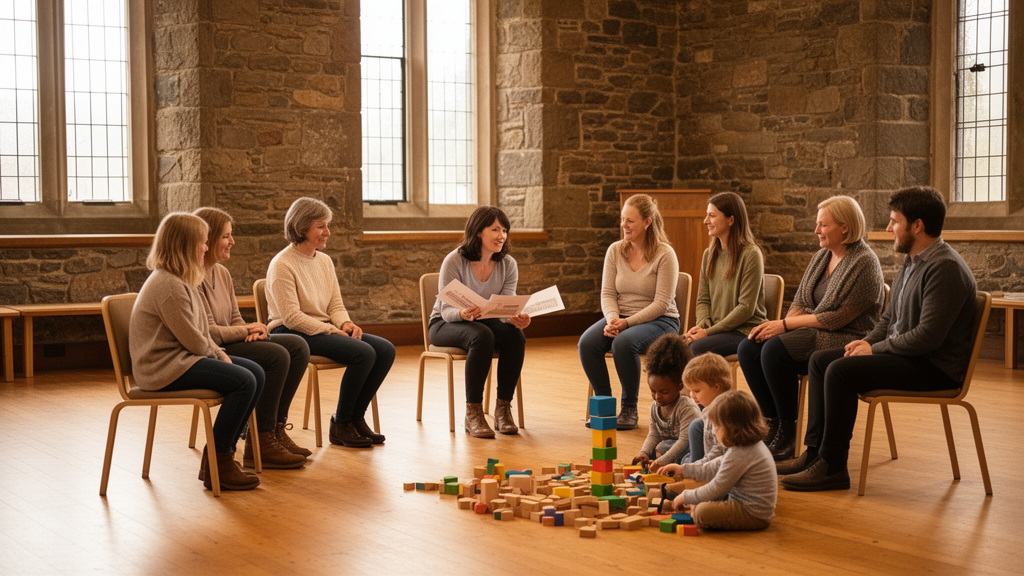
In a former slate-mining community in North Wales, ten mothers sat down with an independent researcher and described what had changed in their homes after twelve weeks of a parenting programme that was never originally designed for them. The programme, called Parenting for Lifelong Health for Young Children, or PLH-YC, was developed as a low-cost, evidence-based intervention for families in low- and middle-income countries, where licensed parenting programmes from high-income nations are often too expensive to deliver. Yet as UK funding for early intervention services has fallen while demand has risen, researchers at Bangor University piloted the programme in two socioeconomically disadvantaged Welsh communities. The results, published in Frontiers in Developmental Psychology, suggest that a parenting intervention built for the global south may have something to offer struggling families in Britain.
The quantitative feasibility findings had already been encouraging. Across three groups, twenty parents were recruited and seventeen provided pre- and post-course data. Retention was high at 85 percent, with parents attending on average 8.7 of the twelve sessions. Baseline assessment showed elevated levels of dysfunctional parenting practices and child behavior difficulties, with parenting scores above the mean for parents of children with behavioral problems and child conduct problems and hyperactivity scores within the clinical range on the Strengths and Difficulties Questionnaire. After the programme, analyses showed significant improvements in parenting practices, particularly reductions in over-reactivity and verbosity, along with large reductions in stress related to managing a difficult child. The new qualitative study, a masters project by the second author, set out to explore how ten of the eleven parents recruited at one center actually experienced the programme and whether any further adaptation was needed.
The programme itself is grounded in the Hanf two-stage model of parenting interventions, a well-established behavioral framework. It runs as twelve weekly group sessions covering core parenting skills in a deliberate sequence: first activities to promote positive child behavior, then limit-setting and discipline strategies. Parents learn to spend one-on-one time with their children, name feelings and actions, use praise and rewards, give clear and positive instructions, establish household rules, redirect negative behaviors, ignore attention-seeking and demanding behaviors, apply realistic consequences, and problem-solve. Sessions also include brief mindfulness-based stress management activities. Rather than relying on dense manuals, the programme uses illustrated comic-strip stories showing examples of parent and child behaviors, originally developed for a randomized controlled trial in South Africa and adapted for a large European trial. Facilitators make mid-week phone calls to encourage engagement, and the programme is delivered collaboratively through discussion and role-play with weekly home activities.
Adaptation for Wales was intentionally minimal. The original version was written in English by a UK-based author, and the stories had already been adapted for a European trial, so the Welsh version required only culturally relevant names, language, and examples. The content, sequence of sessions, collaborative delivery process, and underlying behavioral principles remained unchanged to maintain fidelity. The programme was delivered by an experienced facilitator along with two community workers from a Barnardo’s-funded community center, all of whom completed a three-day accredited training course delivered by a certified PLH trainer. Fidelity was monitored through facilitator checklists, attendance records, and weekly supervision with the trainer, including review of videotaped group footage. The center provided childcare whilst parents attended sessions.
Semi-structured interviews were conducted face-to-face by an independent researcher during home visits, within six weeks of course completion, and lasted between ten minutes and half an hour. The interviews covered five areas drawn from informal parent feedback and discussions with parenting professionals: the usefulness of the programme, the most helpful content and delivery strategies, challenges experienced during attendance, the impact on parenting behavior, and possible improvements. Interviews were recorded, transcribed verbatim, and anonymised. Coding was carried out manually in Excel by the first author, with themes discussed and confirmed by the third author until disagreements were resolved. Using Braun and Clarke’s six-phase thematic analysis, three major themes emerged: learning to parent differently, creating a circle of support, and wanting more time.
The first theme captured concrete changes in parenting practices. Seven participants reported being more emotionally aware in their parenting, which they described as leading to fewer child tantrums, calmer household interactions, and improved child emotional expression. One mother explained how the programme helped her sit her daughter down during a meltdown to explain emotions, noting that whilst they still argue, it is a lot better. Parents described being able to redirect thoughts and behaviors, let things go, apologize to their children, and explain their emotions to them. Clearer house rules and routines were perceived as contributing to improved child behavior and reduced conflict, with one participant noting that her stress levels, which normally would be pulling her hair out by that time of day, had lessened. Tools like redirecting negative behaviors, one-to-one time, and positive instructions were found particularly effective by six of the ten participants, and the concept of spending one-to-one time with their child was a new and impactful idea for some. The illustrated stories and stress management exercises were described as easy to understand and really useful.
The second theme highlighted the group setting as a significant strength. Six of the ten participants mentioned enjoying being able to socialize with other parents, which made them feel less alone or affirmed that they were on the right path in parenting. Shared experiences helped normalize challenges and created a space where parents could learn from one another without judgement. Group discussions, facilitated by experienced leaders, were described as honest and comforting, with seven participants specifically noting their value for collaboration, problem-solving, and sharing tips. One participant said the problem-solving was really good because you sat in the group and could hear other people’s experiences, what worked for them and what didn’t. Participants also valued the accessibility of the facilitators, who were available for phone calls or texts during the week, and described them as brilliant and excellent.
The third theme was almost entirely about session length. The sessions were scheduled to run for two hours, and feedback was varied, with some participants reporting that certain sessions felt rushed given the amount of content. Nine of the ten participants wanted either more or longer sessions, with suggestions including adding half an hour, extending the course to elaborate more or concentrate on one aspect per week, or adding refresher sessions and recaps at the end of sessions to better digest the weekly theme. The authors interpret this as a desire for deeper engagement and more time to practice skills rather than dissatisfaction, pointing to the programme’s success in building parental confidence and a wish for further skill development.
The discussion situates these findings within a broader UK context. Early intervention support for families experiencing socioeconomic disadvantage drove policy in the 2000s through the Sure Start programme, which initially struggled to recruit and retain disadvantaged families but, once the importance of evidence-based programmes delivered with fidelity was appreciated, showed positive subsequent impact with ten-year outcomes reporting significant improvements in educational attainment, conduct disorder, and attention-deficit hyperactivity disorder, with the greatest improvements for children from low socioeconomic and ethnic minority backgrounds. However, the commercially available parenting programmes used within Sure Start were expensive to deliver, which is precisely what motivated the development of the open-source PLH suite. The need is acute: since COVID, 33 percent of children starting school in the UK in 2022/23 lacked essential school readiness skills, rising to 45 percent among socially disadvantaged children, with persistent disruptive behavior the most common reason for subsequent school exclusion.
The authors acknowledge significant limitations. The small sample size, lack of control group, and focus on a single geographic area limit generalisability. Interview participants were all mothers who completed the programme and may have been more positively disposed toward the intervention than those who attended fewer sessions, and the self-reported findings may be influenced by desirability bias. There is also no longer-term follow-up in the present sample, and systematic reviews suggest that although parenting programmes often produce immediate improvements, these effects tend to diminish at follow-up assessments conducted one to twenty-four months later, highlighting the importance of longer-term evaluation and potentially ongoing support such as booster or refresher sessions. A more rigorous trial incorporating a control group or comparison with a well-established UK programme is needed before the programme could be recommended for wider implementation. Nevertheless, the consistency between the qualitative experiences and the quantitative improvements documented in the feasibility trial provides a justification for that more rigorous evaluation. With 97 percent of sessions rated as very helpful in the quantitative feedback, high retention, and no specific content or process adaptations required for further use in Welsh or potentially UK settings, the PLH-YC Caring Families programme represents a promising, low-cost, evidence-based approach to supporting families and promoting positive child mental health trajectories in disadvantaged communities across the UK.
Subject of Research: Parenting intervention research
Article Title: The Parenting for Lifelong Health Caring Families programme with parents of young children in North Wales: a qualitative study of participant feedback
Article References: DeLuca, C., Lunt, J., & Hutchings, J. (2026). The Parenting for Lifelong Health Caring Families programme with parents of young children in North Wales: a qualitative study of participant feedback. Frontiers in Developmental Psychology, 4, Article 1795251. https://doi.org/10.3389/fdpys.2026.1795251
Image Credits: AI Generated
DOI: 10.3389/fdpys.2026.1795251
Keywords: parenting, child mental health, PLH-YC, Wales, thematic analysis, social disadvantage, early intervention, Lifelong, Health, Caring, Families, programme
Cite Scienmag News
Glenn Wilkins. (October 17, 2026). A Parenting Programme Born in the Global South Is Now Helping Families in North Wales. Scienmag. https://scienmag.com/a-parenting-programme-born-in-the-global-south-is-now-helping-families-in-north-wales/
Glenn Wilkins. "A Parenting Programme Born in the Global South Is Now Helping Families in North Wales." Scienmag, 17 October 2026, https://scienmag.com/a-parenting-programme-born-in-the-global-south-is-now-helping-families-in-north-wales/. Accessed 17 October 2026.
Glenn Wilkins. "A Parenting Programme Born in the Global South Is Now Helping Families in North Wales." Scienmag. October 17, 2026. https://scienmag.com/a-parenting-programme-born-in-the-global-south-is-now-helping-families-in-north-wales/


