


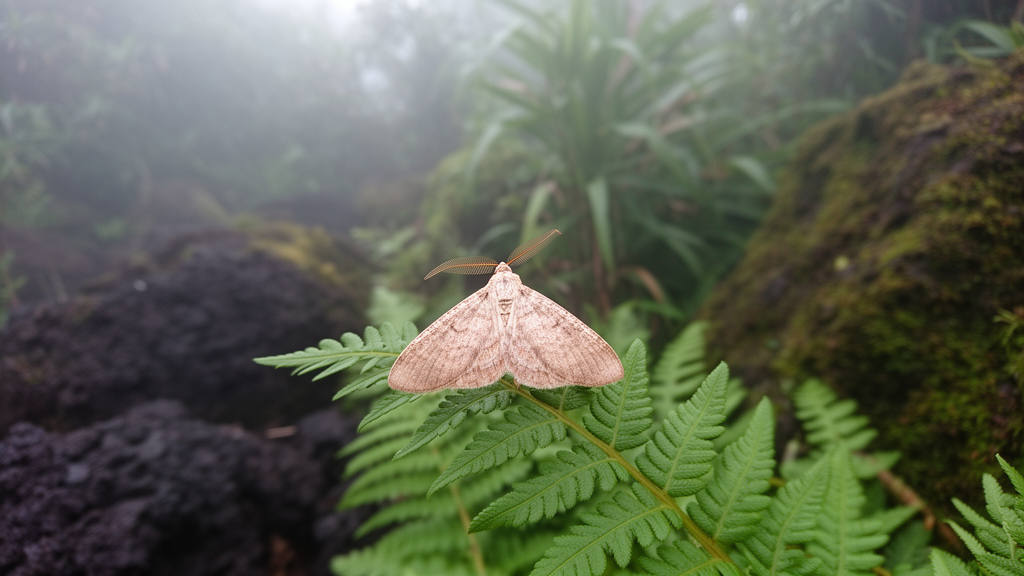
Deep in the subtropical forests of Hahajima, one of Japan’s most remote oceanic islands, entomologists have uncovered a moth that nobody knew existed. The insect, now formally named Morophaga hahajimana, belongs to a genus never before recorded anywhere in the Oceanian region, and its discovery is forcing scientists to rethink how these tiny fungivorous moths reached some of the most isolated islands on Earth.
The Ogasawara Islands, also known as the Bonin Islands, lie roughly 1,000 kilometers south of Tokyo in the Pacific Ocean. Because they are true oceanic islands, formed by volcanic activity rather than continental drift, their plants and animals arrived by long-distance dispersal across open water. This has produced a biota that is strikingly different from that of mainland Japan, with many species found nowhere else. Around 270 species of moths have been recorded from the archipelago, but knowledge of detritivorous microlepidopterans, particularly the family Tineidae, remains fragmented.
The genus Morophaga currently includes 17 described species and is known from the Palearctic, Afrotropical, Oriental, and Australian regions, but it had never been recorded from the New World or the Oceanian region. All species of Morophaga are fungivorous, and some feed on bark covered with fungi. This dietary habit makes some species a pest in shiitake mushroom cultivation, giving the genus economic as well as scientific significance. In Japan, six species had been reported prior to this study, distributed among the bucephala, choragella, and sistrata species groups.
During fieldwork on the Ogasawara Islands, researchers collected specimens using LED UV lamps and mercury lamps at night, a light flight interception trap, and by rearing larvae from their fungal hosts. Collected fungi and rotten wood containing larvae were stored in sealed food storage bags at room temperature until adults emerged. The specimens were dissected and examined under a stereomicroscope, with abdomens boiled in a 10% KOH solution for approximately 10 minutes to prepare male and female genitalia for study. Wing venation was also observed after careful preparation, with detached wings descaled, stained with mercurochrome solution, dehydrated through serial ethanol dilutions, and mounted in Euparal on glass slides.
To infer phylogenetic relationships and identify closely related species, DNA was extracted from adult specimens of the new species, Morophaga formosana, Morophaga fasciculata, and Erechthias zebrina as an outgroup. The partial mitochondrial cytochrome c oxidase subunit I gene, the standard DNA barcode region of 658 base pairs, was amplified using the primers LCO1490 and HCO2198. Sequences were purified, cycle-sequenced, and analyzed in MEGA 11, where a general time-reversible model with a discrete gamma distribution was selected as the best substitution model. Branch support was calculated using 1,000 bootstrap replicates, and COI sequences were searched against the BOLD identification system to find closely related species.
The results were remarkable. The researchers identified two Morophaga species on the islands. One matched Morophaga formosana, a species previously known from Japan, Korea, China, and Taiwan. The other did not match any known species and is now described as Morophaga hahajimana sp. nov. This is the first record of the genus Morophaga from the Oceanian region, extending the known distribution of the genus across a major biogeographic boundary.
The new species is exteriorly similar to Morophaga choragella, but can be distinguished by the brown coloring of the anterior half of the basal third of the forewing, where M. choragella shows only a small spot. In the male genitalia, the gently concaved uncus, the undivided ventral margin of the valva with tough basal bristles, and the phallus bearing two or three lobate carinae further separate the two species. The genitalia are similar to those of M. fasciculata and M. plana, but the new species has a rectangular valva without deep emargination, a tighter and weakly concaved ostium, and a relatively short ductus bursae in the female genitalia.
The biology of the new species is equally intriguing. Larvae bore into white fungi of the family Polyporaceae and feed on them. Two male specimens also emerged from fungi growing on mossy bark on Mt. Sakaiga-take, but these adults were notably small, with forewing lengths of 6.0 and 6.6 millimeters, compared with 8.5 to 9.7 millimeters in other males. This suggests that food quality or quantity may influence body size in this species. A few adults were collected in June using light traps, indicating that the species is on the wing during early summer.
DNA barcoding revealed striking genetic distances. The intraspecific pairwise distances of the new species ranged from 0.15% to 0.31%, while distances between the new species and Morophaga formosana ranged from 9.47% to 10.86%. The BOLD identification system yielded no similar sequences for the new species, with the best identification being no match. The preliminary maximum likelihood and maximum parsimony trees showed that the new species is sister to M. fasciculata, suggesting it belongs to the choragella species group. However, the new species lacks the hook-shaped articulated process in the valva that is considered a conspicuous autapomorphy of that group, leaving its exact phylogenetic position an open question.
The discovery also raises broader questions about the genus itself. The preliminary phylogenetic tree indicated non-monophyly of Morophaga, with the genus emerging as paraphyletic to Diataga and Amorophaga, although bootstrap values were below 75%. The new species emerged from Polyporaceae fungi that are widely found on the Ogasawara Islands, including on Chichijima, Mukojima, and Nakodojima, but only M. formosana was collected from those islands. This non-overlapping distribution pattern may have been caused by the geographic origin and invasion route of the genus, but further research is required to confirm this. For now, the tiny moth of Hahajima stands as a reminder that even well-studied archipelagos can still yield surprises, and that the smallest insects often carry the biggest biogeographic stories.
Subject of Research: First record of the genus Morophaga Herrich-Schäffer ( Lepidoptera , Tineidae ) from the Ogasawara Islands, Japan, with a new species
Article Title: First record of the genus Morophaga Herrich-Schäffer ( Lepidoptera , Tineidae ) from the Ogasawara Islands, Japan, with a new species
Article References: Park, J., Yagi, S., & Hirowatari, T. (2025). First record of the genus Morophaga Herrich-Schäffer (Lepidoptera, Tineidae) from the Ogasawara Islands, Japan, with a new species. Nota Lepidopterologica, 48, 215-228. https://doi.org/10.3897/nl.48.143817
Image Credits: AI Generated
DOI: 10.3897/nl.48.143817
Keywords: First, record, genus, Morophaga, Herrich-Sch, ffer, Lepidoptera, Tineidae, Ogasawara, Islands, Japan, species
Cite Scienmag News
Gavin Prescott. (October 17, 2026). New fungivorous moth species discovered on remote Japanese islands. Scienmag. https://scienmag.com/new-fungivorous-moth-species-discovered-on-remote-japanese-islands/
Gavin Prescott. "New fungivorous moth species discovered on remote Japanese islands." Scienmag, 17 October 2026, https://scienmag.com/new-fungivorous-moth-species-discovered-on-remote-japanese-islands/. Accessed 17 October 2026.
Gavin Prescott. "New fungivorous moth species discovered on remote Japanese islands." Scienmag. October 17, 2026. https://scienmag.com/new-fungivorous-moth-species-discovered-on-remote-japanese-islands/


