


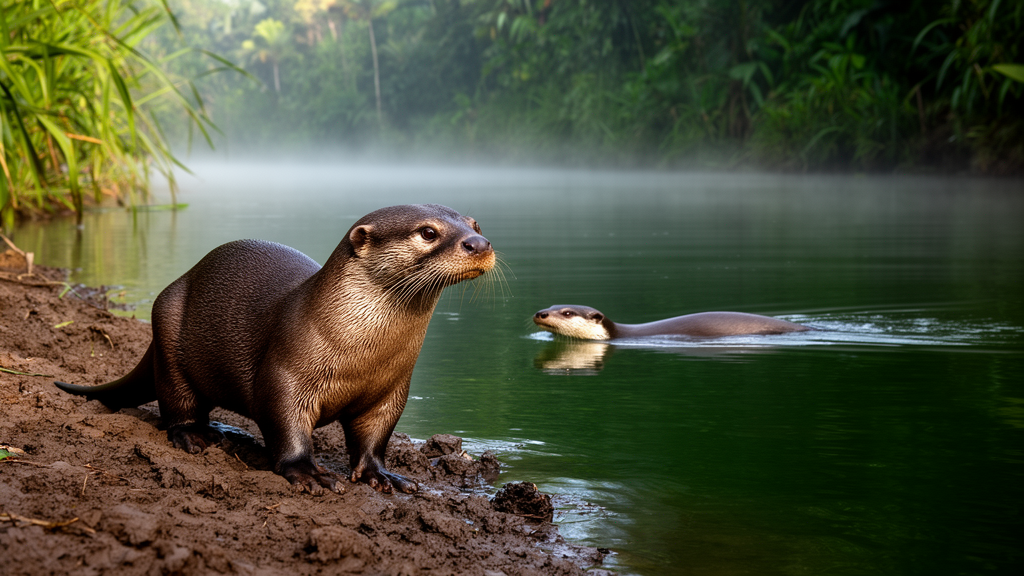
Deep in Brazil’s Pantanal, the world’s largest Neotropical wetland, two otter species glide through waters that scientists are only beginning to understand. Now, a research team has pulled back the curtain on the hidden parasites living inside these charismatic carnivores, revealing an intricate web of ecological interactions that could prove critical for their survival. The study, published in Frontiers in Mammal Science, examined the giant otter (Pteronura brasiliensis) and the Neotropical otter (Lontra longicaudis), two apex predators whose health reflects the condition of the aquatic ecosystems they inhabit. What the researchers found was striking: parasites were present in more than 81 percent of the giant otter fecal samples analyzed, and the team recovered helminth specimens from every carcass examined. Even more remarkably, the study produced the first-ever DNA sequences for two digenean parasite species, Alaria clathrata and Cryptocotyle thapari, filling a major gap in the genetic record of South American wildlife parasites.
Otters are semiaquatic carnivores of the Mustelidae family that sit at the top of aquatic food chains. In Brazil, the giant otter and the Neotropical otter coexist in some areas, though their conservation statuses differ dramatically. Giant otters, among the largest carnivores in South America, are social animals classified globally as Endangered by the International Union for Conservation of Nature, whereas the solitary and smaller Neotropical otter is considered Near Threatened. The giant otter’s geographic distribution was significantly reduced in the past due to hunting driven by the pelt trade, and many populations have yet to recover. Neotropical otters, by contrast, are found widely across Brazil, inhabiting most regions with suitable freshwater bodies. Both species now face mounting threats from habitat loss and degradation, water contamination, human conflict, and climate change, making the need to understand their health dynamics increasingly urgent.
Between February 2020 and November 2021, the research team collected a total of 42 fecal samples and four carcasses, three giant otters and one Neotropical otter, from four locations in the Pantanal Ecoregion: Aquidauana, Corumbá, and Miranda in Mato Grosso do Sul state, and Poconé in Mato Grosso state. The Pantanal covers 179,300 square kilometers, spanning Brazil, Bolivia, and Paraguay, and harbors significant populations of giant otters. Feces were found during river-field expeditions, either through direct observation of otters using latrines or indirectly by detecting the characteristic odor of giant otter excreta. Only fresh samples were collected, each stored in labeled tubes containing 10 percent buffered formaldehyde solution and kept at room temperature until shipment to the laboratory.
To detect endoparasites, the team employed two classic coproparasitological techniques: the Willis–Mollay flotation method and a sedimentation technique. Flotation uses a density gradient solution to separate parasite eggs and oocysts from fecal debris, allowing lighter eggs to rise to the surface for microscopic identification, while sedimentation concentrates heavier eggs that may not float effectively. Photomicrographs and measurements of oocysts and eggs were obtained using an Olympus BX-51 microscope equipped with a digital camera, with measurements expressed in micrometers as arithmetic means with standard deviations. Prevalence data were expressed as percentages, and 95 percent confidence intervals for giant otters were calculated using the Wilson score method without continuity correction. Confidence intervals were not calculated for Neotropical otters due to the small sample size of only four fecal samples.
The results revealed a high prevalence of parasitic infection. Of the 38 giant otter fecal samples analyzed, 31, or 81.6 percent, tested positive for at least one parasite, with a 95 percent confidence interval ranging from 58.7 to 85.1 percent. Digenean eggs were detected in 28 of the 38 samples, making them by far the most common parasite type found. Additionally, one sample showed co-infection with digeneans and strongylid-type eggs, another with digeneans and ascarids, and one was positive for digeneans, strongylid-type, and ascarid eggs simultaneously. The digenean eggs measured 34.5 micrometers in length and 21.6 micrometers in width on average, while ascarid eggs were 60 micrometers long and 46.2 micrometers wide, and strongylid-type eggs were 76.6 micrometers long and 43.3 micrometers wide.
In the Neotropical otter fecal samples, two of the four tested positive for parasitic infections: one for strongylid-type eggs and the other for Cystoisospora sp. oocysts. The Cystoisospora oocysts measured 21.8 micrometers in length and 20.1 micrometers in width. The presence of these coccidian parasites could indicate an undescribed species, though the researchers suggest that spillover from domestic animals may explain their occurrence, with potential impacts on both wildlife and public health. Meanwhile, the detection of Spirometra sp. spargana, known to cause sparganosis in humans and animals, underscores the need for monitoring zoonotic diseases in areas of close human-wildlife interaction.
Necropsies of the four carcasses, named PB1, PB2, PB3, and LL1, allowed the team to recover and identify adult helminth specimens directly from host organs. The gastrointestinal tract was divided into anatomical segments including stomach, small intestine, and large intestine, sectioned longitudinally, and washed with running water over 100-micrometer wire mesh sieves. The material retained in the sieves was fixed and conserved in 70 percent ethanol for careful observation under a stereomicroscope. From the giant otter carcasses, the team recovered specimens of Alaria clathrata and Cryptocotyle thapari from the small intestine, as well as Spirometra sp. plerocercoids from the kidney, spleen, skeletal muscle, and mesentery. The Neotropical otter carcass yielded a single Alaria clathrata specimen from the stomach. The Spirometra plerocercoids averaged 106 millimeters in body length, appearing flat and thin with an irregularly striated surface.
The taxonomic identification of the digeneans was based on morphological characteristics observed under light microscopy. Alaria clathrata specimens have a body divided into two segments separated by a constriction, with the lateral edges of the cranial part slightly curved ventrally, partially covering the tribocytic organ. The average body length is 2.89 millimeters with a width of 0.72 millimeters. Cryptocotyle thapari specimens have an elongated body measuring 2.83 millimeters in length and 0.72 millimeters in width, with vitellaria observed throughout the caudal two-thirds of the body. For taxonomic confirmation, the team conducted molecular sequencing targeting the complete 18S rDNA and the D1–D3 region of 28S rDNA. DNA was extracted using a commercial kit, amplified by polymerase chain reaction, purified, and sequenced using the Sanger method with capillary electrophoresis. The resulting sequences were processed to retain only bases with a Phred score of 20 or higher, then compared with sequences in the NCBI database using the BLAST tool.
Notably, no 18S rDNA or 28S rDNA sequences for Alaria clathrata or Cryptocotyle thapari had previously been available in GenBank. This study deposited the first sequences for these species, with accession numbers PQ492324.1, PQ492325.1, PQ492326.1, and PQ492327.1. The genetic identities revealed close relationships with other digenean species. The 18S rDNA sequence of Alaria clathrata showed 98.31 percent identity with Ichthyocotylurus erraticus and Diplostomum spathaceum indistinctum, while the 28S rDNA sequence showed 99.24 percent identity with Alaria mustelae, a parasite of striped skunks in the United States. The 18S rDNA sequence of Cryptocotyle thapari showed 98.43 percent identity with Cryptocotyle lingua, and the 28S rDNA sequence showed 97.65 percent identity with the same species. These molecular data provide critical reference points for future research on digenean parasites in Neotropical freshwater systems.
The detection of digeneans in both otter species suggests a complex ecological system within their habitats. These parasites typically have multi-stage life cycles involving mollusks as intermediate hosts, yet their specific cycles in freshwater environments remain poorly understood. Knowledge gaps include identifying mollusk hosts, understanding the role of paratenic hosts, and uncovering cercarial infection mechanisms. A comparable pattern in terms of developmental complexity is seen in related species such as Alaria alata, which has a wide array of paratenic hosts including amphibians and mammals. Although human cases of Alaria alata infection have not been documented in Europe, its high prevalence in wild boars and the zoonotic potential of related species like Alaria americana highlight the risk of accidental transmission to mammals, including humans, through the food chain. Given their indirect and complex life cycles, these parasites are highly susceptible to ecological changes, serving as sensitive indicators of ecosystem health. Environmental disturbances, including droughts, wildfires, habitat loss, and fragmentation, may have a direct impact on their presence and persistence. The carcasses of giant otters infected with Spirometra plerocercoids were found during extreme drought conditions, which have become more frequent in recent years, suggesting that changing climate patterns in the Pantanal could exacerbate the spread of such infections. From a conservation perspective, documenting new host-parasite interactions is highly valuable, particularly when assessing potential threats to declining populations and endangered species. This study provides novel insights into the relationship between parasites and Brazilian otters, highlighting the importance of parasite surveillance in wildlife, particularly in aquatic ecosystems, where even the absence of parasites may signal environmental change.
Subject of Research: Parasitological evaluation of the neotropical otter Lontra longicaudis and the giant otter Pteronura brasiliensis: swimming in little-known waters before it is too late
Article Title: Parasitological evaluation of the neotropical otter Lontra longicaudis and the giant otter Pteronura brasiliensis: swimming in little-known waters before it is too late
Article References: Perin, P. P., Leuchtenberger, C., Furtado, M. M., Rodrigues, L. D. A., Soresini, G., Foerster, N., Mourão, G., Oliveira, W. J., Mendonça, T. O., Arias-Pacheco, C. A., Loureiro, F. A., & Lux Hoppe, E. G. (2025). Parasitological evaluation of the neotropical otter Lontra longicaudis and the giant otter Pteronura brasiliensis: swimming in little-known waters before it is too late. Frontiers in Mammal Science, 4, Article 1678138. https://doi.org/10.3389/fmamm.2025.1678138
Image Credits: AI Generated
DOI: 10.3389/fmamm.2025.1678138
Keywords: giant otter, Neotropical otter, Pantanal, parasites, helminths, digeneans, Alaria clathrata, Cryptocotyle thapari, Spirometra, wildlife health, conservation, molecular sequencing
Cite Scienmag News
Gavin Prescott. (October 17, 2026). Hidden Parasites Revealed in Brazil’s Giant and Neotropical Otters. Scienmag. https://scienmag.com/hidden-parasites-revealed-in-brazils-giant-and-neotropical-otters/
Gavin Prescott. "Hidden Parasites Revealed in Brazil’s Giant and Neotropical Otters." Scienmag, 17 October 2026, https://scienmag.com/hidden-parasites-revealed-in-brazils-giant-and-neotropical-otters/. Accessed 17 October 2026.
Gavin Prescott. "Hidden Parasites Revealed in Brazil’s Giant and Neotropical Otters." Scienmag. October 17, 2026. https://scienmag.com/hidden-parasites-revealed-in-brazils-giant-and-neotropical-otters/


