


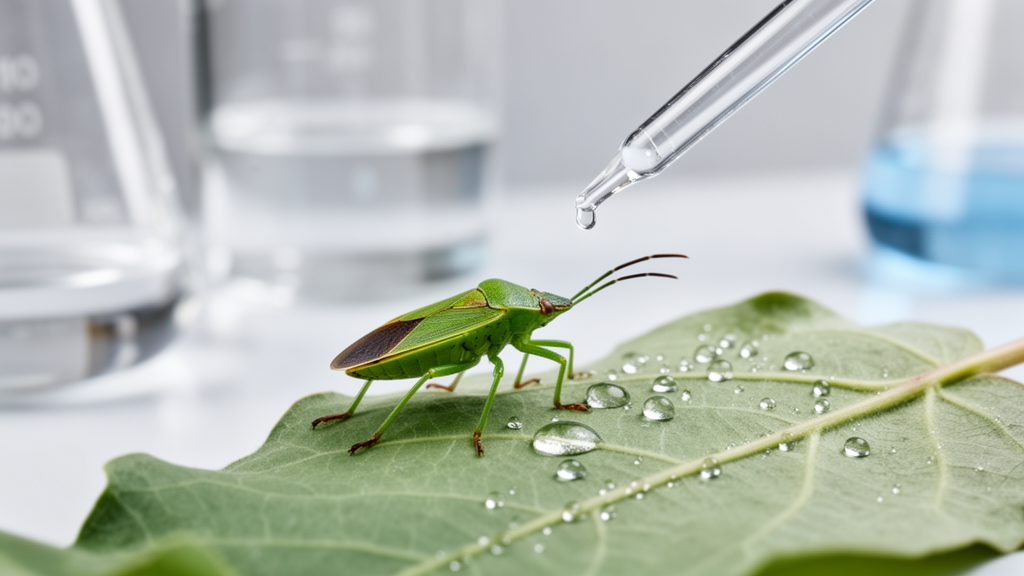
A team of Chinese agricultural scientists has built a new kind of RNA pesticide cocktail that kills a major cotton pest faster and at lower doses than conventional single-gene RNA sprays. The research, published in Frontiers in Insect Science, targets the plant bug Apolygus lucorum, a sap-sucking insect that has become a dominant pest in Chinese cotton fields and feeds on more than 200 host plants, including cotton, fruit trees and vegetables.
The team, led by Juan Luo, Qianqian Guo and Bin Yang at the Institute of Plant Protection of the Chinese Academy of Agricultural Sciences, screened four developmental genes for lethal effects when silenced. They injected double-stranded RNA (dsRNA) fragments into third-instar nymphs and recorded mortality over seven days. Two genes, wupA and Dpp, proved exceptionally lethal, killing 94.44 and 92.22 percent of treated nymphs respectively, while a third gene, Ubx, killed 56.67 percent. A fourth gene, PP1, showed no significant effect compared with controls.
The researchers then refined their dsRNA sequences to improve biosafety. Using BLAST searches against the NCBI database, they identified regions of 19 or more continuous base pairs shared with non-target organisms, including ants, bees, fish and birds, and removed these risky sites. The optimized fragments, dswupA-OTE and dsDpp-OTE, still killed 77.78 and 70.00 percent of nymphs respectively, confirming that safety could be improved without sacrificing potency. The team also deliberately retained broad-spectrum target sites homologous only to other agricultural pests, such as aphids and thrips, which could support future products against multiple pest species.
The study systematically tested how dsRNA length and target position affect silencing efficiency. The researchers divided the optimized fragments into s-type fragments of 100 to 150 base pairs and ss-type fragments of 30 to 90 base pairs. Insecticidal activity generally declined as fragment length decreased, consistent with findings in Drosophila that longer dsRNAs are more effective. However, several short fragments under 100 base pairs, such as dsDpp-ss-2 (65 bp) and dswupA-ss-1 (66 bp), retained high lethal activity, killing 55.56 and 56.67 percent of nymphs respectively. Other fragments of similar length showed no effect, likely due to differences in local mRNA secondary structure and Dicer cleavage preferences.
The core innovation came from assembling the most potent short fragments from different genes into a single artificially recombinant dsRNA. The team concatenated Ubx-ss-1 (75 bp), Dpp-ss-2 (65 bp) and wupA-ss-12 (122 bp) into a novel 262-base-pair construct named Udw. BLAST analysis confirmed no additional off-target sites in the recombinant sequence.
When injected at four concentrations ranging from 0.5 to 5 micrograms per microliter, dsUdw killed 64.44 to 72.22 percent of nymphs over seven days, with mortality increasing gradually with dose. Even at the 10-fold diluted concentration, the construct still caused over 64 percent mortality, suggesting that field applications could use lower doses, cutting production costs and reducing environmental residues.
Most strikingly, the multi-target cocktail acted faster than any single-gene dsRNA. Relative mortality in Udw-treated nymphs was significantly higher than all single-gene groups on days 2 and 3 post-injection, peaking at 45.55 percent on day 3. The researchers attribute this speed to the simultaneous disruption of three independent physiological processes: Ubx regulates morphological development, Dpp mediates signal transduction, and wupA is essential for muscle contraction.
The multi-target strategy also offers theoretical resistance management benefits. Because the construct simultaneously interferes with three essential genes, a pest would need to mutate all three target sites to escape, delaying the evolution of resistance that often undermines single-target pesticides. The approach builds on earlier work showing that fusion dsRNAs targeting multiple salivary protein genes in aphids achieved 60 percent mortality, markedly higher than the 28 to 38 percent from single-gene constructs.
The findings arrive as RNAi-based pest control gains commercial momentum. Transgenic maize MON87411 was approved in 2017, sprayable dsRNA biopesticides Ledprona and Vadescana followed in 2023 and 2025, and in 2026 China’s Institute for the Control of Agrochemicals signaled its intention to approve the country’s first RNA pesticide. The new study provides a complete technical workflow covering target screening, biosafety optimization and functional validation, offering a design strategy for efficient, safe, economical and fast-acting RNAi pesticides.
However, all experiments were conducted via microinjection under laboratory conditions. The authors note that further research, including feeding and spray bioassays as well as field and greenhouse evaluations of control efficacy and non-target organism safety, is required before such recombinant dsRNAs can reach practical application. The work nonetheless verifies the feasibility of multi-target recombinant dsRNA for pest control and lays a theoretical foundation for developing multi-gene RNAi technologies against A. lucorum.
Subject of Research: Screening, optimization and artificial recombination of dsRNA fragments for RNAi-mediated pest resistance in Apolygus lucorum
Article Title: Screening, optimization and artificial recombination of dsRNA fragments for RNAi-mediated pest resistance in Apolygus lucorum
Article References: Luo, J., Guo, Q., Hu, R., Zhang, M., Wang, G., & Yang, B. (2026). Screening, optimization and artificial recombination of dsRNA fragments for RNAi-mediated pest resistance in Apolygus lucorum. Frontiers in Insect Science, 6, Article 1912427. https://doi.org/10.3389/finsc.2026.1912427
Image Credits: AI Generated
DOI: 10.3389/finsc.2026.1912427
Keywords: Screening, optimization, artificial, recombination, dsRNA, fragments, RNAi-mediated, pest, resistance, Apolygus, lucorum, scientific research
Cite Scienmag News
Juliet Wilcox. (October 17, 2026). Recombinant dsRNA cocktail kills plant bug faster, study shows. Scienmag. https://scienmag.com/recombinant-dsrna-cocktail-kills-plant-bug-faster-study-shows/
Juliet Wilcox. "Recombinant dsRNA cocktail kills plant bug faster, study shows." Scienmag, 17 October 2026, https://scienmag.com/recombinant-dsrna-cocktail-kills-plant-bug-faster-study-shows/. Accessed 17 October 2026.
Juliet Wilcox. "Recombinant dsRNA cocktail kills plant bug faster, study shows." Scienmag. October 17, 2026. https://scienmag.com/recombinant-dsrna-cocktail-kills-plant-bug-faster-study-shows/


