


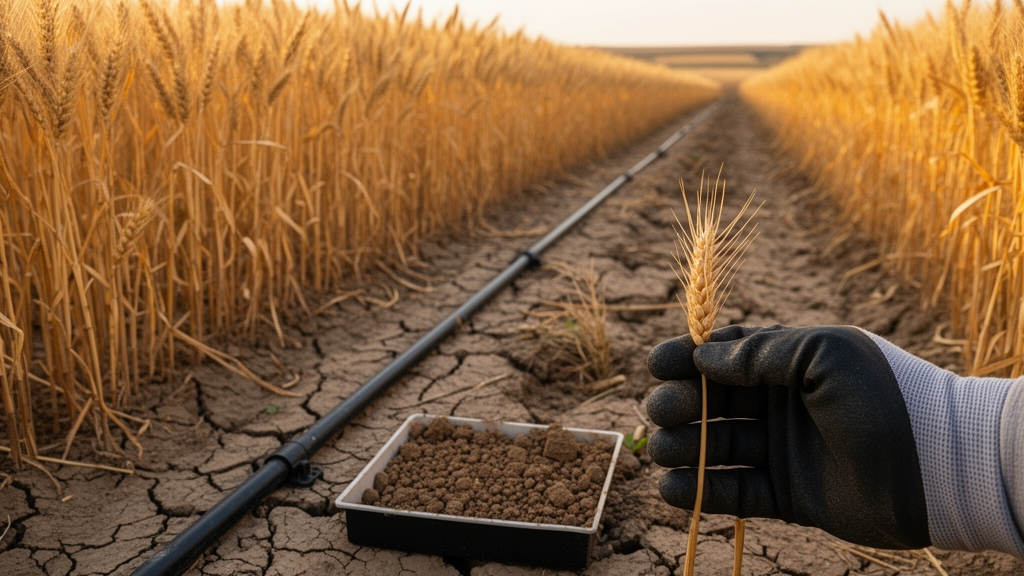
As drought tightens its grip on Mediterranean agriculture, farmers are increasingly looking at an unconventional water source: treated wastewater. But recycled effluent carries a hidden cargo of pharmaceuticals—anticonvulsants, antibiotics, anti-inflammatory drugs—that survive conventional treatment plants and flow onto cropland with every irrigation. A new controlled pot experiment from Italian researchers, published in Frontiers in Soil Science, offers a rare piece of good news: durum wheat, the backbone of pasta production, appears remarkably adept at keeping these contaminants out of its grain, and a cocktail of beneficial soil microbes may make the system even safer.
The research team, led by Noemi Tortorici of the University of Palermo and Francesco De Mastro of the University of Bari Aldo Moro, grew durum wheat cultivar Antalis under a rainout shelter at the Orleans experimental farm in Palermo from January to June 2025. The design crossed three factors: two water sources—fresh groundwater and fully treated municipal effluent from the Campofelice di Roccella treatment plant—four irrigation levels ranging from full field capacity down to 30 percent of that volume, and the presence or absence of a commercial microbial consortium containing arbuscular mycorrhizal fungi, rhizosphere bacteria, and the beneficial fungus Trichoderma atroviride. The factorial combination produced 16 treatment combinations across 480 pots, each monitored with capacitive soil moisture sensors logging every 15 minutes.
Chemical analysis of the treated wastewater revealed a familiar pharmaceutical fingerprint at concentrations generally below one microgram per liter. The antibiotic clarithromycin and the anti-inflammatory diclofenac led the list at 0.57 and 0.41 micrograms per liter respectively, while the antiepileptic carbamazepine averaged around 0.20 micrograms per liter—though several of its transformation products, including 3-hydroxycarbamazepine at 0.72 micrograms per liter, actually exceeded the parent compound. Fresh water contained no detectable pharmaceuticals at all.
By the end of the cropping cycle, the picture had simplified dramatically. Of the eleven compounds detected in the irrigation water, only carbamazepine and clarithromycin, along with some of their metabolites, remained detectable in the sandy soil, which had a low organic matter content of just 1.2 percent. Diclofenac, climbazole, and metoprolol had vanished entirely, likely because their chemistry—diclofenac’s anionic form at soil pH, climbazole’s rapid five-day degradation half-life, metoprolol’s high biodegradability—allowed them to dissipate through degradation and leaching. Carbamazepine, by contrast, is neutral at typical soil pH, weakly adsorbed, and notoriously resistant to biodegradation, making it the classic persistent micropollutant.
The most striking result came from the plant analysis. Carbamazepine was the only pharmaceutical detected in wheat tissues, and it followed a steep concentration gradient: roots held between 29.10 and 69.23 nanograms per gram, straw between 8.40 and 31.23, and soil between 5.87 and 22.57. The transfer factor from roots to straw ranged from just 0.24 to 0.60, confirming that durum wheat acts as a biological filter, trapping the contaminant below ground. This containment is attributed to specialized root anatomy—particularly the exodermis and the Casparian strip—which restrict xylem loading of hydrophilic compounds and promote vacuolar sequestration in root cells. Crucially, every pharmaceutical measured in the grain, including carbamazepine and all its transformation products, fell below the limit of quantification.
Microbial inoculation amplified this protective effect. In soils treated with the consortium, residual concentrations of carbamazepine-related compounds dropped by roughly 35 percent under full irrigation, 26 percent at 70 percent irrigation, and 22 percent at 50 percent irrigation compared with uninoculated controls. The effect was even more pronounced for transformation products than for the parent compound, suggesting that metabolites—which have already undergone structural modification—are more readily degraded by the enhanced microbial community. For clarithromycin, inoculation mainly reduced its metabolite N-desmethylclarithromycin rather than the parent antibiotic, hinting that the consortium shifted transformation pathways in the rhizosphere.
Irrigation regime itself proved to be a powerful lever on contaminant dynamics. Because lower water volumes deliver proportionally less pharmaceutical mass, residual soil concentrations fell steadily from the full-irrigation treatment down to the severe deficit regime, where no quantifiable clarithromycin residues remained at all. The researchers note that this makes irrigation management a practical tool for modulating contaminant persistence—an insight with direct relevance as European water policy, including the revised Urban Wastewater Treatment Directive, tightens micropollutant monitoring requirements.
Physiological measurements at the heading stage revealed a temporary wrinkle. Plants receiving the highest volumes of treated wastewater showed net photosynthetic rates roughly halved compared with fresh-water counterparts, around 16 micromoles per square meter per second, accompanied by reduced stomatal conductance below 0.30 moles per square meter per second. Yet the team attributes this transient dip more plausibly to the organic load and microbial indicators in the effluent than to pharmaceutical toxicity, since the exposure levels were orders of magnitude below those shown to impair photosynthesis in laboratory studies. Importantly, the effect did not translate into yield losses: grain productivity under treated wastewater remained comparable to fresh-water treatments.
Yield data told a nuanced story about the microbial consortium itself. Under fresh-water irrigation, inoculation was associated with a slight yield reduction—possibly a metabolic cost of hosting the introduced microbes or competition with native soil communities in a nutrient-poor environment. Under treated wastewater, however, no yield penalty occurred, perhaps because the effluent’s supply of organic carbon and nutrients offset any competitive trade-offs. Meanwhile, water stress dominated the productivity picture: cutting irrigation from 100 to 70 percent of full supply slashed biomass by more than 40 percent and grain yield by more than 55 percent, with even steeper losses at 50 percent.
The authors are careful to frame their conclusions within the experiment’s limits: a single growing season, controlled pot conditions, a rainout shelter, limited soil volume, and no mineral fertilization. Long-term field-scale monitoring remains essential before these findings can be generalized to operational agriculture. Still, the study delivers a compelling proof of concept that, in the short term, the combination of deficit irrigation management, beneficial microbial inoculation, and crop selection can support the sustainable reuse of treated wastewater while keeping pharmaceutical residues out of the food chain. For a crop as culturally and economically significant as durum wheat—the raw material of pasta across the Mediterranean—that containment ability may prove to be one of its most valuable traits in a water-scarce future.
Subject of Research: Pharmaceutical uptake and attenuation in durum wheat irrigated with treated wastewater under varying irrigation regimes and microbial inoculation
Article Title: Influence of irrigation regime and microbial consortium application on pharmaceutical uptake in durum wheat irrigated with treated wastewater
Article References: Tortorici, N., De Mastro, F., Tuttolomondo, T., Cocozza, C., Brunetti, G., & Iacuzzi, N. (2026). Influence of irrigation regime and microbial consortium application on pharmaceutical uptake in durum wheat irrigated with treated wastewater. Frontiers in Soil Science, 6, Article 1954651. https://doi.org/10.3389/fsoil.2026.1954651
Image Credits: AI Generated
DOI: 10.3389/fsoil.2026.1954651
Keywords: treated wastewater, durum wheat, carbamazepine, clarithromycin, deficit irrigation, microbial consortium, arbuscular mycorrhizal fungi, soil contamination, plant uptake, water reuse, food safety, rhizosphere
Cite Scienmag News
Alan Morgan. (October 17, 2026). Microbes and Deficit Irrigation Keep Pharmaceuticals Out of Durum Wheat Grain. Scienmag. https://scienmag.com/microbes-and-deficit-irrigation-keep-pharmaceuticals-out-of-durum-wheat-grain/
Alan Morgan. "Microbes and Deficit Irrigation Keep Pharmaceuticals Out of Durum Wheat Grain." Scienmag, 17 October 2026, https://scienmag.com/microbes-and-deficit-irrigation-keep-pharmaceuticals-out-of-durum-wheat-grain/. Accessed 17 October 2026.
Alan Morgan. "Microbes and Deficit Irrigation Keep Pharmaceuticals Out of Durum Wheat Grain." Scienmag. October 17, 2026. https://scienmag.com/microbes-and-deficit-irrigation-keep-pharmaceuticals-out-of-durum-wheat-grain/


