


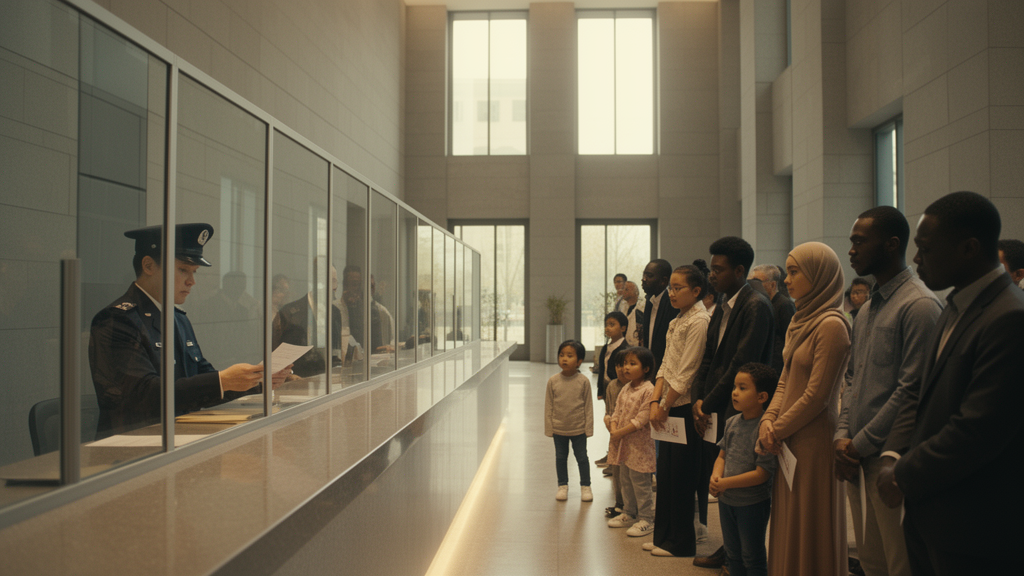
South Korea spent much of the twentieth century defining itself through the myth of danil minjok, a single ethnic nation descended from one pure bloodline. Over the past two decades, that story has been formally abandoned. The state now champions damunhwa, or multiculturalism, and has built an entire administrative apparatus around a new legal category: the multicultural family, damunhwa gajok, created to designate households formed mainly through international marriage between Korean men and foreign wives from China, Vietnam, and the Philippines. On the surface, this looks like a success story of benevolent adaptation. A new study argues that beneath the surface, the vocabulary of inclusion has been quietly repurposed to absorb difference without ever surrendering the ethnic majority’s normative primacy.
Researchers Yidan Luo of The Hong Kong Polytechnic University and Pengfei Bao of the National University of Defense Technology published the analysis in Frontiers in Communication, combining corpus-assisted critical discourse analysis with computational word-embedding methods. They compiled two specialized English-language corpora spanning 2006 to 2023: one drawn from white papers, annual reports, and press releases issued by the Ministry of Gender Equality and Family, the Korean Immigration Service, and the Ministry of Education, and the other from 608 articles retrieved from the Korea JoongAng Daily and The Korea Times, two English-language newspapers with conservative to centrist editorial stances. The government corpus totaled roughly 135,500 words across 48 documents; the media corpus about 128,000 words. The team split both corpora into three periods anchored to policy milestones, beginning with the 2008 Multicultural Families Support Act.
The analytical pipeline was deliberately layered. Using LancsBox 6.0, the researchers identified statistically salient collocates of the node multicultural famil within a five-word span, applying a Mutual Information threshold of at least 3 and a minimum raw frequency of 5. Collocates were then inductively grouped into five semantic categories: Support/Welfare, Integration/Empowerment, Deficit/Vulnerability, Policy/Management, and Conflict/Discrimination. Two trained coders independently annotated samples of concordance lines, reaching a Cohen’s kappa of 0.87 for category membership and 0.82 for semantic prosody valence. To quantify conceptual proximity, the team trained period-specific skip-gram Word2Vec models in Gensim, with 200-dimensional vectors, a window of 5, and 50 epochs, and computed the cosine similarity between the bigram tokens multicultural_family and korean_family, bootstrapping each subcorpus 1,000 times to derive 95 percent confidence intervals.
The collocational results reveal a striking asymmetry. In government texts, the phrase multicultural family is persistently surrounded by support, assistance, welfare, and education, with support recording the highest association strength in every time slice. Yet the official lexicon visibly modernized: integration and rights entered the collocate set in the second period, and empowerment, diversity, inclusion, and global appeared by the third. The media corpus tells a different story. In the first period, newspapers linked multicultural family to marriage, foreign, problem, and victim; by the second, discrimination and abuse intensified; and by the third, hate speech, failure, and conflict dominated. A chi-square test comparing the semantic category distributions between the two corpora was significant in every period, with effect sizes rising from Cramér’s V of 0.42 to 0.51, indicating that the discursive divergence between state and press widened over time rather than narrowing.
Semantic prosody analysis sharpened the contrast. Government texts enveloped multicultural family in a predominantly positive aura, with 65 to 70 percent of concordance lines coded as positive and the negative share falling from 10 to 5 percent by the final period. Media texts produced the mirror image: roughly two-thirds of contexts carried negative evaluative meaning, a pattern stable across all seventeen years. The qualitative reading shows what the positivity conceals. Government lines such as the Ministry will provide comprehensive support for multicultural families to help them settle in Korean society construct the state as an active giver and the family as a passive beneficiary whose success is measured by adaptation. Even the term rights is framed differently: in government texts rights are granted by a protective state, while in the press they are demanded from below by migrant wives denied them by an indifferent system.
The word-embedding analysis produced what the authors call a scissor effect. In the government corpus, the cosine similarity between multicultural_family and korean_family rose monotonically from 0.31 in the first period to 0.43 in the second and 0.54 in the third, with non-overlapping confidence intervals indicating a statistically significant increase. In the media corpus, similarity barely moved, from 0.25 to 0.32, with overlapping intervals between the later periods signaling no reliable change. The researchers are careful about what this metric means: cosine similarity indexes overlapping discursive environments, not semantic equivalence or social closeness. A benchmark comparison makes the limits clear. The similarity between korean_family and a composite average_family vector, built from neutral terms like household and home, reached 0.79 in the government’s final period, well above the 0.54 achieved for multicultural families. The marked category remains a satellite orbiting the normative core, not a member of it.
A supplementary finding crystallizes the media’s boundary work. The exact phrase ordinary Korean families appears 31 times in the newspaper corpus and never once in government texts, always in contrastive constructions such as while ordinary Korean families receive subsidies or unlike ordinary Korean families. In the Korean context, ordinary indexes conformity to unmarked social norms: Korean ethnicity, Korean-language competence, and conventional family structures. By describing the majority as ordinary, the press implicitly renders multicultural families extraordinary, and within an overwhelmingly negative prosody, that extraordinariness shades into deviance. The phrase is never defined, which is precisely its ideological power: it naturalizes the ethnic majority as the universal standard against which all other family forms are measured and found wanting.
From these converging patterns the authors derive their central theoretical contribution: discursive annexation. The term describes a governmental logic that is neither classical assimilation nor genuine inclusion. It is not assimilation because the state no longer explicitly demands cultural erasure; it is not inclusion because the normative center remains unchallenged. Instead, the state symbolically incorporates minority groups by extending the lexicon of recognition, diversity, empowerment, global citizen, while leaving institutional hierarchies untouched: residency precarity, employment discrimination, educational segregation. The researchers ground the concept in governmentality theory, arguing that the shift from welfare provision to empowerment reflects a neoliberal re-engineering in which families are called to become entrepreneurial selves responsible for their own integration. The narrowing semantic distance in government texts, they argue, reflects nation-branding for international audiences rather than a redistribution of symbolic or material power. The authors explicitly note that annexation is used in its governmental and lexicographic sense, not to invoke the 1910 Japan-Korea Annexation Treaty or equate governance of marriage migrants with colonial subjugation.
The study also reads the media’s crisis narrative through intercultural communication theory, and here the picture becomes more ambivalent. The conservative press performs a democratic watchdog function, exposing the gap between official rhetoric and structural marginalization, from hate speech that surged online with few prosecutions to government audits revealing budget execution below 40 percent. Yet the same framing traps multicultural families in subject positions as suffering victims or failed policy objects, denying positive face by casting them as objects of pity and negative face by presenting them as perpetually in need of intervention. Read through communication accommodation theory, the contrastive rhetoric constitutes divergent accommodation, accentuating intergroup salience to reassure ethnic Korean readers that the boundary between us and them remains intact. Crucially, the two ostensibly opposed discourses share a foundational assumption: neither ever deconstructs the category itself or imagines a social landscape where families are simply families. Collocates such as leader, contributor, expert, or neighbor are absent from both corpora.
The authors acknowledge the limits of their design with unusual candor. The English-language corpora capture international-facing discourse rather than domestic Korean-language policy debate, and the period-specific subcorpora of roughly 41,000 to 47,500 words are modest for embedding models, though sensitivity analyses varying vector dimensions from 100 to 300 and training epochs from 25 to 100 confirmed that the monotonic trajectory is robust. Transformer-based architectures would require corpora exceeding one million words, making them impractical here. The deeper point survives these caveats: even if the semantic convergence is merely lexical, the institutional performance of convergence carries constitutive effects, legitimizing the state as benevolent and framing integration as accomplished fact regardless of lived conditions. The Korean case thus offers a cautionary tale with resonance far beyond the peninsula: the language of diversity and empowerment can coexist with, and actively obscure, the preservation of symbolic hierarchies, demanding recognition that refuses to condition belonging on assimilation.
Subject of Research: Discursive construction of multicultural families in South Korean government and media discourse
Article Title: From assimilation to discursive annexation? Tracing ‘multicultural family’ in South Korean government and media discourses
Article References: Luo, Y., & Bao, P. (2026). From assimilation to discursive annexation? Tracing ‘multicultural family’ in South Korean government and media discourses. Frontiers in Communication, 11, Article 1962502. https://doi.org/10.3389/fcomm.2026.1962502
Image Credits: AI Generated
DOI: 10.3389/fcomm.2026.1962502
Keywords: South Korea, multicultural family, discourse analysis, Word2Vec, semantic prosody, collocation, nation-branding, governmentality, intercultural communication, conservative media, integration, damunhwa
Cite Scienmag News
Gavin Prescott. (October 17, 2026). How South Korea’s Language of Multicultural Inclusion Absorbs Difference Without Redistributing Power. Scienmag. https://scienmag.com/how-south-koreas-language-of-multicultural-inclusion-absorbs-difference-without-redistributing-power/
Gavin Prescott. "How South Korea’s Language of Multicultural Inclusion Absorbs Difference Without Redistributing Power." Scienmag, 17 October 2026, https://scienmag.com/how-south-koreas-language-of-multicultural-inclusion-absorbs-difference-without-redistributing-power/. Accessed 17 October 2026.
Gavin Prescott. "How South Korea’s Language of Multicultural Inclusion Absorbs Difference Without Redistributing Power." Scienmag. October 17, 2026. https://scienmag.com/how-south-koreas-language-of-multicultural-inclusion-absorbs-difference-without-redistributing-power/


