


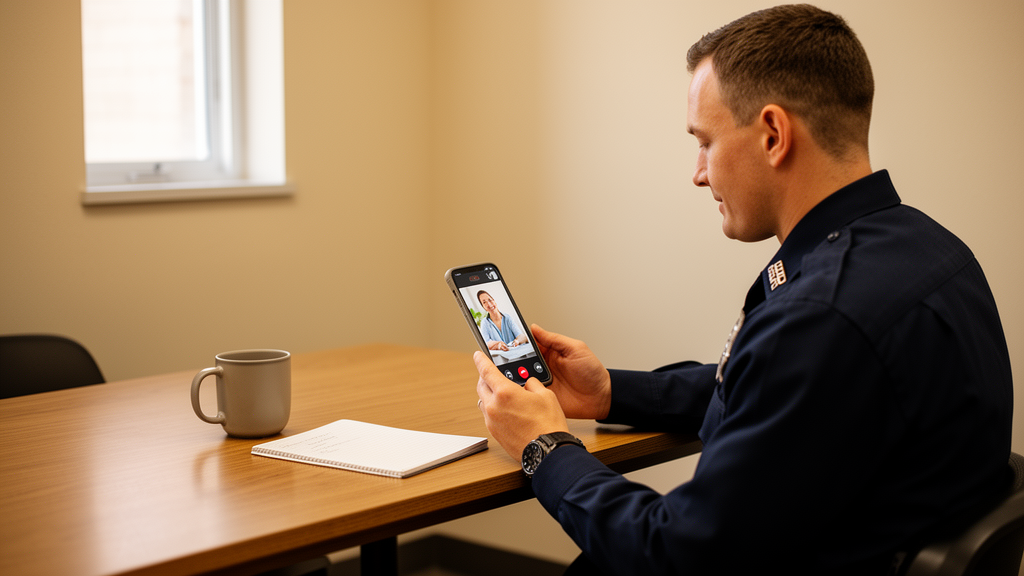
Correctional workers spend their careers inside institutions built for control, not comfort, and the psychological toll is staggering. Survey data from the Union of Canadian Correctional Officers indicate that 98 percent of officers have faced at least one traumatic event on the job, and roughly half have witnessed an assault on a colleague or the death of an inmate. Against that backdrop, public safety personnel are about three times more likely than the general population to develop a mental health disorder and four times more likely to experience suicidal thoughts, attempts, or deaths. Yet the very people who need help most often avoid seeking it, deterred by stigma, punishing shift schedules, and the fear that admitting distress could end their careers.
A new randomized controlled trial from a research team led by investigators at Queen’s University in Ontario, published in Frontiers in Psychiatry, offers a potential way around those barriers. The study tested a diagnosis-specific electronic cognitive behavioral therapy (eCBT) program built specifically for correctional workers, delivered through a secure online platform called the Online Psychotherapy Tool (OPTT). Over twelve weeks, participants who received the digital therapy showed significantly greater reductions in symptoms of depression, anxiety, and posttraumatic stress disorder than those who continued with treatment as usual. Symptom severity fell by 61.37 percent in the eCBT group, compared with 23.29 percent in the control group, and the between-group effect size reached a moderate Cohen’s d of 0.68.
The trial enrolled 84 current or former correctional workers across Ontario, all of whom met DSM-5 criteria for major depressive disorder, generalized anxiety disorder, or PTSD. Diagnoses were established through the structured Mini-International Neuropsychiatric Interview, supplemented by a psychiatric assessment conducted by a research psychiatrist, which allowed the team to sort overlapping symptoms into the correct diagnostic track. Participants were then randomized by a computerized random number generator, with a team member uninvolved in data collection handling allocation, into either the eCBT arm (40 participants) or the treatment-as-usual arm (44 participants). Anyone who had completed another CBT program in the previous six months was excluded, and stable medication use was permitted.
The intervention itself was engineered to mirror the mechanics of traditional in-person CBT while stripping away the obstacles that keep correctional workers out of clinics. Each of the twelve weekly modules contained roughly thirty slides and interactive videos covering standard CBT concepts, such as the links between thoughts, feelings, behaviors, physical responses, and environment. Every session ended with a mandatory clinical homework assignment, submitted through the online portal by an agreed deadline before the next module unlocked. A typical exercise might involve a Thought Record in which a participant logs a distressing automatic thought, names the cognitive distortion behind it, such as catastrophizing, and constructs a more balanced alternative. Care providers, trained research assistants supervised throughout by the principal investigator, reviewed each submission and drafted personalized feedback in fifteen to twenty minutes using pre-validated templates, ensuring consistent care while keeping responses specific to each participant’s life and profession.
What set this program apart from generic digital therapy was its tailoring. Focus groups with correctional workers shaped the language, examples, and scenarios embedded in the modules, so that the content reflected the occupational stressors and lived experiences of the population rather than textbook vignettes. The researchers argue that this customization likely strengthened the therapeutic alliance and made the material feel directly relevant, a critical factor for a workforce that has historically distrusted mental health services. The platform itself was built for privacy: OPTT is a cloud-based system hosted on Amazon Web Services in Canada, compliant with HIPAA, PIPEDA, and SOC-2 standards, collecting only anonymized metadata to improve performance.
Symptom severity was measured at baseline, week six, and week twelve using validated instruments: the PHQ-9 and QIDS-SR-16 for depression, the GAD-7 and the DASS-42 anxiety subscale for anxiety, the PCL-5 for PTSD, and the Q-LES-Q-SF for quality of life. The results showed a clear temporal pattern. Depression and anxiety scores improved significantly by the midpoint of the trial, while PTSD symptoms, measured by the PCL-5, only showed statistically significant improvement by post-treatment, where the eCBT group scored meaningfully lower than controls. The researchers attribute this staggered response to the structure of CBT itself: foundational skills like cognitive restructuring and behavioral activation are front-loaded into early modules, whereas trauma-focused work, exposure-based exercises, and gradual re-engagement with avoided memories demand sustained engagement and typically appear later in the protocol.
Mixed linear models confirmed the pattern with a significant treatment-by-time interaction favoring eCBT (p<0.01), and a modified intention-to-treat analysis, including participants who completed at least one post-baseline assessment, preserved that finding. Interestingly, quality of life did not differ significantly between the groups at any time point. The authors suggest that quality-of-life measures capture broad domains, occupational functioning, relationships, and environmental stressors, that are heavily shaped by persistent workplace conditions such as irregular shifts, understaffing, and ongoing exposure to traumatic events. In other words, substantial symptom relief may not translate into immediate gains in broader life satisfaction if the external stressors themselves remain unchanged, a pattern consistent with prior research on chronically stressed occupational populations.
The trial was not without limitations, and the authors are candid about them. Dropout rates were high, 65 percent in the eCBT arm and 54.5 percent in the control arm, though attrition analyses using Fisher’s exact tests found no significant differences between completers and dropouts on any demographic or diagnostic category, suggesting dropout was not driven by a particular subgroup. The final sample of 84 fell short of the planned 110, reducing statistical power. The study also combined results across three diagnostic programs, and the normalization approach, which assumed that equal percentages of maximum scores on different instruments reflect comparable clinical severity, was not independently validated. Because no correction for multiple comparisons was applied, the authors note that scale-level p-values should be read as exploratory, with the treatment-by-time interaction serving as the primary inferential test. The sample was also predominantly White and English-speaking, and self-report measures in a population that may underreport distress due to workplace normalization of trauma introduce additional bias.
Perhaps the most telling detail concerns recruitment. Because of the sensitive nature of the occupation, the researchers could not contact correctional workers through their own organizations and instead relied on union outreach, family physicians, and news coverage. Many participants later reported being glad their employers were not involved, and the separation from the workplace influenced their decision to enroll. This points toward a practical lesson for occupational mental health: external referral pathways, Employee Assistance Programs, and services deliberately disconnected from institutional chains of command may be more effective at drawing stigmatized workers into care than anything routed through the employer itself.
The findings land at a moment when digital mental health is being scrutinized for whether it can genuinely reach populations that traditional services fail. For correctional workers, a group whose exposure to violence, injury, and death is woven into the job description, the answer from this trial is cautiously affirmative. Diagnosis-specific eCBT, tailored to the realities of the job and delivered asynchronously on the worker’s own schedule, produced clinically meaningful reductions in depression, anxiety, and PTSD symptoms compared with usual care. The authors argue that the format directly addresses the key barriers of stigma, scheduling, and access, and they call for future work to improve adherence, extend follow-up periods, and test whether embedding such programs within occupational health structures could normalize help-seeking. If adherence challenges can be solved, eCBT may offer a scalable route to mental health care for a workforce that has too often been left to cope alone.
Subject of Research: Efficacy of diagnosis-specific online cognitive behavioral therapy for depression, anxiety, and PTSD in correctional workers
Article Title: Delivering online cognitive behavioral therapy to address mental health challenges in correctional workers: a randomized controlled trial
Article References: Holmes, C., Gutierrez, G., Stephenson, C., Moghimi, E., Malakouti, N., Jagayat, J., Patel, C., Simpson, A., Gerritsen, C., Martin, M., Fitzpatrick, M., Eadie, J., Agrawal, A., Jarabana, V., Asadpour, K., Khan, F., Groll, D., Omrani, M., & Alavi, N. (2026). Delivering online cognitive behavioral therapy to address mental health challenges in correctional workers: a randomized controlled trial. Frontiers in Psychiatry, 17, Article 1922912. https://doi.org/10.3389/fpsyt.2026.1922912
Image Credits: AI Generated
DOI: 10.3389/fpsyt.2026.1922912
Keywords: correctional workers, online cognitive behavioral therapy, eCBT, PTSD, depression, anxiety, digital mental health, randomized controlled trial, public safety personnel, OPTT, occupational mental health, stigma
Cite Scienmag News
Glenn Wilkins. (October 17, 2026). Online Therapy Cuts Depression, Anxiety and PTSD Symptoms in Correctional Workers, Trial Finds. Scienmag. https://scienmag.com/online-therapy-cuts-depression-anxiety-and-ptsd-symptoms-in-correctional-workers-trial-finds/
Glenn Wilkins. "Online Therapy Cuts Depression, Anxiety and PTSD Symptoms in Correctional Workers, Trial Finds." Scienmag, 17 October 2026, https://scienmag.com/online-therapy-cuts-depression-anxiety-and-ptsd-symptoms-in-correctional-workers-trial-finds/. Accessed 17 October 2026.
Glenn Wilkins. "Online Therapy Cuts Depression, Anxiety and PTSD Symptoms in Correctional Workers, Trial Finds." Scienmag. October 17, 2026. https://scienmag.com/online-therapy-cuts-depression-anxiety-and-ptsd-symptoms-in-correctional-workers-trial-finds/


