


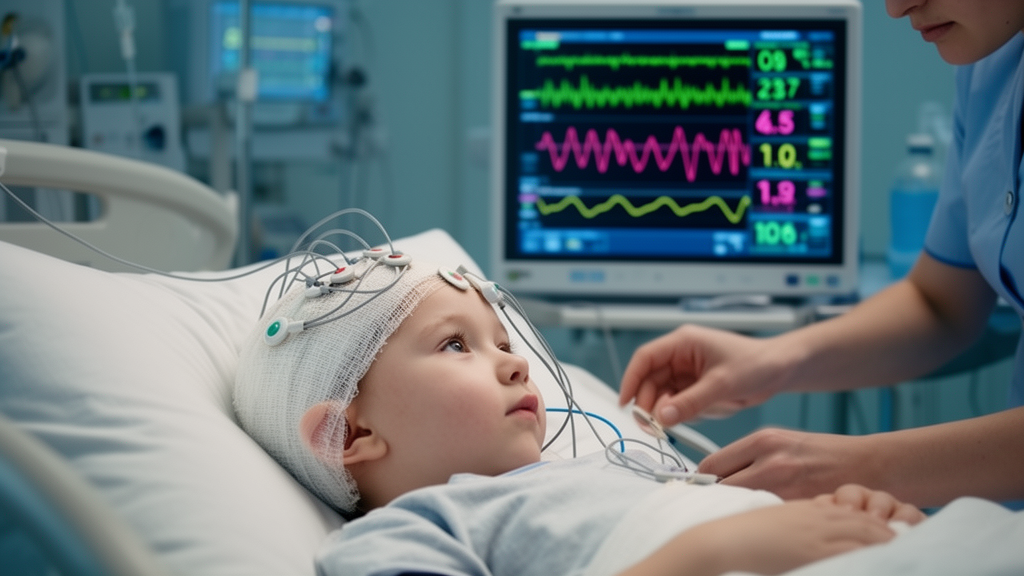
When a child arrives at a hospital with a severe head injury, doctors face one of the most difficult questions in medicine: how badly is the brain hurt, and will this child recover? A new study from Qinghai Provincial Women and Children’s Hospital in China offers a strikingly precise answer. By combining two bedside monitoring technologies with a clinical score and a blood test, researchers built a prediction tool that achieved an accuracy of 0.91 on a standard statistical scale, meaning it correctly distinguished between children who recovered well and those who did not in roughly nine out of ten cases.
The research, published in the journal Frontiers in Neuroscience, focused on children with moderate-to-severe traumatic brain injury, a condition that affects between 50 and 60 million people worldwide each year and carries a mortality rate of 15 to 30 percent in its most severe pediatric forms. For decades, doctors have relied on measuring pressure inside the skull to guide treatment. But that measurement reveals nothing about whether brain cells are actually getting enough oxygen, which is often what determines whether a child survives with intact neurological function.
The team addressed this gap by using two complementary technologies. The first, called regional cerebral oxygen saturation monitoring, uses near-infrared light shone through the forehead to measure how much oxygen is present in the tissue beneath the skull. The second, called bispectral index monitoring, reads electrical activity from the brain’s surface through electrodes placed on the scalp, providing a real-time window into how deeply sedated a child is and how well the brain’s cortical circuits are functioning.
Between December 2023 and December 2025, the researchers prospectively enrolled 93 children with moderate-to-severe traumatic brain injury who received both types of monitoring. They compared these children to a retrospective group of 66 similar patients treated between January 2021 and November 2023 without such monitoring. All 159 children were managed according to established guidelines for pediatric severe traumatic brain injury, including blood pressure control, intracranial pressure reduction, and surgical intervention when indicated.
The results were notable. Children who received the combined monitoring spent significantly less time in the hospital and in the pediatric intensive care unit, and required fewer days on mechanical ventilation, compared to those monitored conventionally. Their functional outcomes at six months, measured on the Glasgow Outcome Scale, were also significantly better. However, the researchers caution that because the two groups were treated during different time periods, they cannot definitively conclude that the monitoring itself caused these improvements.
To understand what happened during monitoring, the team analyzed hundreds of alert events. When brain oxygen saturation dropped below 50 percent or fell by more than 15 percent from baseline, clinicians responded with interventions such as airway suctioning, increasing inspired oxygen, adjusting ventilator settings, giving fluids, or administering medications to reduce intracranial pressure. After these interventions, median brain oxygen saturation rose significantly from 42 percent to 45 percent within 30 to 60 minutes. Similarly, when electrical activity readings signaled inadequate sedation or excessive suppression, clinicians adjusted sedative doses accordingly, and the readings responded significantly.
The researchers then built a statistical model, called a nomogram, that assigns weighted scores to four key variables: the Glasgow Coma Scale score at admission, the average brain oxygen saturation during the first week, the average bispectral index during the first week, and blood levels of neuron-specific enolase, a protein released when neurons are damaged. When combined, these four factors predicted poor six-month functional outcome with an area under the curve of 0.91, with sensitivity of 76.7 percent and specificity of 92 percent.
The model’s strength lies in its incremental value. Using the Glasgow Coma Scale alone yielded an area under the curve of 0.744. Adding the blood biomarker improved this to 0.813. Adding the two monitoring parameters pushed it to 0.836. Combining all four variables produced the highest accuracy at 0.907. This stepwise improvement demonstrates that each component contributes unique information about the child’s condition, reflecting the multifactorial nature of brain injury in the developing nervous system.
The developing brain is particularly vulnerable to fluctuations in oxygen supply because its autoregulation mechanisms are immature. This makes continuous monitoring of cerebral oxygenation and electrical activity especially valuable in children, where a single measurement or scoring system may miss critical secondary insults such as ischemia, hypoxia, or metabolic imbalance. The researchers suggest that their approach captures reversible secondary injuries early, allowing clinicians to intervene before permanent damage occurs.
The team acknowledges several limitations. The study was conducted at a single center with a relatively small sample size, and the use of a historical control group introduces potential bias. The brain oxygen measurements were taken every six hours rather than continuously, which may have missed transient hypoxic episodes. Future randomized controlled trials and multicenter validation will be needed to confirm whether this monitoring approach directly improves outcomes and whether the prediction model performs reliably across diverse patient populations.
Subject of Research: Neuroscience
Article Title: Prognostic prediction model construction and validation based on regional cerebral oxygen saturation and bispectral index monitoring in pediatric traumatic brain injury
Article References: Li, B., Ma, R., Tian, Z., Wan, Y., Zhong, X., Wang, W., Yan, W., & Zhao, S. (2026). Prognostic prediction model construction and validation based on regional cerebral oxygen saturation and bispectral index monitoring in pediatric traumatic brain injury. Frontiers in Neuroscience, 20, Article 1866247. https://doi.org/10.3389/fnins.2026.1866247
Image Credits: AI Generated
DOI: 10.3389/fnins.2026.1866247
Keywords: neuroscience, traumatic brain injury, pediatrics, medical monitoring, prognosis, Prognostic, prediction, model, construction, validation, based, regional
Cite Scienmag News
Cassandra Pierce. (October 17, 2026). Brain Oxygen and EEG Monitors Predict Outcomes in Children With Severe Head Injuries. Scienmag. https://scienmag.com/brain-oxygen-and-eeg-monitors-predict-outcomes-in-children-with-severe-head-injuries/
Cassandra Pierce. "Brain Oxygen and EEG Monitors Predict Outcomes in Children With Severe Head Injuries." Scienmag, 17 October 2026, https://scienmag.com/brain-oxygen-and-eeg-monitors-predict-outcomes-in-children-with-severe-head-injuries/. Accessed 17 October 2026.
Cassandra Pierce. "Brain Oxygen and EEG Monitors Predict Outcomes in Children With Severe Head Injuries." Scienmag. October 17, 2026. https://scienmag.com/brain-oxygen-and-eeg-monitors-predict-outcomes-in-children-with-severe-head-injuries/


