


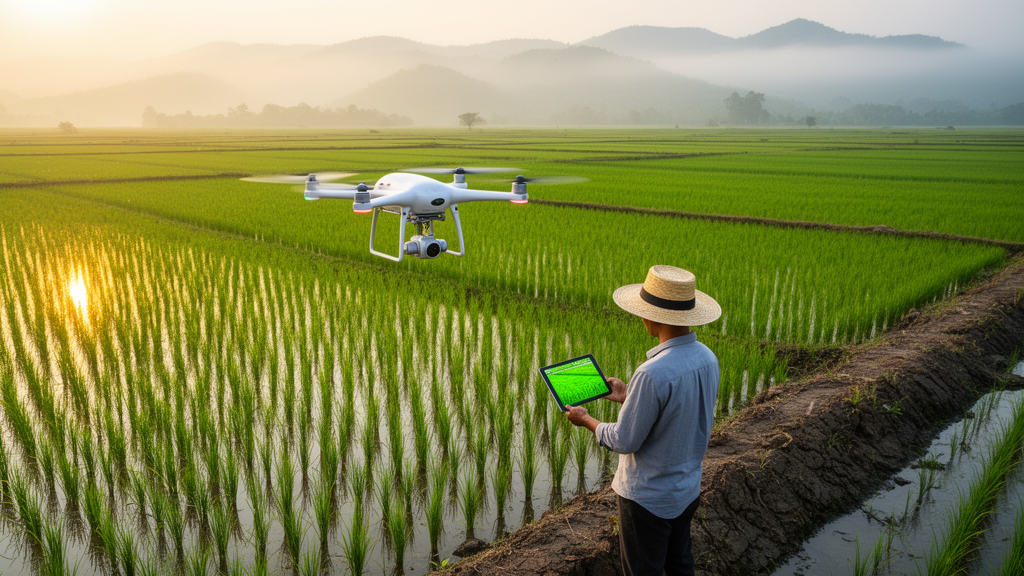
Rice feeds more than half of humanity, but the way it is planted varies dramatically from field to field, and those differences have long been invisible to satellites. A team of researchers in India has now shown that a consumer-grade drone combined with a hybrid deep learning framework can tell apart three major rice establishment methods with accuracies approaching 96 percent. The study, published in Frontiers in Remote Sensing, demonstrates that subtle distinctions between transplanted rice and two forms of direct seeded rice can be read directly from ordinary color photographs taken 40 meters above the ground.
The research was conducted during the 2023 Kharif season at an experimental field operated by Praanadhaara Organised Agro Forestry Private Limited in Bapatla District, Andhra Pradesh, a tropical region where monsoon rainfall makes rice the dominant crop. The team, drawn from institutions including Acharya N. G. Ranga Agricultural University, the ICAR-Indian Institute of Rice Research, and South Dakota State University, cultivated three plots of roughly two acres each: broadcasted direct seeded rice, wet direct seeded rice, and transplanted rice. Each method leaves a distinct signature in the field, from the scatter pattern of broadcast seed to the flooded, orderly rows of transplanted seedlings, but capturing that signature requires imagery far sharper than what orbiting satellites can provide.
Using a DJI Mavic 2 Pro drone equipped with a 20-megapixel Hasselblad camera, the researchers flew automated waypoint missions on three dates: October 15, 2023, October 27, 2023, and December 1, 2023. Flights were held to a constant altitude of 40 meters, with 80 percent forward and 75 percent side image overlap, under clear skies and gentle winds between 3 and 4 meters per second. Each mission produced roughly 425 raw red-green-blue images at a ground sampling distance of 1.1 centimeters per pixel. That resolution is extraordinary by remote sensing standards: previous efforts to map direct seeded rice relied on satellite sensors with resolutions between 10 and 250 meters, which blur out the fine structural cues that separate one planting method from another.
After the raw images were orthorectified into georeferenced mosaics, the team overlaid GPS-derived plot boundaries using QGIS software and cut the mosaics into 400-by-400-pixel patches. The resulting dataset contained 1,966 labelled patches: 672 of broadcasted direct seeded rice, 612 of transplanted rice, and 682 of wet direct seeded rice. Because all three systems were managed under identical agronomic conditions and sowing schedules were controlled, any differences the models detected could be attributed to the establishment method itself rather than to confounding variation in crop age or management.
The classification pipeline paired a convolutional neural network with a conventional machine learning classifier. ResNet-50, a 50-layer deep residual architecture, served as the feature extractor, converting each image patch into a 2,048-dimensional vector that encodes spatial and textural information. The authors chose ResNet-50 deliberately: its transfer learning capability and moderate complexity suit relatively small drone datasets, where deeper networks would risk overfitting. Those feature vectors were then fed to six different classifiers: k-nearest neighbor, support vector machine, decision tree, random forest, Naïve Bayes, and a neural network, producing six hybrid models. Two additional end-to-end architectures, YOLOv5 and YOLOv8, were trained on the same data for comparison.
Performance was tested rigorously. The dataset was split across nine different training-to-testing ratios, from 10:90 up to 90:10, and evaluated with overall accuracy, precision, recall, F1-score, the kappa coefficient, and mean average precision. The clear winner was the ResNet-50 plus neural network combination, which achieved average overall accuracies of 93.16 percent, 95.81 percent, and 93.31 percent across the three acquisition dates. No other model matched that consistency. The next best, ResNet-50 plus support vector machine, reached 92.07, 95.24, and 92.09 percent, while the weakest performers, Naïve Bayes and decision tree hybrids, hovered in the high 70s. The YOLO models, despite their popularity in agricultural computer vision, landed in the middle at roughly 78 to 89 percent.
The winning model also posted the strongest secondary metrics, with precision between 0.93 and 0.97, recall between 0.92 and 0.97, F1-scores from 0.92 to 0.97, and kappa coefficients of 0.89 to 0.96. The kappa coefficient is particularly telling, because it corrects for agreement that could occur by chance, meaning the model was genuinely discriminating between classes rather than exploiting class imbalance. Notably, the peak performance came at the second acquisition date, when direct seeded rice was mid-establishment, suggesting the features that distinguish planting methods become most legible partway through the season.
The authors are candid about the study’s limitations. Because transplanted rice was not put into the ground until November 3, the first two drone flights captured that treatment only as pre-transplant field preparation, so early-stage classifications partly reflect soil, water, and land preparation differences rather than a mature transplanted canopy. The design also synchronized sowing dates across treatments, whereas real-world farms stagger planting according to rainfall, water availability, and labor. At regional scales, such phenological variation could complicate classification, and the authors recommend validating the framework across multiple seasons, planting dates, and regions before operational deployment.
Even so, the implications are substantial. Knowing which establishment method dominates a given landscape matters for precision agriculture: transplanted rice, wet direct seeded rice, and broadcast rice differ sharply in water consumption, labor demands, methane emissions, and input requirements. Accurate, fine-grained maps of establishment methods could sharpen area estimates, guide site-specific management, and support policies promoting water-saving direct seeding. The authors point toward future upgrades, including multispectral and hyperspectral sensors to capture plant physiology, transformer and self-supervised architectures that need less labelled data, explainable AI for transparency, and lightweight models that run in real time aboard the drone itself. For now, the study stands as a compelling proof of concept: an off-the-shelf drone, a pretrained network, and a well-chosen classifier can read the hidden history of how a rice field was planted, written in centimeter-scale patterns of leaves, soil, and water.
Subject of Research: Deep learning classification of rice establishment methods using high-resolution drone imagery
Article Title: Deep learning-based classification of wet direct seeded rice, broadcasted direct seeded rice and transplanted rice using drone imagery for precision agriculture
Article References: Gubbala, A. L., Rathod, S., Dasyam, R., Rapolu, M. K., Dasari, A. K., Kurra, P., Madireddy, H. R., Shashishekhar, P. R., Mural, R. V., Kumar, A., & Sundaram, R. M. (2026). Deep learning-based classification of wet direct seeded rice, broadcasted direct seeded rice and transplanted rice using drone imagery for precision agriculture. Frontiers in Remote Sensing, 7, Article 1698781. https://doi.org/10.3389/frsen.2026.1698781
Image Credits: AI Generated
DOI: 10.3389/frsen.2026.1698781
Keywords: deep learning, drone imagery, precision agriculture, remote sensing, ResNet-50, YOLOv8, rice, direct seeded rice, transplanted rice, UAV, image classification, crop mapping
Cite Scienmag News
Alan Morgan. (October 17, 2026). Drone Images and Deep Learning Reveal How Rice Is Grown With 95% Accuracy. Scienmag. https://scienmag.com/drone-images-and-deep-learning-reveal-how-rice-is-grown-with-95-accuracy/
Alan Morgan. "Drone Images and Deep Learning Reveal How Rice Is Grown With 95% Accuracy." Scienmag, 17 October 2026, https://scienmag.com/drone-images-and-deep-learning-reveal-how-rice-is-grown-with-95-accuracy/. Accessed 17 October 2026.
Alan Morgan. "Drone Images and Deep Learning Reveal How Rice Is Grown With 95% Accuracy." Scienmag. October 17, 2026. https://scienmag.com/drone-images-and-deep-learning-reveal-how-rice-is-grown-with-95-accuracy/


