


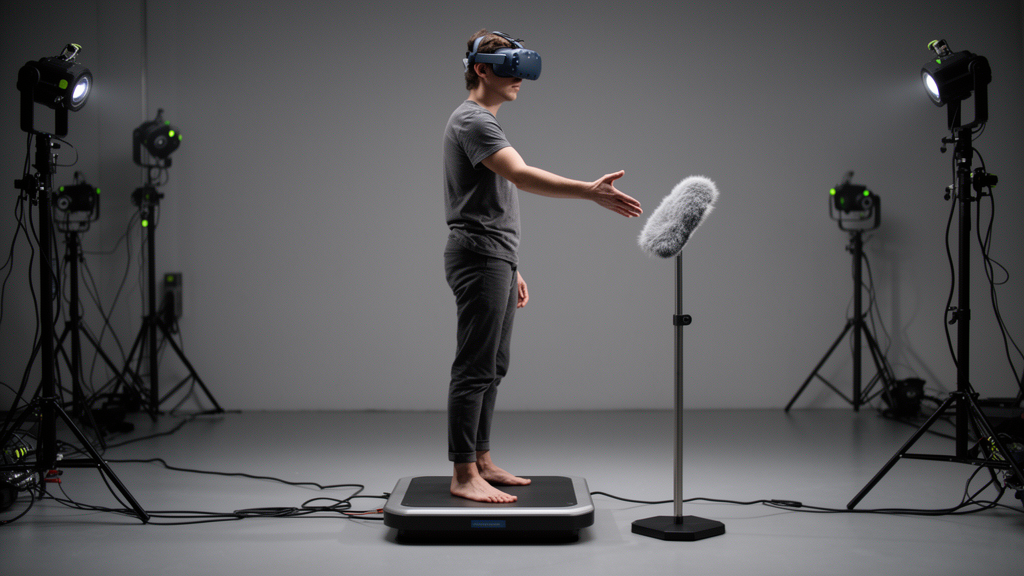
When you reach for a cup of coffee, your brain quietly turns down the volume on touch. Scientists call this phenomenon tactile suppression: the sensitivity of the skin on a moving limb drops noticeably, sometimes even before the movement begins. The prevailing explanation involves internal forward models, neural machinery that predicts the sensory consequences of our own actions and filters out the expected sensations. It is the same principle that makes it impossible to tickle yourself. But a new study suggests this filtering system is not a fixed setting. Fear, it turns out, can crank the dial even further.
Researchers at Justus Liebig University Giessen, including Belkis Ezgi Arikan, Meaghan McManus and Katja Fiehler, set out to test whether the emotional meaning of a situation changes how strongly the brain suppresses touch during movement. Their work, published in the journal iScience, placed participants inside a virtual reality environment where they either fled from a threatening stimulus or reached toward a harmless one, all while their ability to feel faint vibrations on the moving hand was measured with laboratory-grade precision. The result was striking: when people moved to avoid a virtual spider, their sense of touch was dulled more than when they moved toward a virtual rabbit.
The logic behind the experiment rests on a tension at the heart of motor control. Tactile suppression exists because predicted sensations are less informative than unexpected ones, so the brain mutes what it can anticipate. Yet sensory feedback is also essential for guiding movements, and previous research has shown that suppression weakens when touch genuinely matters, for example during haptic exploration or when handling a slippery object. The question was what happens when the emotional stakes rise. Under threat, the authors reasoned, the priority shifts. A negative, avoidance-driving context should favor fast, efficient withdrawal, and that means trusting motor predictions over incoming feedback, producing stronger suppression.
To find out, the team built a virtual forest rendered through an HTC Vive Pro Eye headset, complete with a virtual right hand wearing a red leather glove. Forty-three right-handed volunteers stood in this environment and, on each trial, saw one of three objects: a black sphere signaling a baseline condition in which they held their hand still, a wiggling animated spider, or a rabbit nibbling on grass. When the spider appeared, participants had to move their hand away from it; when the rabbit appeared, they had to reach toward and touch it. These movements were extensions or flexions of the arm, performed quickly, and the mapping was deliberately ecological: threatening stimuli are avoided, non-threatening ones are approached.
During each movement, the haptic actuator inside the VR controller delivered a brief 50-millisecond vibration at 250 hertz, drawn from eight intensities spanning a logarithmic range, or no vibration at all. After each trial, participants answered a simple question by moving their virtual hand into a cube labeled yes or no: had they felt anything? From these responses, the researchers fitted psychometric functions and extracted each person’s detection threshold in every condition. The vibrations themselves were arbitrary controller values rather than physical units, an approach validated in earlier work from the same laboratory, and pink noise played through the headset’s headphones ensured participants could not hear the actuator running.
The baseline findings confirmed decades of research. Detection thresholds rose significantly in every movement condition compared with holding the hand still, with effect sizes ranging from moderate to large, and false alarm rates, the tendency to report feeling a vibration that never occurred, were low and statistically identical across conditions. That last point matters, because it rules out response bias as an explanation: participants were not simply guessing differently when frightened. They genuinely became less sensitive to touch while moving, and even more so when the movement served escape.
The critical comparison came next. When movement speed was included as a covariate, avoiding the spider produced stronger tactile suppression than approaching the rabbit, with a modest but reliable effect. Participants also moved faster toward the spider, consistent with the urgency of threat, but the suppression difference held after accounting for speed. Self-report questionnaires confirmed that the manipulation worked on the emotional level: the spider was rated as less pleasant and more arousing, more anxiety-provoking and more disgusting than the rabbit. Interestingly, however, none of these subjective ratings correlated with individual detection thresholds, suggesting the effect operates through general sensorimotor prioritization rather than the intensity of a person’s particular fear response.
The study also probed a second question with a long history in psychology: whether hard-wired motor predispositions, such as arm flexion for approach and extension for avoidance, shape sensorimotor processing. Here the answer was more nuanced. Extension movements produced greater suppression than flexion movements, and the two factors did not interact. To determine whether the kinematics of extending versus flexing the arm could explain this on their own, the researchers ran a control experiment in which 35 new participants performed the same movements toward neutral gray boxes. In that affect-free setting, suppression was equally strong for both movement types, and a Bayesian analysis provided moderate evidence in favor of no difference. The extension advantage in the main experiment therefore cannot be attributed to movement mechanics alone.
The authors propose several interpretations for this residual pattern. One possibility involves the peripersonal space, the zone immediately surrounding the body where the brain integrates vision and touch with special urgency. Flexion movements bring the hand toward the body, into this near space, which may enhance the processing of feedback signals and thereby soften suppression. The animated, emotionally charged stimuli of the first experiment may also have engaged visuotactile interactions in near space in ways that plain geometric boxes could not. The researchers are careful to note that movement type was coupled to different motivational goals across the two experiments, so these explanations remain hypotheses for future work with fully crossed designs rather than settled conclusions.
The implications reach beyond the laboratory. Failure to process tactile feedback under threat could place an organism at real risk, but overestimating threat can produce the opposite problem, misinterpreting harmless stimuli as harmful, a hallmark of phobias. Clinical research already points to altered sensorimotor processing in fear-inducing contexts, and virtual reality exposure therapy has become a mainstream treatment for spider phobia. If threat systematically reshapes how the brain gates touch during action, that mechanism could inform new therapeutic interfaces, including haptic augmentation techniques that let patients safely experience contact with feared objects. The study also carries the practical message that the brain’s sensory filters are tuned by context: the same hand, making the same movement, feels the world differently depending on whether it is reaching for something gentle or fleeing something frightening.
Subject of Research: How affective context and movement type modulate tactile suppression during goal-directed arm movements in virtual reality
Article Title: Avoiding spiders: Affective context shapes tactile sensitivity during movement
Article References: Arikan, B. E., McManus, M., & Fiehler, K. (2026). Avoiding spiders: Affective context shapes tactile sensitivity during movement. iScience, 29(11), Article 117902. https://doi.org/10.1016/j.isci.2026.117902
Image Credits: AI Generated
DOI: 10.1016/j.isci.2026.117902
Keywords: tactile suppression, virtual reality, affective context, threat avoidance, motor prediction, peripersonal space, psychophysics, sensorimotor control, fear, spider phobia, haptic perception, arm movement
Cite Scienmag News
Cassandra Pierce. (October 17, 2026). Fear of a Virtual Spider Dulls the Sense of Touch While You Move. Scienmag. https://scienmag.com/fear-of-a-virtual-spider-dulls-the-sense-of-touch-while-you-move/
Cassandra Pierce. "Fear of a Virtual Spider Dulls the Sense of Touch While You Move." Scienmag, 17 October 2026, https://scienmag.com/fear-of-a-virtual-spider-dulls-the-sense-of-touch-while-you-move/. Accessed 17 October 2026.
Cassandra Pierce. "Fear of a Virtual Spider Dulls the Sense of Touch While You Move." Scienmag. October 17, 2026. https://scienmag.com/fear-of-a-virtual-spider-dulls-the-sense-of-touch-while-you-move/


