


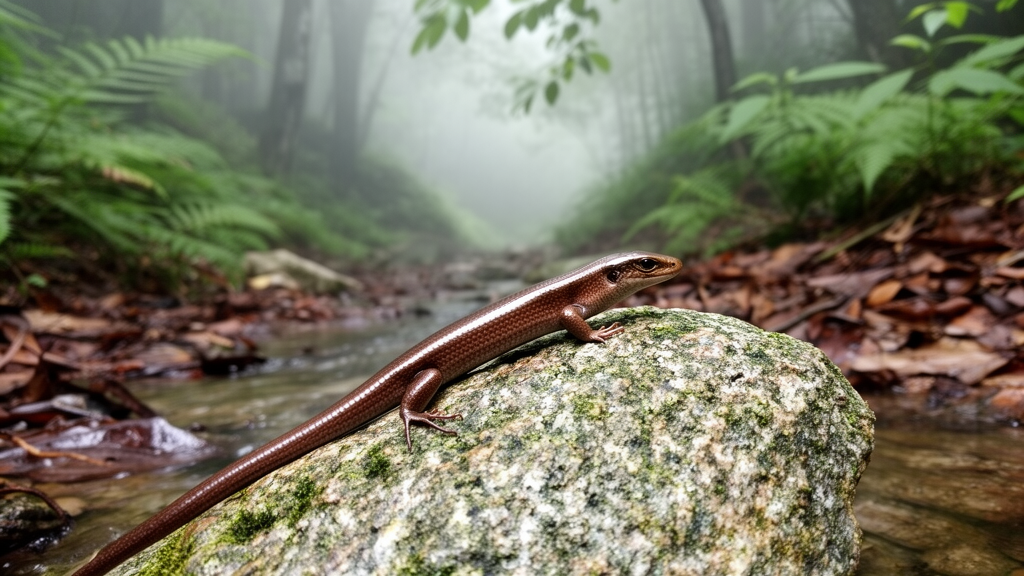
Deep in the Dabie Mountains, where the provinces of Anhui, Henan and Hubei converge, a small bronze lizard has been hiding in plain sight. Scientists surveying the forested slopes between 2020 and 2025 collected 39 ground skinks of the genus Scincella, expecting to sort them into familiar species. Instead, genetic sequencing and careful anatomical comparisons revealed something far more exciting: an entirely undescribed species, now named Scincella dabieshanensis, the Dabie Mountains Ground Skink. The discovery, published in Zoosystematics and Evolution, brings the number of Scincella species recorded in China to 19 and adds a new branch to one of the most taxonomically tangled lizard lineages in Asia.
The genus Scincella belongs to the family Scincidae, the skinks, which is among the most species-rich lizard families on Earth with roughly 291 genera and more than 2,000 species. Ground skinks are small, smooth-scaled reptiles with short limbs, long tails and a transparent window in the lower eyelid, a feature that gives them their characteristic bright-eyed appearance. Their conservative body plan means that closely related species often differ only in subtle proportions, scale counts and stripe patterns, which has made the genus a notorious challenge for taxonomists. Fifty-one species are currently recognized worldwide, and a remarkable twelve of them have been described in the past two years alone, a signal that the true diversity of the group remains badly underestimated.
What makes the new find particularly significant is its location. Research on Scincella in China has concentrated on the mountainous southwest, the country’s center of diversity for the genus, where twelve of the 19 known species occur. Eastern China, by contrast, had yielded only three species: S. modesta, S. formosensis and S. vandenburghi. Previous studies had already raised red flags, reporting that S. modesta appeared to be polyphyletic, meaning that specimens assigned to that species did not all share a single common ancestor, and documenting a surprising population of S. vandenburghi in Qingdao, Shandong Province. Because the Dabie Mountains lie geographically between Qingdao, Ningbo and Yichang, the team reasoned that intensive sampling there could help untangle the relationships among these problematic populations.
The molecular work behind the discovery was extensive. The researchers extracted genomic DNA from liver tissue and sequenced four mitochondrial gene fragments, 12S, 16S, COI and CYTB, together with one nuclear gene, RAG1, generating a concatenated dataset from 137 homologous sequences representing 32 Scincella species plus an outgroup. Phylogenetic trees reconstructed by both maximum-likelihood and Bayesian inference methods produced strikingly similar topologies, giving the team high confidence in the evolutionary relationships they inferred. The results showed that the 39 Dabie specimens comprised 23 individuals of the new species and 16 belonging to S. vandenburghi, confirming for the first time that two distinct Scincella species coexist in the same mountain range.
The genetic evidence was unambiguous. Within the new species, uncorrected genetic distances in the 16S rRNA gene ranged from just 0.2 to 0.4 percent, while distances to other congeneric species varied between 3.0 and 11.0 percent. The closest relative proved to be S. vandenburghi, at a minimum distance of 3.0 percent, which sits exactly at the widely accepted threshold for lizard species delimitation. The greatest divergence, 11.0 percent, was from S. gemmingeri. Phylogenetically, the new species was recovered as the sister lineage to populations previously labeled S. modesta from Yichang in Hubei and Nanjing in Jiangsu, with strong nodal support, and this combined clade is in turn sister to a larger lineage containing S. vandenburghi, S. formosensis, S. dunan and S. boettgeri.
Morphology told a parallel story. The new skink is slender and small, with snout-vent lengths between 24.47 and 40.60 millimeters, making it noticeably smaller than its closest relative. Analysis of variance revealed significant differences from S. vandenburghi in snout-vent length, head length, head width, head depth, palpebral-disc diameter, snout length, interorbital distance, midbody width and axilla-groin distance. Principal component analysis, based on size-corrected morphometric data, showed that the two species form separate, tight clusters, with the first two components explaining 42.8 percent of total variance. Several diagnostic characters stand out: the new species has 9 to 12 enlarged lamellae beneath the fourth finger and 14 to 17 beneath the fourth toe, compared with 8 to 10 and 11 to 14 in S. vandenburghi, and, most tellingly, when the limbs are pressed against the body, the toes and fingers touch or overlap in the new species but do not in S. vandenburghi.
The holotype, an adult female catalogued as AHU 25079, was collected on 16 September 2025 at Jingangtai in Shangcheng County, Henan Province, at an elevation of 620 meters. In life, the lizard displays a bronze dorsum with two longitudinal dark stripes whose upper edges are relatively wavy and lower edges irregular, a reddish-brown head scattered with dark spots, and a creamy white underside. The species has so far been found at only four locations, all in the hinterland of the Dabie Mountains, where specimens were collected diurnally at elevations of 400 to 1,000 meters, concealed in rock crevices under leaf litter, beneath decaying logs or beside tree roots, with ambient temperatures of 28 to 30 degrees Celsius and water sources just a few meters away.
The Dabie Mountains themselves are emerging as a hotspot of herpetological endemism. The range serves as the watershed separating the Yangtze and Huaihe River basins and is home to eight amphibian species endemic to the region. Recent years have seen the description of a endemic snake, Achalinus dabieshanensis, a gecko, Gekko dabieshanensis, and a tree frog, Hyla dabieshanensis, all bearing the mountain range’s name. The new skink now joins this growing roster, and the researchers suggest that the region’s favorable geography and climate provide ample opportunities for speciation, making it a priority for future biodiversity surveys.
Perhaps the most consequential finding concerns S. modesta, a species described by Günther in 1864 whose taxonomy has long been problematic. The phylogeny recovered S. modesta as paraphyletic: the population from its type locality in Ningbo occupies a basal position, while specimens from Nanjing and Yichang, previously archived in GenBank as S. modesta, nested within the S. dabieshanensis clade with strong support. Given that genetic distances among these lineages do not exceed the interspecific threshold, the team considers the Nanjing and Yichang populations conspecific with the new species. This discrepancy between original morphological identifications and true evolutionary history highlights the presence of cryptic species within the genus and suggests that the taxonomic labels of many museum specimens may not accurately reflect their phylogenetic placement.
Notably, the results also challenge the assumption that the Yangtze River acts as an absolute biogeographic barrier for these tiny lizards, since populations of the new species appear on both banks, in the Dabie Mountains, Nanjing and Yichang, and are likely conspecific. The team also hypothesizes that S. vandenburghi might be a junior synonym of the northern subspecies S. m. septentrionalis, described by Schmidt in 1927, because the two could not be separated by any of the characters previously used to distinguish them. Resolving these questions will require extensive sampling, including at the type locality of S. m. septentrionalis on Mount Xinglong in Hebei Province. For now, the discovery of S. dabieshanensis stands as a vivid reminder that even in well-populated eastern China, an entire species can slip unnoticed beneath the leaf litter, waiting for the right combination of fieldwork, sequencing and skeptical eyes to bring it into the light.
Subject of Research: A new Scincella species ( Squamata , Scincidae ) from the Dabie Mountains, China, with delimitation of its closely related congeners
Article Title: A new Scincella species ( Squamata , Scincidae ) from the Dabie Mountains, China, with delimitation of its closely related congeners
Article References: Zhang, H., Yi, F., Yang, L., Wang, X., Xu, S., Zhan, Z., Zhai, X., Chu, J., Hou, M., Zhang, Y., Wen, J., Zhang, C., & Zhang, B. (2026). A new Scincella species (Squamata, Scincidae) from the Dabie Mountains, China, with delimitation of its closely related congeners. Zoosystematics and Evolution, 102(4), 1005-1022. https://doi.org/10.3897/zse.102.187997
Image Credits: AI Generated
Keywords: Scincella, species, Squamata, Scincidae, Dabie, Mountains, China, delimitation, closely, related, congeners, scientific research
Cite Scienmag News
Drew Townsend. (October 17, 2026). A new Scincella species (Squamata, Scincidae) from the Dabie Mountains, China, with delimitation of its closely related congeners. Scienmag. https://scienmag.com/a-new-scincella-species-squamata-scincidae-from-the-dabie-mountains-china-with-delimitation-of-its-closely-related-congeners/
Drew Townsend. "A new Scincella species (Squamata, Scincidae) from the Dabie Mountains, China, with delimitation of its closely related congeners." Scienmag, 17 October 2026, https://scienmag.com/a-new-scincella-species-squamata-scincidae-from-the-dabie-mountains-china-with-delimitation-of-its-closely-related-congeners/. Accessed 17 October 2026.
Drew Townsend. "A new Scincella species (Squamata, Scincidae) from the Dabie Mountains, China, with delimitation of its closely related congeners." Scienmag. October 17, 2026. https://scienmag.com/a-new-scincella-species-squamata-scincidae-from-the-dabie-mountains-china-with-delimitation-of-its-closely-related-congeners/


