


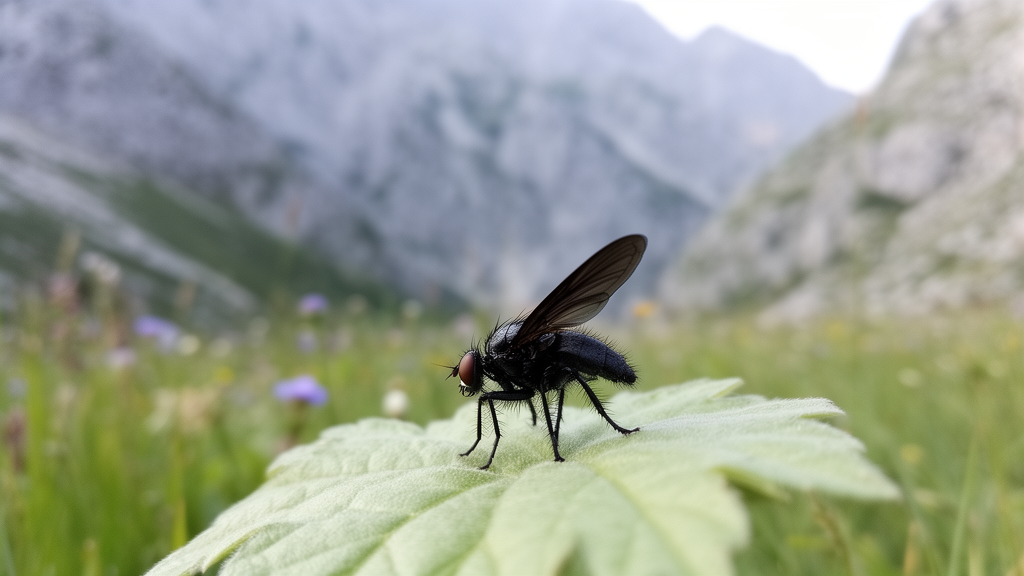
Deep in the karst highlands of central Albania, a team of Hungarian entomologists has uncovered a fly so unusual that it required an entirely new species description. During a five-day field expedition in October 2025, researchers swept up specimens of a fly family never before formally documented in the country, including one individual whose wings are so densely covered in black microscopic hairs that they appear almost completely dark. The discovery, published in the journal Evolutionary Systematics, marks the first specimen-based record of the family Psilidae from Albania and adds a strikingly distinctive new species to the European fauna.
Psilidae, commonly known as rust flies, is a small family of acalyptrate Diptera comprising roughly 340 species worldwide. Europe, including Turkey and the Caucasus in the broad sense used by specialists, currently hosts at least 61 described species. Despite this diversity, the Balkan Peninsula remains one of the most poorly surveyed regions for these insects. Previous compilations listed just two species from Serbia, one from Montenegro, one from Croatia, and none at all from Albania, figures that stand in stark contrast to neighbouring non-Balkan countries such as Hungary, where approximately 25 species have been recorded.
The new study, led by researchers collecting Brachycera material across Albanian mountain habitats between 9 and 13 October 2025, changes that picture. Specimens were gathered by sweep netting at elevations between 850 and 1450 metres above sea level, killed with ethyl acetate, and preserved dry on minuten pins before being deposited in the Hungarian Natural History Museum in Budapest. Male genitalia were dissected, macerated in approximately 10 percent sodium hydroxide solution, neutralised with lactic acid, and examined under compound magnifications of 50 to 400 times, a standard protocol for distinguishing morphologically cryptic psilid species.
Among the material, the team identified Chamaepsila homochroa, a species originally described from Israel and previously recorded in Europe only once, from Turkey in 2017. The Albanian finds, consisting of twelve specimens from three localities, represent the westernmost known occurrence of the species and only its second record from Europe. The species is characterised by a uniformly dark body, three to four dorsocentral setae, an elongated frontal triangle, and, most diagnostically, an apically forked phallus, a feature the original describers considered unique within the genus. Notably, the Albanian specimens all possess four dorsocentral setae, matching the Turkish material rather than the predominantly three-setae Israeli populations.
The phenology of the captures proved equally interesting. The type specimens of C. homochroa were collected between November and January, and the earliest Turkish record dated from 22 October. The Albanian specimens, taken on 10 and 11 October, now constitute the earliest known records of the species anywhere in its range. This supports the hypothesis that the flight period of the Chamaepsila hebraica species group shifts earlier at higher latitudes, farther from the equator, a pattern consistent with the general tendency of many insects to advance seasonal activity in cooler climates.
The centrepiece of the paper, however, is the formal description of Chamaepsila gropensis sp. nov., a species named after the Mali me Gropa massif, whose Albanian name means hill full of pits. The holotype, a single male measuring 4.2 millimetres in body length with a 3.8-millimetre wing, was swept from a stand of bracken fern, Pteridium aquilinum, growing on a steep west-facing karstic slope in a recently burnt area at approximately 1400 metres elevation. The species is immediately distinguishable from all other Palearctic Chamaepsila by its strongly and uniformly darkened, blackish wings, a pigmentation produced by dense black microtrichia, microscopic hair-like structures, covering practically the entire wing surface on both sides. In familiar relatives such as the carrot fly, Chamaepsila rosae, these microtrichia are light, yellowish to brownish, and sparsely distributed, leaving the wings fully transparent or only slightly darkened.
Based on overall habitus, male genitalia, head and thoracic coloration, setation, leg patterning, and even flight period, C. gropensis belongs to the C. hebraica group and most closely resembles C. homochroa. The two species differ in several decisive characters: C. homochroa has transparent wings and three to four dorsocentral setae, whereas C. gropensis bears only two. The phallus of the new species tapers toward the apex from its midpoint and is not forked, meaning its terminal parts do not cross each other, unlike the distinctive forked structure of C. homochroa. Additional differences in femoral coloration, frontal triangle pigmentation, and antennal segmentation separate it from other superficially similar species that emerge from existing European and Palearctic identification keys.
Because psilid species can sometimes have enormous distributions, the authors also ran the new species through the comprehensive Palearctic and Oriental key by Shatalkin, which covers the genus Psila in the broad sense. Depending on how the vertical setae are counted, the specimen keys out near Chamaepsila sardoa or Chamaepsila mixta, but both alternatives are excluded by the blackish wings, entirely black antennae, and dark leg coloration of the Albanian fly. The detailed morphological description covers the glossy black thorax and abdomen, the yellow-and-black leg segmentation, the dark wing venation with a section of vein R4+5 more than four times the length between the r-m crossvein and its junction with R2+3, and the finely sclerotised male terminalia, all documented with high-magnification photographs and line drawings.
The ecological context of the discovery adds another layer of intrigue. While C. homochroa proved to be a common species during the trip, swept from several localities across different habitat types, particularly around Liqeni i Shkallës, a small lake surrounded by rocky slopes, C. gropensis is known exclusively from its type locality and is likely a local, potentially endemic species associated with karst habitats. Its host-plant association remains unknown, but the fact that the single specimen was collected by sweeping in bracken suggests a possible relationship with this fern, which will require targeted investigation to confirm. The female of the species remains entirely unknown, leaving much of its biology a mystery.
The findings underscore how much basic biodiversity documentation remains to be done even in well-travelled corners of Europe. The Psilidae fauna of Albania now stands at just three recorded species, and the authors argue that active collecting across the Balkan Peninsula, especially in higher-altitude areas, is likely to reveal further Chamaepsila species. As supporting evidence, they note that the four most recently described European species of the genus, including C. gropensis itself, have all been collected above 800 metres elevation. For a family that includes agriculturally significant pests such as the carrot fly, which causes substantial economic losses in cultivated Apiaceae crops like carrot, celery, and parsley, understanding the true diversity and distribution of Psilidae is not merely an academic exercise but a practical necessity for developing non-chemical control strategies and effective population monitoring.
Subject of Research: First record of Psilidae flies from Albania and the description of a new black-winged Chamaepsila species
Article Title: The occurrence of the family Psilidae ( Diptera ) in Albania, with description of a new Chamaepsila Hendel, 1917 species
Article References: Varga, N., Horváth, Á., & Balogh, B. (2026). The occurrence of the family Psilidae (Diptera) in Albania, with description of a new Chamaepsila Hendel, 1917 species. Evolutionary Systematics, 10(1), 93-99. https://doi.org/10.3897/evolsyst.10.188012
Image Credits: AI Generated
DOI: 10.3897/evolsyst.10.188012
Keywords: Psilidae, Chamaepsila, Albania, new species, Diptera, taxonomy, Balkans, karst habitat, entomology, biodiversity, Chamaepsila homochroa, Mali me Gropa
Cite Scienmag News
Margaret Porter. (October 17, 2026). Tiny Black-Winged Fly from Albanian Mountains Is a Brand-New Species. Scienmag. https://scienmag.com/tiny-black-winged-fly-from-albanian-mountains-is-a-brand-new-species/
Margaret Porter. "Tiny Black-Winged Fly from Albanian Mountains Is a Brand-New Species." Scienmag, 17 October 2026, https://scienmag.com/tiny-black-winged-fly-from-albanian-mountains-is-a-brand-new-species/. Accessed 17 October 2026.
Margaret Porter. "Tiny Black-Winged Fly from Albanian Mountains Is a Brand-New Species." Scienmag. October 17, 2026. https://scienmag.com/tiny-black-winged-fly-from-albanian-mountains-is-a-brand-new-species/


