


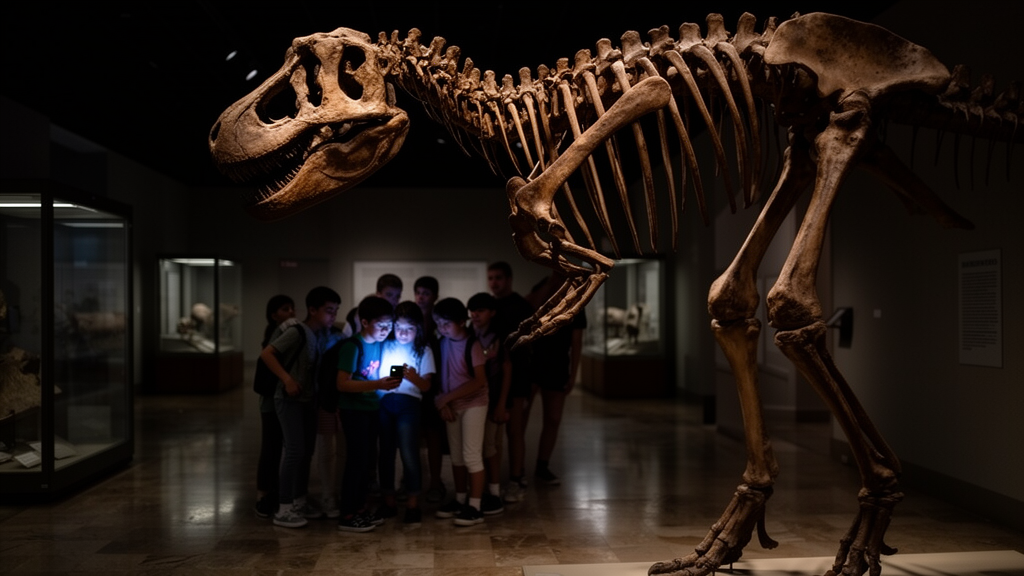
Basic science often comes with an existential question: why? Why collect, study, and pursue knowledge that seems esoteric? Most researchers can give impassioned answers, citing real-world applications and world-changing advances built on curiosity-driven science. Yet many also quietly acknowledge that most of their scholarly pursuits will never lead to any direct human application. When utilitarian arguments are limited or hopeful aspirations for future work, what more immediate value propositions can be made for basic scientific research? A provocative new argument published in the journal Natural History Collections and Museomics proposes an unexpected answer: media-based storytelling should become a more prominent application of basic research, and natural history museums and the researchers within them are uniquely positioned to fill that opportunity gap.
The argument is exemplified through a media-making experience from a decade ago. The author, then a post-doctoral researcher and a few years into producing online media about their science, was invited to co-instruct an ant systematics-focused field course sponsored by the California Academy of Sciences. Working with students, they produced a set of short videos about what the students were learning. For one video, they interviewed the course instructors—all ant biology researchers—asking each the same question: why does ant diversity matter? The answer that both surprised and resonated most came from Jack Longino, a leading expert in ant alpha taxonomy who had, at the time of filming, described and named more than 130 new ant species. While other instructors emphasized the need to understand the biological world at large, Longino’s answer was strikingly different.
Longino admitted he was not sure why it matters, noting that it is simply something a lot of people study. Everybody knows what ants are, he observed, and there is a word for ant in every language. Whenever he goes to dinner parties, he said, pretty soon everybody gathers around him as he tells stories about ants—it kind of captures people’s attention. The response felt near to an admission that basic biology might not matter in a conventional sense. Yet Longino pointed to ways his work connects to people that nearly all natural history researchers can relate to. First, everyone has some baseline familiarity with nature. Second, people are curious to deepen their experience with the natural world and are fascinated by hearing directly from people who can provide that special insight. In today’s online media environment, everyone has an opportunity to share stories that reach and influence a broad range of people. Like Longino’s dinner parties, media platforms such as YouTube, TikTok, and Instagram are places people regularly go to hear stories and connect with those sharing unique insights. Natural history researchers have interesting stories to tell and objects to show that provide special insights into our world—and the argument is that they need to show up to these online dinner parties and tell their stories more often.
So are museums actually talking about their collections and research online? The evidence suggests largely not. Though many natural history museums are housed in institutions with public-facing missions, exhibits, and programming, museum collections and the research they facilitate have been largely inaccessible to public audiences. In recent decades, digital efforts have opened access in a few ways: online specimen digitization has provided digital access to collections, and collections-based research has engaged public audiences through citizen and participatory science projects. Despite these efforts, there is a persistent recognition of a field-wide need to better communicate the value of museums. A consensus report on biological collections from the National Academies of Sciences, Engineering, and Medicine found that a consistent challenge facing biological collections is a lack of awareness of their value, and that the collections community needs to improve its ability to communicate the importance of specimens in research and education to a wider audience, especially to funders and decision makers.
Social scientists have made informative assessments of what natural history museums communicate through online platforms, and they have found that stories about collections and research functions are largely missing. In a study of the Museum of Natural History of Florence, researchers found that sharing information about collections was mentioned only once among nine stated communication objectives across six social media platforms. The museum’s content was mostly focused on promoting tourist visitation, generated mostly as an instrument for communicating the museum’s activities to potential or actual visitors. Another study analyzed Instagram posts from 108 different science museum accounts and found that 31 percent of posts had no science-related content, only 11 percent depicted a science-related professional, and fewer than 1 percent provided any information about the scientific process or discovery. Instead, the posts promoted public-facing exhibits and activities, missing opportunities to raise awareness of the inner workings of the museum. This practice of using social media primarily for event listings and promotion is pervasive beyond natural history museums, having also been documented in US history and art museums and across nearly 300 museums in Berlin and Prague.
More recently, the author and collaborators assessed 574 English-language YouTube videos published in 2019 and 2023 by 28 US natural history museums with collections and research staff. Of those videos, 24 percent—or 137—were uploads of live event recordings, a practice of using YouTube as an archive for live recordings and hoping that users will watch this second-hand content instead of content made specifically for the platform. For the remainder, made specifically to communicate to a YouTube audience, the content was categorized by main topic. Across all videos, only 16 percent were about original research and just 6 percent were about collections or specimens. Most videos posted were promotional content about museum exhibits and programs, much as the earlier studies reported. This is a practice akin to using social media accounts like a physical billboard, advertising to locals who might be driving by. However, social media platforms are global in their reach, and much of the potential audience will likely never physically visit a particular museum. Using museum accounts to primarily advertise to in-person visitors means the content is irrelevant to most of a platform’s users—a non-consideration also reflected in the finding that nearly a quarter of natural history museum YouTube content consists of second-hand live recordings.
There is, however, good news in this collective assessment: it reveals an opportunity. Collections and research facilitated by natural history museums have been the basis of many successful and effective social media channels—most happening off main museum institutional pages. YouTube remains the most popular and widely used social media platform across all age demographics, and several examples demonstrate what effective museum content looks like. The American Museum of Natural History, in stark contrast to its institutional output, debuted an eight-episode YouTube series called Insectarium! centered on research and hosted by an AMNH curator. Each episode, directed and produced by museum staff, featured researchers on-screen and in the field doing their work. The on-screen host, Dr. Jessica Ware, contextualized both the information and the research from her perspective as a museum entomologist and curator, often presenting from inside the collections themselves. The videos have been viewed millions of times, humanizing science and providing a diverse portrait of museum work by centering women and people from a broad range of racial backgrounds. The series was funded through a National Science Foundation grant to PBS Digital Studios and published on the PBS Terra channel—meaning viewers will not find these views of museum science on the museum’s main YouTube page.
Other examples reinforce the pattern. Both the Field Museum and the North Carolina Museum of Natural Sciences have institutional-branded YouTube channels dominated by uploads of live event recordings, with total view counts under six million and subscriber audiences under 20,000 relative to hundreds of uploads over fifteen or more years. This is contrasted by two channels that have operated within these museums focusing on communicating museum-based research and collections activity: The Brain Scoop, formerly with the Field Museum, and Ant Lab, the author’s own channel while at NCMNS. With tens of millions of views and hundreds of thousands of subscribers, both channels reach larger audiences than their respective institutions. The Brain Scoop, created and hosted by Emily Graslie, began when Graslie started filming behind-the-scenes stories from working at the Philip L. Wright Zoological Museum at the University of Montana. From there, Graslie was hired into the Field Museum to continue producing collections and research focused stories, finding success in presenting behind-the-scenes portrayals of research and humanized interviews with researchers themselves. Ant Lab started out of a desire to create video-based summaries of the author’s own research papers, expanding into entomology-focused natural history content and behind-the-scenes access to colleagues’ work. In contrast, the channel Odd Animal Specimens focuses strictly on presenting informative videos about biological museum specimens and is produced by a full-time independent content producer without a museum staff appointment, built early on around specimens from the University of Michigan’s Museum of Zoology. Its visually stylized, educational, specimen-based approach has attracted millions of subscribers and more than one billion video views—a proof of value and public interest in specimen-based content.
The implications of storytelling as an application of basic research are significant. Successful natural history museum media can be made from many different creator perspectives: Insectarium! and Brain Scoop show collaboration between museum research and communication staff, Ant Lab is produced solely by a museum researcher, and Odd Animal Specimens is produced entirely outside museum communication efforts. Regardless of who creates the content, stories about natural history collections and museum-based research have proven their interest to large audiences. The media environment is not saturated with this type of content, and there remain great opportunities for individuals within and beyond natural history museums to tell their stories. Doing so will benefit the museum field at large and, potentially, individual careers in unexpected ways. In the author’s own experience, making media about museum-based science has reconfigured what doing scholarly work looks like—now, when pursuing new research projects, they consider what they can do to produce work relevant to a peer-professional audience as well as an interested-public audience. Because the work has been made accessible and interesting to public audiences, collaborations with artists, opportunities with public-television shows, and speaking engagements have followed that would not have been accessible otherwise. Generating online content has also opened additional revenue streams for the lab, making it possible to fund student research and assistantships through things like adsense revenue on YouTube and funds from content licensing. Of course, putting considerable time and effort into online content creation has meant doing less traditional scholarly work, and content creation is not without its own challenges.
A main challenge of online platforms is navigating—and hopefully breaking through—their algorithm-driven recommendation systems to find an audience. Platforms like YouTube have changed from an original broadcast-yourself ethos to a place where mainstream legacy broadcast television shows post videos competing for attention from the same audience an amateur creator might hope to reach. A platform’s focus on audience attention and user engagement also means science content must compete with sensationalized click-bait, emotionally-charged anecdotes, and even content intentionally made to misinform. This can lead to the most-watched science videos on a particular topic being those with misinformation made by non-experts with commercial bias. Social science experts observe that this is a new media ecosystem wherein scientists must compete in an attention economy in which they are just one of many voices, and in which proprietary algorithms now serve as a new kind of gatekeeper. Collectively, this can make getting started and finding an audience seem like an impossible task for individuals or institutions beginning to create content in addition to the time required for traditional work. However, most scientists have stories that no one else can tell, and most museums have specimens and collections that many people do not have access to or have never even seen. Showcasing unique personal stories, specimens, and spaces is how natural history museum content can break through a competitive online media marketplace. The professionalization of science communication also offers an opportunity to reframe online storytelling as professional work—for individual researchers, whether collaborating with a producer or making content themselves, it is important to legitimize this work as part of a portfolio of scholarly output, through interacting with professional science communication societies, publishing in science communication journals, and applying for awards specifically for those who communicate science to public audiences. The hope, ultimately, is that those in the museum collections and research field will continue to find value in telling stories about their work at dinner parties—and that some will find inspiration to bring those stories beyond the dinner party and onto online media platforms as well.
Subject of Research: Online media as an application of natural history museum science
Article Title: Online media as an application of natural history museum science
Article References: Smith, A. A. (2026). Online media as an application of natural history museum science. Natural History Collections and Museomics, 3, Article e176227. https://doi.org/10.3897/nhcm.3.176227
Image Credits: AI Generated
Keywords: Online, media, application, natural, history, museum, science, scientific research
Cite Scienmag News
Cora Reilly. (October 17, 2026). Why Natural History Museums Are Missing Their Biggest Online Audience. Scienmag. https://scienmag.com/why-natural-history-museums-are-missing-their-biggest-online-audience/
Cora Reilly. "Why Natural History Museums Are Missing Their Biggest Online Audience." Scienmag, 17 October 2026, https://scienmag.com/why-natural-history-museums-are-missing-their-biggest-online-audience/. Accessed 17 October 2026.
Cora Reilly. "Why Natural History Museums Are Missing Their Biggest Online Audience." Scienmag. October 17, 2026. https://scienmag.com/why-natural-history-museums-are-missing-their-biggest-online-audience/


