


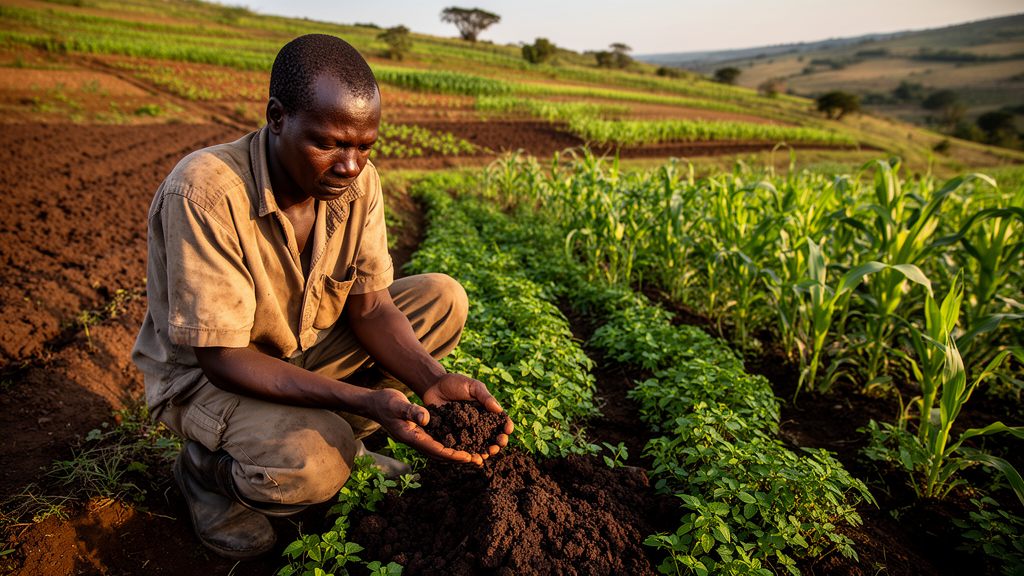
Regenerative agriculture has been heralded as a pathway to restore degraded soils, strengthen agroecosystem functioning, and build resilience in farming systems under mounting pressure from climate variability and land degradation. Yet a new study from Kenya reveals that the way smallholder farmers engage with this principle-based approach is far more complex than the simple adopter-versus-non-adopter categories that dominate empirical research. The findings, published in Discover Sustainability, challenge the binary lens through which agricultural adoption is routinely measured and expose a spectrum of engagement states that carry distinct implications for policy and practice.
The research team, led by Joshua Muloi of the Center for Development Research at the University of Bonn, conceptualized regenerative agriculture adoption not as a single decision but as a continuum of engagement. Working across two contrasting Kenyan counties—semi-arid Makueni in the southeast and the humid, commercially intensive Kirinyaga on the slopes of Mount Kenya—the researchers combined an exploratory qualitative phase with a large household survey. The qualitative work involved 33 individual farmer interviews, 14 focus group discussions, 9 expert interviews, and a stakeholder workshop with 196 participants, conducted in Swahili, Kamba, and Kikuyu languages between September and December 2024. These insights then informed the design of a survey administered to 949 farmers between August and September 2025.
Regenerative agriculture is organized around five core principles rather than a fixed package of technologies: minimizing soil disturbance, maximizing soil cover, increasing agrobiodiversity, maintaining living roots in the soil, and integrating livestock into cropping systems. Because farmers engage with combinations of interdependent practices rather than a single technology, the researchers argue that conventional binary measures collapse substantively different forms of engagement into one misleading distinction. A farmer experimenting with zai pits on a small plot, a farmer who delayed uptake for years after first hearing about the approach, and a farmer who abandoned the practices altogether may all be lumped together as non-adopters—or, conversely, as adopters—despite occupying fundamentally different positions.
To capture this heterogeneity, the team developed a seven-state typology based on four interconnected dimensions: awareness, uptake timing, continuity of use, and post-adoption behavioral adjustment. The states distinguish farmers who are not aware of regenerative agriculture, aware non-adopters, disadopters who previously practiced but stopped, trailing adopters who experienced delayed uptake, new adopters, plateau adopters who maintain practices without intensifying, and intensifying adopters who expand their engagement over time. The classification draws on social practice theory, which conceptualizes change as the reconfiguration of everyday practices through the interaction of materials, competences, and meanings rather than as a sequence of isolated individual decisions.
The results expose how much the binary lens conceals. A conventional classification would identify 49 percent of surveyed farmers as current implementers and 51 percent as non-implementers. But the seven-state breakdown reveals that within the non-implementer group, 33.7 percent had never heard of regenerative agriculture, 13.8 percent were aware but had not implemented it, and 3.5 percent had previously practiced and discontinued. Among implementers, 11.1 percent were trailing adopters with delayed uptake, 20.7 percent were new adopters, 2 percent had plateaued, and 15.3 percent were intensifying their engagement. The researchers emphasize that these states represent cross-sectional positions consistent with potential adoption pathways rather than directly observed transitions over time.
Qualitative evidence reinforced the quantitative patterns. Farmers described testing practices on small portions of their land before expanding, with one reporting that she started on one-eighth of an acre and subsequently expanded to three-quarters of her property. Another explained that each farmer picked what worked for their own farm from the range of practices they had been trained on. Discontinuation took varied forms: some farmers stopped individual practices that produced limited benefits or did not fit their conditions, while others withdrew from groups implementing the approach because of heavy labor requirements or unmet expectations of financial support. In the coffee-growing context of Kirinyaga, farmers described converting gradually to avoid disrupting existing production, for instance by grafting a limited number of coffee stems at a time rather than changing the entire farm at once.
Using a multinomial logit model with the not-aware group as the base outcome, the researchers examined which socioeconomic and institutional factors were associated with membership in each state. Credit access emerged as the most consistent correlate across engagement states beyond awareness. Farmers with access to credit had a 12-percentage-point higher predicted probability of being new adopters, while their probabilities of being not aware and aware non-adopters were 14.3 and 6.7 percentage points lower, respectively. Qualitative accounts provided a plausible mechanism: farmers described needing financial resources to hire labor, obtain manure, and acquire other inputs required for implementation. In Kirinyaga, some farmers accessed loans or advances through coffee cooperatives and tea factories connected to the Rainforest Alliance’s Mount Kenya Sustainable Landscape and Livelihoods programme.
Other factors showed more selective and sometimes counterintuitive associations. Land tenure security was negatively associated with being an aware non-adopter, disadopter, or trailing adopter relative to not being aware, but positively—though weakly—associated with intensifying adoption. The qualitative findings help explain why formal ownership should not be equated with operational control: participants described households where land was registered to men while women managed the farming, or where members cultivated separate portions. Marriage was positively associated with trailing and intensifying states, but the researchers interpret this as a marker of heterogeneous household decision and support arrangements rather than a single mechanism. Men were less likely than women to be classified as disadopters or new adopters relative to the not-aware category, while other gender comparisons were not statistically significant. Farm income was not significantly associated with any engagement state, and off-farm income was only weakly and negatively associated with intensifying adoption, suggesting that resource endowments alone are insufficient to explain engagement patterns.
The study identifies two critical transition gaps. First, a third of all farmers were unaware of regenerative agriculture, indicating an awareness gap that reflects limited knowledge diffusion among smallholders. Second, aware non-adopters, farmers with delayed uptake, and disadopters highlight a conversion gap: awareness alone does not resolve the practical constraints of labor requirements, limited income, perceived risks, and the need to observe convincing results before committing resources. The predominance of new adopters points to a recent wave of initial uptake, potentially linked to growing visibility of the approach through governmental and non-governmental programmes. Meanwhile, plateau engagement emerges as a distinct and relatively underexplored state in which farmers maintain practices without further intensification, for reasons the researchers hypothesize may include standardized training framings that limit continued experimentation, biophysical and production constraints, deliberate maintenance when benefits of expansion do not outweigh costs, or social identity dynamics that confer recognition without incentivizing further change.
The findings carry direct implications for how regenerative agriculture is promoted and financed. The researchers argue that extension systems and public-private advisory services should shift from one-off dissemination toward long-term accompaniment that supports iterative learning and progression across engagement states. Subsidies, grants, concessional credit, or in-kind support could help reduce the financial constraints that appear to bind most tightly during initial implementation, when farmers face upfront costs and delayed or uncertain returns. Programme monitoring systems could incorporate indicators of awareness, adoption timing, implementation intensity, and discontinuation to identify farmers requiring different forms of support. The seven-state typology, the team suggests, offers a potentially transferable framework for diagnosing where farmers sit along the engagement continuum and for designing state-contingent interventions that address both entry barriers and progression constraints—moving the field beyond the binary categories that have long obscured the differentiated reality of agricultural transitions among smallholders.
Subject of Research: Heterogeneous states of regenerative agriculture adoption among smallholders in Kenya
Article Title: Heterogeneous states of regenerative agriculture adoption among smallholders in Kenya
Article References: Muloi, J., Kamau, H., Betancur-Corredor, B., Kadenge, E., Rwanda, C., Wario, D. K., Stellmacher, T., Borgemeister, C., & Beuchelt, T. D. (2026). Heterogeneous states of regenerative agriculture adoption among smallholders in Kenya. Discover Sustainability, 7(1), Article 1737. https://doi.org/10.1007/s43621-026-05058-9
Image Credits: AI Generated
DOI: 10.1007/s43621-026-05058-9
Keywords: regenerative agriculture, smallholder farmers, Kenya, adoption pathways, credit access, mixed methods, multinomial logit, soil health, extension services, disadoption, agroecology, sustainability transitions
Cite Scienmag News
Alan Morgan. (October 17, 2026). Kenyan Smallholders Reveal Seven Distinct States on the Regenerative Agriculture Continuum. Scienmag. https://scienmag.com/kenyan-smallholders-reveal-seven-distinct-states-on-the-regenerative-agriculture-continuum/
Alan Morgan. "Kenyan Smallholders Reveal Seven Distinct States on the Regenerative Agriculture Continuum." Scienmag, 17 October 2026, https://scienmag.com/kenyan-smallholders-reveal-seven-distinct-states-on-the-regenerative-agriculture-continuum/. Accessed 17 October 2026.
Alan Morgan. "Kenyan Smallholders Reveal Seven Distinct States on the Regenerative Agriculture Continuum." Scienmag. October 17, 2026. https://scienmag.com/kenyan-smallholders-reveal-seven-distinct-states-on-the-regenerative-agriculture-continuum/


