


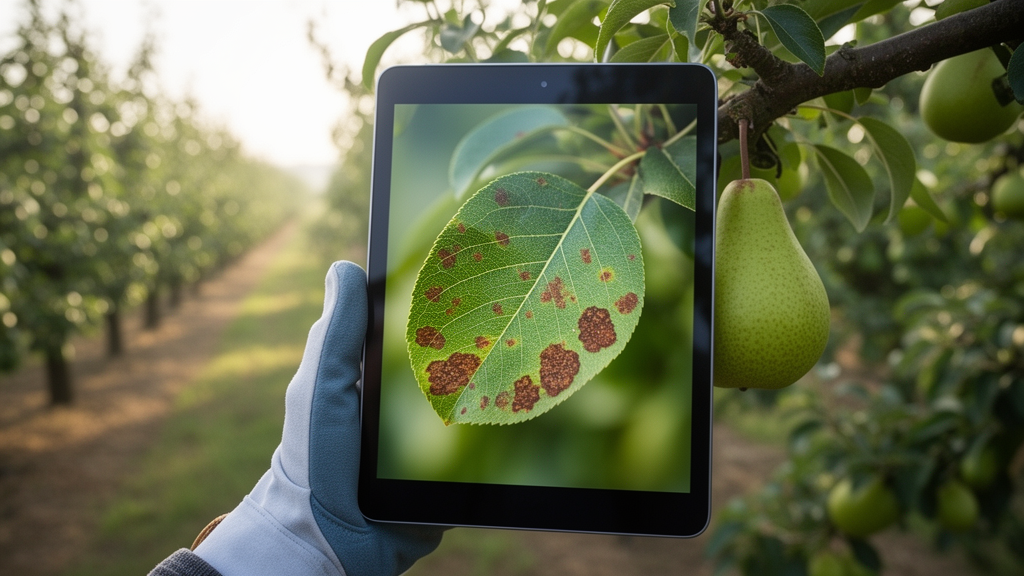
Pear orchards face a quiet but growing threat. Leaf curl, leaf spot, and slug damage spread through orchards long before symptoms reach the fruit, and by the time a grower notices, the economic damage may already be done. A research team at Vellore Institute of Technology in Chennai, India, has now built an artificial intelligence system designed to catch these diseases at the leaf stage, where early intervention can still save a crop. Their network, called SwinPyramidNet, achieved a classification accuracy of 92.69% on the DiaMOS Plant dataset, outperforming both leading convolutional neural networks and modern vision transformers on the same benchmark.
The stakes are considerable. Pears contribute more than 25 million metric tonnes to global production according to the U.S. Department of Agriculture, with China alone accounting for roughly 80% of the world’s pear cultivation area. The market value of the fruit is projected to climb from an estimated $32.35 billion in 2024 to $41.47 billion by 2028. Yet pear trees remain vulnerable to fungal diseases that distort leaves, hinder photosynthesis, and trigger premature leaf drop. Pathogens and pests are estimated to cause annual global crop losses of approximately US$220 billion, and conventional diagnosis, which relies on domain experts meticulously inspecting leaf surfaces, is labor-intensive, costly, and prone to human error, particularly in large-scale farming operations.
What makes SwinPyramidNet distinctive is its dual-track architecture. Rather than forcing a single network to learn everything, the researchers split the task. One track, built on the Swin Transformer, captures global contextual information by modeling long-range dependencies across the entire leaf image. The other track, a Hybrid Convolutional Feature Pyramid Network the team calls HCFPNet, focuses on fine-grained local features through multi-scale convolutional processing. The outputs from both branches are then fused and refined using a coordinate attention mechanism that encodes positional information to emphasize spatially relevant features across channels. This complementary strategy lets the network learn both the sweeping patterns of disease spread and the subtle local textures of individual lesions.
The Swin Transformer track works hierarchically. Input images, resized to 224 by 224 pixels with three color channels, are divided into non-overlapping patches known as tokens. A linear embedding layer reduces the dimensionality of these patch embeddings, and successive Swin blocks process them through alternating normalization layers, attention modules, and multi-layer perceptrons. The first sub-unit employs Window Multi-Head Self Attention to identify dependencies between patch embeddings, while the next applies Shifted Window Multi-Head Self Attention to concentrate on shifted windows. This shifted-window approach allows the architecture to efficiently capture long-range dependencies while reducing the number of parameters. A patch merging layer then reduces feature map resolution by combining representations of adjacent patches, producing a 96-channel activation map that feeds into the fusion stage.
The HCFPNet track takes a different route through the same image. It chains together Mobile inverted Bottleneck Convolution blocks, known as MBConv, alongside 2D convolution layers and batch normalization. Each MBConv block begins with an expansion layer that increases channel dimensionality, applies a depthwise separable convolution that captures spatial features at low computational cost, and finishes with a pointwise convolution that projects the features back to target output channels. A Squeeze and Excitation block performs channel recalibration, first reducing channels with ReLU activation and then expanding them with sigmoid activation, multiplying the resulting attention vector back into the feature map. Residual connections add the input directly to the output when shapes match, improving gradient flow and model stability. This efficient design makes the track suitable for resource-constrained environments.
At the end of the HCFPNet track, a Bidirectional Feature Pyramid Network, or BiFPN, fuses features from different spatial resolutions. Unlike traditional Feature Pyramid Networks, BiFPN introduces a bidirectional flow of information through weighted connections, allowing the model to leverage high-level semantic information and low-level details simultaneously. Once feature maps from different resolutions are dimensionally aligned, they are summed together, and two depthwise separable convolutions with 3-by-3 filters, batch normalization, and ReLU activation enhance the fused representation. The result is a track that captures both fine-grained and coarse-grained information, which the researchers found essential for accurate predictions.
The coordinate attention module then refines the combined features. The input feature map undergoes two parallel global pooling operations along its spatial dimensions, isolating positional cues specific to each axis. The pooled outputs are concatenated along the channel axis, processed through a 2D convolutional layer to blend spatial context, and passed through batch normalization and non-linear activation. The activated feature map splits into two paths, each generating separate attention maps for the height and width dimensions, activated with sigmoid functions to scale values between 0 and 1. These maps are broadcast and multiplied across the original feature map, re-weighting it to emphasize spatially significant channels while suppressing less relevant ones. The refined features then pass through global average pooling and a Softmax activation for final classification.
The team trained the network on the DiaMOS Plant dataset, which contains 3,006 pear leaf images distributed across four classes: curl, healthy, spot, and slug. The data was split 60:20:20 into training, testing, and validation sets, with random horizontal flipping, vertical flipping, and 90-degree rotations applied on-the-fly during training. Experiments ran on an NVIDIA Tesla P100 GPU with 16 GB of memory. Systematic hyperparameter tuning identified a batch size of 32, 50 epochs, the Adam optimizer with a learning rate of 0.0001, a dropout rate of 0.5, and a ReduceLROnPlateau scheduler with factor 0.5 and patience 3 as the optimal configuration. Ablation studies showed each component mattered: a baseline five-layer CNN reached 82.88% accuracy, adding MBConv blocks raised it to 83.45%, the full HCFPNet track alone achieved 85.68%, the Swin Transformer track alone 84.86%, and the dual-track network without coordinate attention 84.21%. Only when coordinate attention was added did accuracy jump to 92.69%, with precision of 93.02%, recall of 92.69%, and an F1 score of 92.78%.
Comparative benchmarks reinforced the result. Widely adopted CNNs including Xception, ResNet50, VGG16, MobileNetV2, and DenseNet121 all fell short, with the best, DenseNet121, reaching only 72.39% accuracy. Modern transformer architectures fared better but still trailed: the Swin Transformer alone managed 84.86%, Transformer-in-Transformer 84.19%, and the Vision Transformer 77.02%. Previous studies on the same dataset, including CycleGAN combined with ResNet50 at 86.59% and EfficientNetB0 with InceptionV3 at 91.14%, also came in below the new network. External validation showed meaningful generalization: the model achieved 94.27% accuracy on the PV_ALE apple leaf disease dataset and 80.50% on the broader PlantVillage benchmark, the latter reflecting distributional shift in imaging conditions and class compositions.
The researchers acknowledge limitations. The DiaMOS dataset lacks representation of environmental factors that affect disease presentation in practical settings, and the model’s computational complexity, at 42.86 million parameters and 40.36 GFLOPs, would need reduction for real-time deployment on resource-constrained devices. Future work, they suggest, could integrate domain adaptation techniques and cross-domain feature learning to enhance usability across diverse datasets. The team also envisions integrating such systems with drones for remote monitoring and diagnostics. Still, the findings highlight the applicability of hybrid CNN-Transformer architectures in smart agriculture and plant disease management, offering a reliable and efficient approach for automated pear leaf disease diagnosis at a moment when climate change continues to pressure cultivation worldwide.
Subject of Research: Artificial Intelligence in Agriculture
Article Title: SwinPyramidNet: a deep learning network for pear leaf disease classification using hybrid convolutional feature pyramids and swin transformer
Article References: Sharma, T., Shinde, N., Mukundh, J., Karthik, R., & Suganthi, K. (2026). SwinPyramidNet: a deep learning network for pear leaf disease classification using hybrid convolutional feature pyramids and swin transformer. Frontiers in Signal Processing, 6, Article 1821900. https://doi.org/10.3389/frsip.2026.1821900
Image Credits: AI Generated
DOI: 10.3389/frsip.2026.1821900
Keywords: deep learning, pear leaf disease, Swin Transformer, convolutional neural network, precision agriculture, coordinate attention, plant pathology, computer vision, SwinPyramidNet, deep, learning, network
Cite Scienmag News
Blake Davidson. (October 17, 2026). AI Learns to Read Pear Leaves: Hybrid Network Spots Disease With 92.69% Accuracy. Scienmag. https://scienmag.com/ai-learns-to-read-pear-leaves-hybrid-network-spots-disease-with-92-69-accuracy/
Blake Davidson. "AI Learns to Read Pear Leaves: Hybrid Network Spots Disease With 92.69% Accuracy." Scienmag, 17 October 2026, https://scienmag.com/ai-learns-to-read-pear-leaves-hybrid-network-spots-disease-with-92-69-accuracy/. Accessed 17 October 2026.
Blake Davidson. "AI Learns to Read Pear Leaves: Hybrid Network Spots Disease With 92.69% Accuracy." Scienmag. October 17, 2026. https://scienmag.com/ai-learns-to-read-pear-leaves-hybrid-network-spots-disease-with-92-69-accuracy/


