


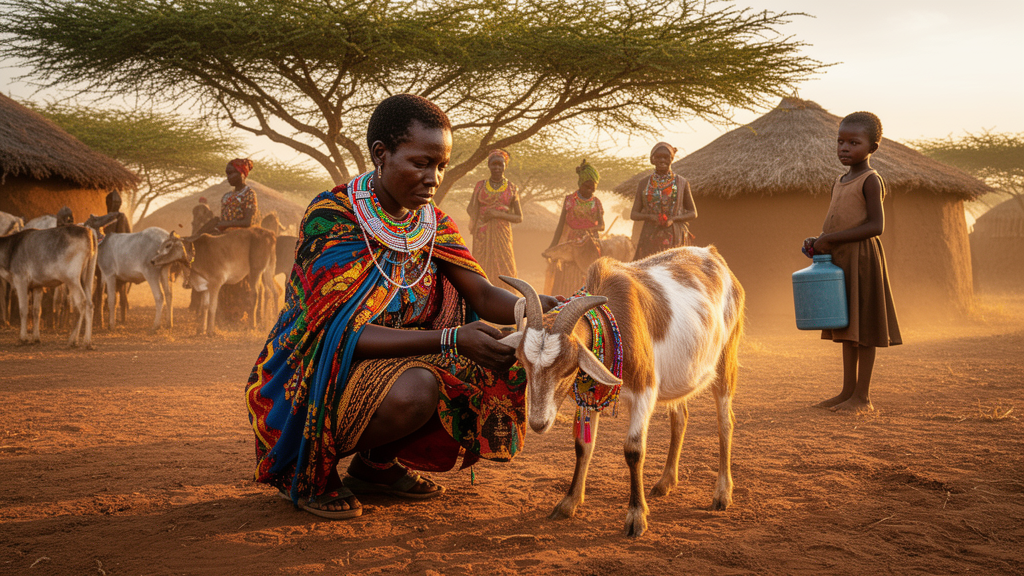
In the arid rangelands of Turkana County, northern Kenya, the health of people, livestock, and the environment is not an abstract policy concept but a lived, daily reality. A new study published in the journal Pastoralism reveals that pastoralist men and women in this drought-prone region understand the interconnected health system in strikingly different ways, and that these differences carry profound implications for how One Health policy is designed and delivered. The research, led by Evan F. Griffith of Tufts University’s Cummings School of Veterinary Medicine together with colleagues from the University of Nairobi and the Turkana County Government, is the first to empirically examine how pastoralist men and women themselves conceptualize One Health, the holistic framework that seeks to sustainably balance the health of humans, animals, and ecosystems.
Pastoralism is a livelihood practiced by more than 200 million people worldwide, and in East Africa’s drylands pastoralists manage most of the livestock while making significant contributions to national economies and ecosystem regulation. Yet these communities remain politically and economically marginalized, with markedly poorer health and development outcomes than sedentary populations. Turkana County, spanning 77,000 square kilometers, is home to roughly 1.26 million people, the majority of whom practice pastoralism. The county’s livestock herds are vast and diverse, including an estimated 2.8 million cattle, 6.7 million sheep, 6.9 million goats, nearly one million camels, 600,000 donkeys, and about 160,000 Indigenous poultry. Health indicators are grim: the under-five mortality rate stands at 65 per 1,000 live births, infant mortality at 39 per 1,000, and global acute malnutrition has reached emergency levels of 34.8 percent.
One Health has gained prominence as an approach capable of addressing the intensifying socioecological risks pastoralists face, from climate change and infectious disease outbreaks to chronic food insecurity and armed conflict. However, existing gendered One Health research in pastoral settings has narrowly focused on zoonotic disease, leaving a critical gap in understanding how pastoralist men and women themselves prioritize and connect the components of health in their daily lives. To address this, the research team employed a mixed-methods design that combined participatory fuzzy cognitive mapping with grounded theory qualitative analysis, conducting 15 small-group mapping sessions across one village and five mobile kraals spanning three subcounties, deliberately targeting transboundary communities along the borders with South Sudan and Uganda.
Fuzzy cognitive mapping is a participatory technique in which community members identify concepts, or nodes, and draw signed, weighted connections between them to represent how strongly one factor influences another. Facilitators guided participants to identify components and relationships among people, livestock, and the environment, with a focus on health-related processes. Hand-drawn maps were transcribed into the Mental Modeler software for standardization, then treated with fuzzy transitive closure, a mathematical procedure that identifies indirect relationships between components, before being aggregated into gendered maps using the FCMapper package in R. Network metrics, including component counts, connection density, and standardized degree centrality calculated as z-scores, allowed the team to compare the relative importance of shared concepts across men’s and women’s maps while controlling for differences in map size and structure.
The results were revealing. The aggregated women’s cognitive map contained 66 components and 515 connections, with an average of 7.8 connections per component, while the men’s map contained 55 components and 410 connections, averaging 7.5 connections per component. Women’s larger maps with more connections underscore a more integrated systems perspective rooted in daily labor and care across household, livestock management, and environmental domains. Remarkably, men and women shared the same top ten most central components: human health, livestock health, nutrition, animal source foods, veterinary services, health services, foodstuffs, pasture resources, income, and water resources. Yet within these shared priorities, women placed greater emphasis on animal source foods, veterinary services, and foodstuffs, while men prioritized income, water resources, and health services.
Grounded theory analysis of the mapping transcripts exposed the embodied experiences behind these structural differences. Women described how their daily tasks, including collecting water, caring for children and young livestock, securing food, and gathering firewood, were physically demanding and exhausting, with consequences for their own health. One woman explained, “We truly get worked out with the amount of work we do. We carry water cans on the head as we carry the baby on the back, together with the daily routine chores in the homestead that internally affects our health and causes severe pain and aches in the whole body.” During droughts, women reported having to travel farther for everything because resources dried up, and migration for livestock access added labor burdens including building huts, constructing livestock enclosures, and digging shallow wells in each new location.
Men, by contrast, framed the same environmental conditions in relation to herd management rather than their own labor and health. They described water scarcity as a fundamental constraint to livestock, explaining how reduced rainfall forces herds together as water and pasture dry up, increasing livestock density, grazing pressure, and disease transmission risks. Components found only in the men’s map, including livestock density, forage quality, and soil minerals, further reflect their focus on herd health as a primary outcome. Men also articulated a broader set of benefits tied to livestock that extended beyond nutrition to income generation, bride wealth, and school fees, and they emphasized the economic implications of livestock disease, noting that emaciated animals fetch lower market prices or attract no buyers at all.
Veterinary service access revealed another stark gendered divide. Women described the physical burden of transporting sick animals for treatment, often traveling long distances to the nearest agrovet when local infrastructure was non-functional. Despite these constraints, women expressed a strong commitment to their animals’ wellbeing, with one group declaring, “We are ready to buy veterinary drugs. We love our livestock.” Men, in contrast, focused on tradeoffs between private and government services and the role of community animal disease reporters, highlighting limitations related to mobility during dry season migration. Insecurity, primarily armed inter-ethnic conflict over livestock, water, and pasture, compounded these challenges: women experienced it as restricting access to water points and wild fruits and as the loss of donkeys essential for domestic transport, while men framed it as a danger to livestock mobility and resource governance, sometimes engaging in communal fights to access pasture.
Perhaps the most consequential finding concerns knowledge and power. Women demonstrated extensive knowledge of livestock diseases encountered through daily caregiving, yet they showed less awareness of zoonotic diseases than men. The researchers attribute this gap not to capacity but to structural exclusion: women are barred from formal and customary governance spaces, including male-dominated institutions such as the Tree of Men, and face social norms requiring men’s permission to interact with service providers. In a companion study, women frontline animal and human health workers demonstrated in-depth knowledge of zoonotic diseases and prevention methods, supporting that institutional access and training, not innate ability, explains the disparity. The authors frame this as a form of epistemic oppression, in which marginalized groups’ knowledge is systematically devalued regardless of its relevance or quality.
The study argues that care-based One Health represents a paradigm shift capable of expanding the framework beyond its biomedical and surveillance focus. Rather than targeting only disease systems, care-based One Health would address the everyday relational and material conditions that sustain health across people, animals, and environments, including women’s own physical health as a direct consequence of caregiving labor, a dimension largely absent from current One Health frameworks. In practice, this would mean reducing the physical burden of water collection, supporting veterinary and health service access as part of household caregiving responsibilities, mitigating the labor and safety challenges that accompany drought and migration, and prioritizing donkey welfare to simultaneously reduce women’s burdens and improve multispecies wellbeing. Men’s governance and risk perspective complements women’s care-based framing by articulating key socioecological relationships across conflict, livestock mobility, and service delivery. Excluding either perspective, the authors conclude, would produce an incomplete understanding of how the One Health system functions, making gender not merely an equity concern but a fundamental analytical entry point for more effective and equitable One Health policy and practice in pastoral drylands.
Subject of Research: One Health
Article Title: “We love our livestock”: relational care-based One Health in pastoral drylands
Article References: Griffith, E. F., Opondoh, A., Kaluwa, C., Nakadio, E. L., Rotich, K., Kipkemoi, J. R., Levin, J., Mutua, J., & Amuguni, J. H. (2026). “We love our livestock”: relational care-based One Health in pastoral drylands. Pastoralism: Research, Policy and Practice, 16, Article 16200. https://doi.org/10.3389/past.2026.16200
Image Credits: AI Generated
Keywords: One Health, pastoralism, gender, Turkana, Kenya, fuzzy cognitive mapping, care-based epistemology, drylands, love, livestock, relational, care-based
Cite Scienmag News
Joyce Wexler. (October 16, 2026). Pastoralist Women Redefine One Health Through Care in Kenya’s Drylands. Scienmag. https://scienmag.com/pastoralist-women-redefine-one-health-through-care-in-kenyas-drylands/
Joyce Wexler. "Pastoralist Women Redefine One Health Through Care in Kenya’s Drylands." Scienmag, 16 October 2026, https://scienmag.com/pastoralist-women-redefine-one-health-through-care-in-kenyas-drylands/. Accessed 17 October 2026.
Joyce Wexler. "Pastoralist Women Redefine One Health Through Care in Kenya’s Drylands." Scienmag. October 16, 2026. https://scienmag.com/pastoralist-women-redefine-one-health-through-care-in-kenyas-drylands/


