


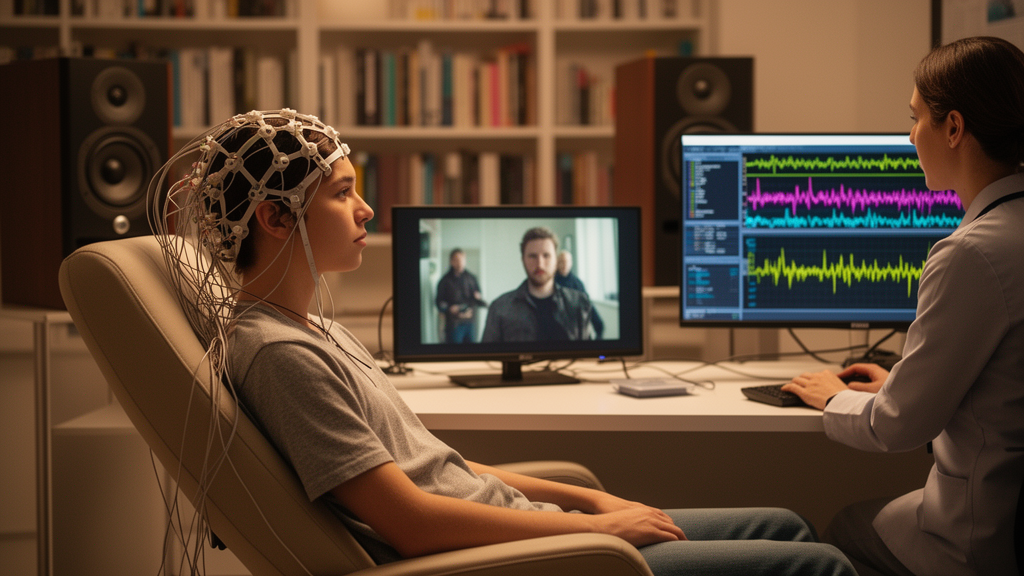
When you read the sentence “Harry has a Patronus. It takes the form of a stag,” your brain makes a split-second judgment about whether that final word fits the fictional world you know. For fans of Harry Potter, the word “stag” slides into place with barely a ripple of neural effort. Swap it for “lion,” and something changes: a characteristic brain response called the N400 swells, signaling that the word clashes with what you know. Now a new study has used that clash to answer a question that has long frustrated cognitive scientists: which kind of experience builds the knowledge we deploy when understanding language in real time—reading books, or watching movies?
The surprising answer, published in Frontiers in Cognition by psychologist Melissa Troyer of the University of Nevada, Las Vegas, is that for the brain potentials measured in this experiment, self-reported experience watching the Harry Potter films outperformed experience reading the books. The finding challenges theories in which word meaning is grounded purely in linguistic experience, and it lends fresh support to the idea that rich, multimodal, audiovisual input may accelerate access to knowledge during comprehension.
The N400 is a negative-going brain potential that peaks roughly 400 milliseconds after a potentially meaningful stimulus such as a word, picture, or line drawing. Since Kutas and Hillyard first reported it in 1980, it has become one of the most trusted tools in the psychology of language. The principle is simple: the N400 is small when a word is facilitated by context—by the sentence, by word frequency, even by who is speaking—and large when more information must be activated to process its meaning. Crucially, it is also sensitive to what an individual knows. In earlier work, Troyer and Marta Kutas showed that the size of N400 effects in Harry Potter sentences tracked participants’ scores on a trivia quiz about the series. High-knowledge readers showed rapid effects of context on semantic processing; the least knowledgeable showed none.
But the earlier studies left a nagging problem unresolved. Participants completed four different measures: an objective Harry Potter trivia quiz, self-reports of how many times they had read each book, self-reports of how many times they had seen each movie, and a composite of general reading experience built from author and magazine recognition tests. All four correlated moderately to strongly with one another, with Pearson’s r ranging from 0.39 to 0.66. When predictors are that collinear, standard regression modeling cannot reliably say which one carries the explanatory weight. The measures were, in effect, tangled together.
To cut the knot, Troyer turned to two methodological advances. The first is the regression ERP, or rERP, approach described by Nicholas Smith and Marta Kutas in 2015. Instead of computing a simple point-by-point average of brain activity, a regression model estimates each data point, allowing researchers to visualize—and statistically test—the millisecond-by-millisecond influence of continuous variables such as an individual difference measure, without resorting to median splits that reduce statistical power. The second is an exploratory model comparison technique based on the Akaike Information Criterion, familiar from behavioral ecology. Four regression models, each containing one of the four individual difference measures, were fit to the same difference-wave data. For every time point and electrode, the AIC of each model was compared with the best-fitting model’s AIC, yielding a metric called AICmin Δ. Models with values of 2 or less have substantial support; values above 10 have essentially none. Unlike nested model comparison, this approach does not require the models to be related, making it ideal for asking, head-on, which measure best explains the data.
The dataset came from Troyer and Kutas’s 2020 study, in which participants read 156 sentence pairs describing fictional facts about the wizarding world, one word at a time, while their electroencephalogram was recorded. Each sentence ended in one of three ways: with the contextually supported word (“goblins” running the wizard bank), an unsupported but contextually related word (“werewolves”), or an unrelated anomalous word (“Alohomora”). Two difference waves were computed: the contextual support effect, unrelated minus supported, and the related anomaly effect, unrelated minus related. The related anomaly effect is especially interesting, because it reflects the immediate availability of event-related knowledge—words that are linguistically inappropriate but still connected to the events the sentence describes.
The results were unambiguous in the N400 time window of 250 to 500 milliseconds, particularly over central and parietal electrodes where N400 activity is most prominent. All three Harry Potter measures outperformed general reading experience, which was rarely the best-fitting model at any time point. Mean AICmin Δ values for general reading experience reached 7.48 over midline central and 8.38 over midline parietal electrodes for the contextual support effect—well into the range of considerably less support. The Harry Potter movie-watching model, by contrast, had the lowest AIC across the majority of the N400 time period, with median values of 0.00 at the central, parietal, and occipital midline electrodes for both effects. Book-reading experience tended to have AICmin Δ values above 2 when pitted directly against movie experience, especially for the related anomaly effect, where the parietal book model averaged 5.40 compared with the movie model’s 0.57. The objective trivia quiz measure was rarely distinguishable from the movie measure, with values consistently below 2, but it never outperformed it.
What could explain the edge held by movies? The arithmetic is striking. The seven-book series spans roughly 4,100 pages and over a million words—more than 80 hours of reading even for fast readers. The eight films constitute only about 20 hours of content. Yet movies deliver direct audiovisual experiences unavailable to readers: faces, voices, settings, and motion, often encountered in socially situated contexts such as theaters or living rooms. That wealth of perceptual and social association may be exactly what accelerates knowledge use during comprehension. The finding aligns with theories of grounded and embodied cognition, which hold that we recruit perceptual processing mechanisms—the same ones involved in actually perceiving sensory input—when later bringing those percepts to mind. It also resonates with neuroimaging work showing that word meanings are distributed across the cortex, with non-arbitrary links between sensory-motor systems and concepts, such as leg-related action words recruiting parts of the motor system involved in planning leg motion.
Troyer is careful to note that this does not mean books are unpredictive of the N400 effects—only that when the measures were pitted directly against one another, movie-watching carried the most explanatory power. Nor does the AIC approach say anything about the total variance explained; it identifies the best model within a defined set. The study is also an exploratory re-analysis of existing data, and the original experiment was not designed to manipulate the modality of experience. Future work could assign participants to read books or watch films and then examine how the two experiences differentially shape comprehension and memory.
The broader implications run deep. This study connects to a growing literature on how specific experience shapes comprehension, including recent fMRI research showing that readers with diverse topical print exposure display more varied activity in the default mode network during fiction reading—a network tied to integrating past experiences with ongoing sense-making. It also touches on the notion of absorption, the feeling of being gripped by a story world, which has been linked to perceptuomotor mental simulation during reading. Perhaps the perceptual richness gleaned from movies allows fans to mentally simulate the events described in a short sentence more directly, becoming more immersed in the fictional world and thereby accessing not only the contextually appropriate word but also event-related content—even when it is linguistically anomalous. Against theories in which meaning is built from the company words keep alone, the message is clear: the brain’s real-time meaning-making draws on a lifetime of multimodal experience, and sometimes the movie theater teaches it faster than the page.
Subject of Research: Regression analyses of event-related brain potentials dissociate general reading experience and domain-specific knowledge sources during language comprehension
Article Title: Regression analyses of event-related brain potentials dissociate general reading experience and domain-specific knowledge sources during language comprehension
Article References: Troyer, M. (2026). Regression analyses of event-related brain potentials dissociate general reading experience and domain-specific knowledge sources during language comprehension. Frontiers in Cognition, 5, Article 1856123. https://doi.org/10.3389/fcogn.2026.1856123
Image Credits: AI Generated
DOI: 10.3389/fcogn.2026.1856123
Keywords: Regression, analyses, event-related, brain, potentials, dissociate, general, reading, experience, domain-specific, knowledge, sources
Cite Scienmag News
Cassandra Pierce. (October 16, 2026). Harry Potter Movies Beat Books in Brain Study of Real-Time Language Understanding. Scienmag. https://scienmag.com/harry-potter-movies-beat-books-in-brain-study-of-real-time-language-understanding/
Cassandra Pierce. "Harry Potter Movies Beat Books in Brain Study of Real-Time Language Understanding." Scienmag, 16 October 2026, https://scienmag.com/harry-potter-movies-beat-books-in-brain-study-of-real-time-language-understanding/. Accessed 16 October 2026.
Cassandra Pierce. "Harry Potter Movies Beat Books in Brain Study of Real-Time Language Understanding." Scienmag. October 16, 2026. https://scienmag.com/harry-potter-movies-beat-books-in-brain-study-of-real-time-language-understanding/


