


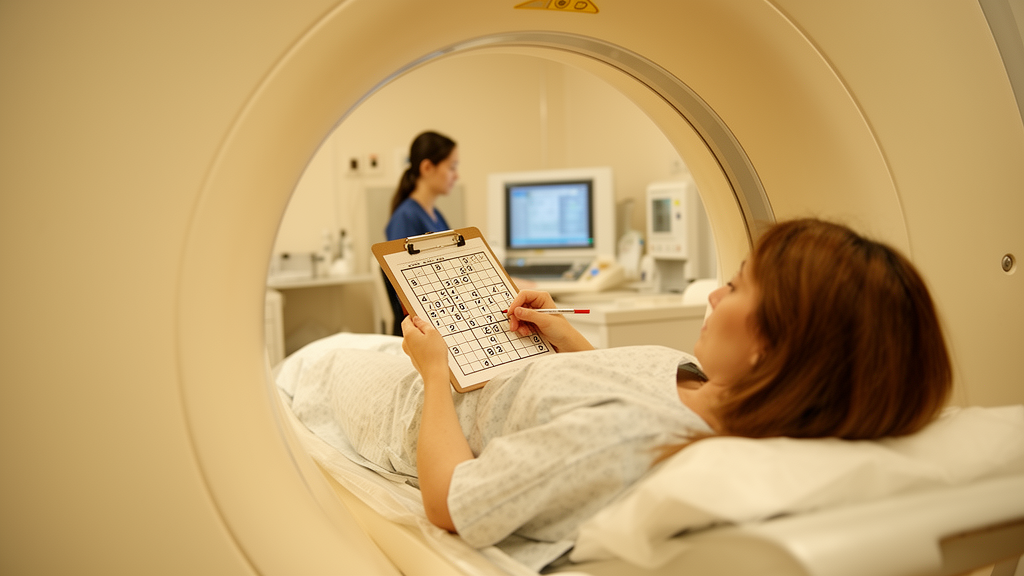
Sudoku has long been dismissed as a pleasant way to kill time on a train. A new systematic review, published in Frontiers in Neuroimaging, argues that the humble number puzzle deserves far more scientific respect. Morgan J. Williams of the University of Leicester, Ellie J. Williamson of Liverpool John Moores University, and Samantha Jane Brooks of the University of Witwatersrand combed the neuroimaging literature and found that when people solve Sudoku inside a brain scanner, they light up some of the most sophisticated circuitry the cortex has to offer: the frontoparietal executive control network, the anterior cingulate cortex, and even the ventral striatum, the brain’s reward hub.
The review is striking for how little evidence there was to synthesise. Following PRISMA guidelines, the team searched PubMed for studies combining Sudoku with any major neuroimaging technique, screened 289 results through title, abstract and full-text stages, and ended up with just six eligible publications: five using functional magnetic resonance imaging and one using functional near-infrared spectroscopy, or fNIRS. That scarcity is itself a headline. One of the world’s most popular puzzles, played by millions daily since it was popularised in 1980s Japan by the company Nikoli, has almost never been studied with modern brain imaging.
What the six studies do show is remarkably consistent. Across haemodynamic measures of brain activity, Sudoku solving reliably engages the dorsolateral prefrontal cortex and posterior parietal regions, including the intraparietal sulcus, the core components of the frontoparietal control network that underpin working memory and executive function. The dorsal anterior cingulate cortex, a region long implicated in conflict detection and performance monitoring, also appears repeatedly, as does the lateral frontopolar cortex, which the review links to metacognitive control, the ability to adjust decisions based on uncertainty.
The technical details of the included studies reveal how researchers have squeezed the puzzle into the scanner. Qin and colleagues in 2012 asked healthy young adults to solve simplified 4×4 Sudoku grids during fMRI, tracking blood-oxygen-level-dependent responses in predefined regions of interest including the prefrontal cortex, posterior parietal cortex, fusiform gyrus, caudate and dorsal anterior cingulate. All five regions showed task-positive BOLD responses, linking Sudoku to heuristic problem solving. Jin and colleagues in 2012 studied elderly participants performing simple and complex rule-based Sudoku tasks and found something different: deactivation of the posterior cingulate cortex and precuneus, key nodes of the default mode network, with greater suppression during more complex puzzles.
That default mode suppression is a technically important finding. The posterior cingulate and precuneus are most active when the mind wanders internally, and their deactivation during demanding Sudoku solving suggests the puzzle pulls the brain firmly into externally directed, goal-oriented cognition. The extent of deactivation scaled with task complexity, meaning the harder the puzzle, the more the brain suppressed its internally oriented circuitry. This pattern mirrors what is seen in other demanding cognitive tasks and reinforces the review’s argument that Sudoku is a genuine probe of executive engagement rather than a passive pastime.
Two later fMRI studies pushed the paradigm further by examining metacognition. Qiu and colleagues in 2018 used a re-decision paradigm in which participants made an initial Sudoku judgment and then revisited it, implicating the lateral frontopolar cortex in metacognitive control and the dorsal anterior cingulate and anterior insular cortex in metacognitive monitoring. Intriguingly, the ventral striatum was uniquely active during Sudoku, tracking reductions in decision uncertainty, and its functional coupling with the frontopolar cortex predicted how much individuals improved their accuracy. Su and colleagues in 2022 confirmed the dorsal anterior cingulate’s role, showing increased activity when participants re-evaluated their initial answers, alongside the dorsolateral prefrontal cortex and intraparietal sulcus.
The single fNIRS study broadened the ecological picture. Ashlesh and colleagues in 2020 fitted 33 healthy adults with a 16-channel forehead sensor array measuring oxygenated and deoxygenated haemoglobin over the prefrontal cortex, then had them solve paper-and-pencil Sudoku progressing from isolated 3×3 subgrids to a full 9×9 matrix. Both medial and lateral prefrontal regions showed increased activation, scaling with task complexity. Because fNIRS is lightweight and tolerant of movement, it captures Sudoku solving under far more natural conditions than fMRI, and the converging prefrontal findings suggest the scanner results are not artefacts of an artificial laboratory setup.
The review also situates Sudoku against established cognitive training paradigms. The n-back task isolates continuous updating of information under time pressure, and mental arithmetic emphasises numerical manipulation and speeded processing, but Sudoku integrates multiple executive processes within a single task: visuospatial working memory, rule maintenance, hypothesis testing, conflict monitoring and metacognitive evaluation. That composite structure more closely resembles real-world problem solving, where demands shift dynamically. Sudoku also differs from chess, which the authors note in a companion review, because chess places stronger demands on visual-perceptual expertise and occipito-temporal regions, whereas Sudoku offers a more flexible, rule-based probe of working memory and cognitive control, and is typically played individually without competitive pressure.
Translational potential is where the review becomes genuinely provocative. In the only longitudinal study included, Nombela and colleagues in 2011 put patients with Parkinson’s disease through a six-month Sudoku-based cognitive training programme and found enhanced activation in frontal, temporal and parietal regions afterwards, interpreted as a marker of functional reorganisation and neuroplasticity. The authors argue that Sudoku’s accessibility, familiarity and intrinsic motivation could make it a low-cost vehicle for maintaining executive function in older adults, particularly since motivation is a critical determinant of adherence in cognitive training interventions. Portable fNIRS extends this viability to bedside, home-based and rehabilitation contexts.
Yet the authors are careful not to oversell. With only six studies, small samples, heterogeneous designs and just one longitudinal clinical investigation, the evidence base cannot yet establish whether Sudoku training produces benefits that generalise beyond the puzzle itself. Most studies relied on cross-sectional, single-session imaging, and no study employed EEG, leaving the temporal dynamics of Sudoku-related cognition unexplored. The review calls for larger and more diverse samples, harmonised task protocols contrasting grid sizes and decision phases, and multimodal imaging combining fMRI, fNIRS and EEG within unified designs. If those gaps are filled, Sudoku may earn a place not just in the newspaper but in the clinical toolkit, as a window into the neural architecture of executive function and a practical instrument for supporting cognitive health across the lifespan.
Subject of Research: Neuroscience
Article Title: Neural correlates of Sudoku play: a systematic review of brain imaging studies
Article References: Williams, M. J., Williamson, E. J., & Brooks, S. J. (2026). Neural correlates of Sudoku play: a systematic review of brain imaging studies. Frontiers in Neuroimaging, 5, Article 1756394. https://doi.org/10.3389/fnimg.2026.1756394
Image Credits: AI Generated
DOI: 10.3389/fnimg.2026.1756394
Keywords: Sudoku, neuroimaging, fMRI, fNIRS, executive function, working memory, cognitive training, systematic review, Neural, correlates, play, systematic
Cite Scienmag News
Cassandra Pierce. (October 16, 2026). Sudoku in the Scanner: Brain Imaging Reveals the Puzzle’s Hidden Neural Machinery. Scienmag. https://scienmag.com/sudoku-in-the-scanner-brain-imaging-reveals-the-puzzles-hidden-neural-machinery/
Cassandra Pierce. "Sudoku in the Scanner: Brain Imaging Reveals the Puzzle’s Hidden Neural Machinery." Scienmag, 16 October 2026, https://scienmag.com/sudoku-in-the-scanner-brain-imaging-reveals-the-puzzles-hidden-neural-machinery/. Accessed 16 October 2026.
Cassandra Pierce. "Sudoku in the Scanner: Brain Imaging Reveals the Puzzle’s Hidden Neural Machinery." Scienmag. October 16, 2026. https://scienmag.com/sudoku-in-the-scanner-brain-imaging-reveals-the-puzzles-hidden-neural-machinery/


