


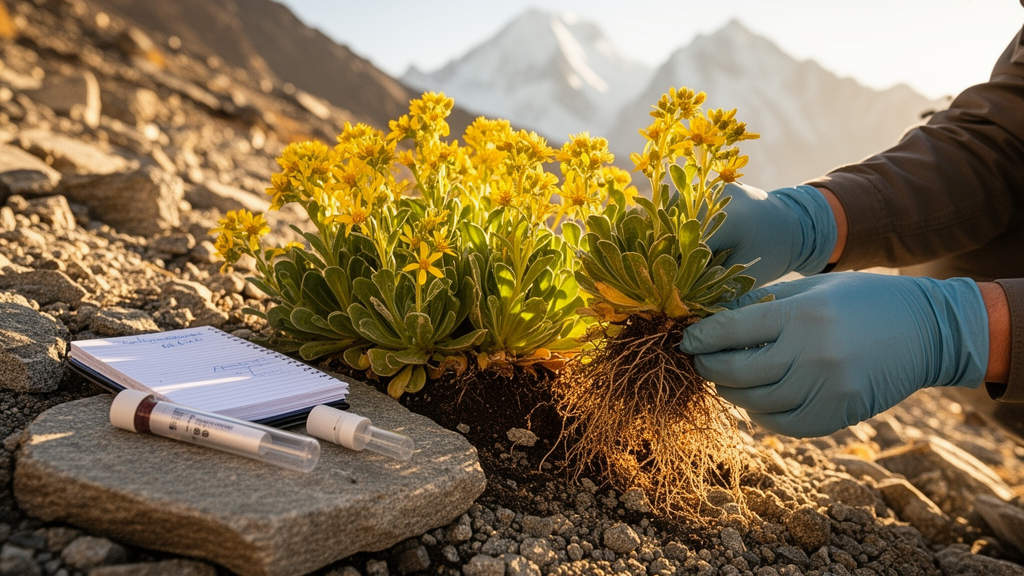
Deep in the Eastern Himalayas, at elevations above 2,500 meters, grows one of the world’s most pharmacologically precious plants — and it is running out of time. Coptis teeta Wall., a critically endangered member of the buttercup family, has been harvested for centuries for its golden rhizomes loaded with berberine, coptisine, and palmatine, alkaloids prized for antimicrobial, anti-inflammatory, and antidiabetic properties. Now, a team of researchers at Gauhati University in Assam, India, has peered inside the plant’s cells to see exactly how it copes when the climate turns hostile — and their findings reveal a molecular drama of survival, sacrifice, and metabolic triage that could determine whether this species survives the century.
The study, published in Frontiers in Plant Physiology, represents the first genome-wide transcriptomic analysis of C. teeta under drought and heat stress. Led by Manabendra Nath and Bhaben Tanti, the research team collected saplings from Myodia Pass in Arunachal Pradesh at 2,580 meters elevation, then subjected them to controlled drought — withholding water until visible dehydration appeared after roughly two weeks — and heat stress at 43°C for six hours. Using RNA sequencing on an Illumina NovaSeq 6000 platform, they captured the plant’s entire transcriptional response at the moment of crisis, generating between 33 and 44 million clean reads per sample.
The numbers alone tell a striking story. Drought stress triggered 3,099 differentially expressed genes (DEGs), heat stress activated 816, and combined stress produced 3,790 — a synergistic reshaping far exceeding either stress alone. But the most revealing finding was how little overlap existed between the two responses. Of the top 500 upregulated genes, only six were shared across all comparisons. Just 122 DEGs overlapped between drought and heat treatments overall, confirming that this plant deploys fundamentally different molecular arsenals depending on the nature of the threat.
Under drought, C. teeta essentially shut down its photosynthetic machinery. Genes encoding chlorophyll a/b binding proteins, photosystem II components, thylakoid lumen proteins, and ribosomal proteins were strongly downregulated — a classic energy-conservation strategy that sacrifices growth for survival. Simultaneously, the plant ramped up lipid transport, vesicle trafficking, aquaporin activity, and cell-wall remodeling, mobilizing resources to maintain cellular integrity. Genes like ZAT12, SnRK2.6, DREB2A, AREB1, and LEA14 formed a temporal cascade from early signaling through transcriptional regulation to late-stage structural protection of proteins and membranes.
Heat stress told a completely different story. Rather than suppressing photosynthesis as dramatically, the plant activated a focused proteostasis network — roughly 22 heat-responsive genes dominated by the HSP20, HSP40 (DNAJ), HSP70/Clp, and heat shock factor (HSF) families. These molecular chaperones prevent protein denaturation and aggregation under thermal stress, essentially acting as cellular bodyguards. The enrichment of protein folding, refolding, and ATP-dependent chaperone activity in gene ontology analysis confirmed that C. teeta prioritizes keeping its existing proteins functional over producing new ones when temperatures spike.
Perhaps the most intriguing discovery involves the plant’s antioxidant strategy. Under both stresses, enzymatic antioxidants — ascorbate peroxidase (APX), superoxide dismutase (SOD), and glutathione peroxidase (GPX) — were significantly upregulated, while thioredoxin and glutaredoxin redox regulators were suppressed. This represents a strategic shift from thiol-based redox buffering toward peroxidase-driven detoxification of reactive oxygen species (ROS). The researchers interpret this as an energy-efficient reallocation: peroxidases consume less cellular energy than maintaining the full thioredoxin-peroxiredoxin cycling system, allowing the plant to neutralize hydrogen peroxide and superoxide radicals without depleting already-scarce resources.
Transcription factors emerged as the master conductors of this molecular orchestra. The NAC, DREB, WRKY, bZIP, and HSF families showed strong stress-specific induction, with DREB2A, AREB1, and HSFA2 acting as central regulatory hubs. Under drought, NAC family members — particularly NAM, ATAF1/2, and CUC2 — coordinated dehydration tolerance, while growth-associated GRAS and ARF families were downregulated, consistent with the plant’s decision to halt development. Under heat, HSF-A2 and zinc-finger proteins took center stage, driving the chaperone response. The shared induction of NAC, WRKY, and AP2/ERF under both stresses suggests cross-talk between drought and heat signaling networks, hinting at conserved regulatory architecture.
But the most consequential finding for medicine — and for the plant’s future — concerns its benzylisoquinoline alkaloid (BIA) biosynthesis pathway. Early pathway genes, especially S-norcoclaurine synthase (NCS), the rate-limiting entry point, were significantly upregulated under drought, suggesting enhanced precursor formation. Yet downstream enzymes — norcoclaurine 6-O-methyltransferase, berberine bridge enzyme (BBE), stylopine synthase (CYP719A), and multiple cytochrome P450 monooxygenases — were consistently downregulated. This creates a metabolic bottleneck: precursors accumulate, but the plant cannot complete the conversion to berberine and coptisine. The researchers interpret this as a survival trade-off, redirecting metabolic resources from alkaloid diversification toward antioxidant defense and osmotic adjustment.
Quantitative real-time PCR validation confirmed the RNA-Seq results for eight key genes, including ZAT12, DREB2A, APX, NAC, HSP, and HSF, demonstrating that drought preferentially activates redox and dehydration signaling while heat strongly induces thermotolerance pathways. The consistency between transcriptomic and qRT-PCR data lends credibility to the genome-wide findings and establishes a reliable molecular reference for future functional studies.
The implications extend far beyond a single endangered species. As climate change intensifies drought and heat extremes across mountain ecosystems worldwide, moisture-dependent medicinal plants face existential pressure. This transcriptomic resource — publicly available through NCBI BioProject PRJNA1313294 — provides candidate genes for conservation genomics, stress-tolerance enhancement, and climate-resilient cultivation strategies. For C. teeta, whose natural populations are steadily declining due to prolonged dry spells and rising temperatures, understanding these molecular survival mechanisms may be the difference between extinction and adaptation. For pharmacology, it reveals how environmental stress reshapes the very chemistry that makes this plant valuable — a warning that the medicines of tomorrow may depend on how well we protect the molecular flexibility of the plants that produce them today.
Subject of Research: Transcriptomic responses of the endangered Himalayan medicinal plant Coptis teeta to drought and heat stress
Article Title: Transcriptomic analysis reveals differential gene expression and metabolic reprogramming in Coptis teeta Wall. under drought and heat stress
Article References: Nath, M., Bhattacharjya, D. K., Regon, P., Goswami, D., Kalita, K., Boro, K., Kundu, B. K., & Tanti, B. (2026). Transcriptomic analysis reveals differential gene expression and metabolic reprogramming in Coptis teeta Wall. under drought and heat stress. Frontiers in Plant Physiology, 3, Article 1715857. https://doi.org/10.3389/fphgy.2025.1715857
Image Credits: AI Generated
DOI: 10.3389/fphgy.2025.1715857
Keywords: Coptis teeta, transcriptomics, drought stress, heat stress, benzylisoquinoline alkaloids, reactive oxygen species, antioxidant defense, transcription factors, Himalayan medicinal plants, RNA sequencing, climate change, conservation genomics
Cite Scienmag News
Juliet Wilcox. (October 16, 2026). Himalayan Gold Rush Plant Rewires Its Genes to Survive Drought and Heat. Scienmag. https://scienmag.com/himalayan-gold-rush-plant-rewires-its-genes-to-survive-drought-and-heat/
Juliet Wilcox. "Himalayan Gold Rush Plant Rewires Its Genes to Survive Drought and Heat." Scienmag, 16 October 2026, https://scienmag.com/himalayan-gold-rush-plant-rewires-its-genes-to-survive-drought-and-heat/. Accessed 16 October 2026.
Juliet Wilcox. "Himalayan Gold Rush Plant Rewires Its Genes to Survive Drought and Heat." Scienmag. October 16, 2026. https://scienmag.com/himalayan-gold-rush-plant-rewires-its-genes-to-survive-drought-and-heat/


