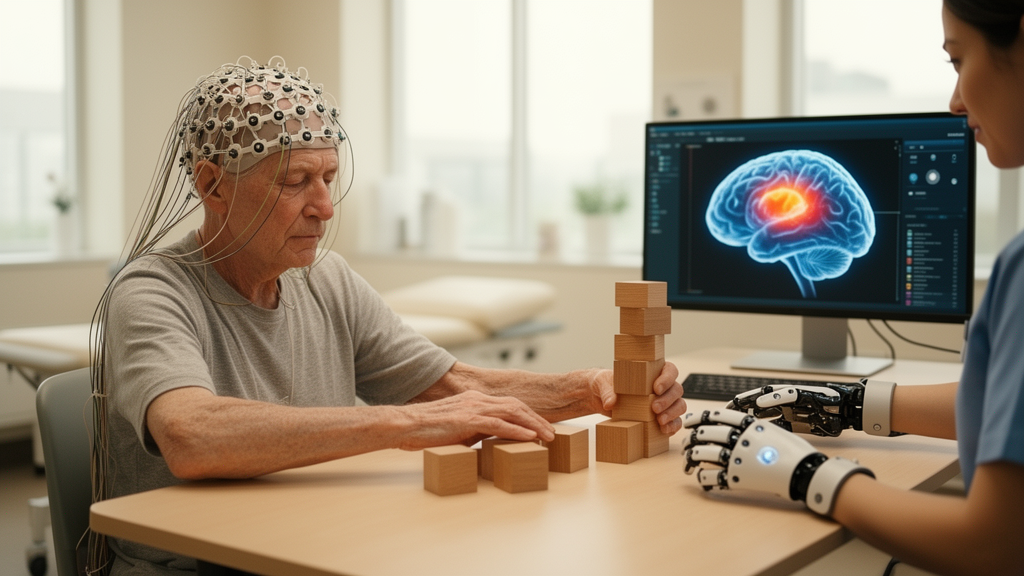
For millions of stroke survivors worldwide, the hardest battle after the emergency is often the quiet one fought in rehabilitation wards: coaxing a paralyzed arm back to life. Now, a sweeping analysis of randomized clinical trials suggests that brain-computer interface training — technology that lets patients drive external devices with nothing but their thoughts — may offer a meaningful edge, but only when paired with the right kind of feedback. The findings, published in Frontiers in Neuroscience, could reshape how rehabilitation teams decide which high-tech therapy to prescribe.
A team of researchers led by Fuqiang Wang and colleagues at Guangdong Sanjiu Brain Hospital and South China Normal University conducted a systematic review and network meta-analysis of 22 randomized controlled trials involving 956 patients across subacute, chronic, and mixed post-stroke stages. Rather than treating brain-computer interface training as a single, monolithic therapy, the researchers broke it down by its primary therapeutic feedback modality: robotic or exoskeleton-assisted feedback, functional electrical stimulation feedback, visual feedback, and multimodal feedback combining several sensory channels. This granular approach allowed them to compare the relative efficacy of different feedback strategies within a single statistical framework — something previous meta-analyses, which relied on subgroup analyses, had never done.
The core idea behind brain-computer interface rehabilitation is elegant. Stroke often damages the brain circuits that generate movement commands, leaving patients unable to move a limb even though the muscles themselves may be intact. A brain-computer interface reads electroencephalography signals associated with motor imagery or attempted movement, decodes the patient’s intention in real time, and translates it into external feedback — a robot moving the arm, electrical stimulation contracting a muscle, or a visual display showing the imagined action. This creates a closed loop between intention, feedback, and sensory input that may promote neuroplasticity and reorganization of sensorimotor networks, even in patients with severe impairment who cannot produce overt movement.
The results were striking but nuanced. When compared with usual rehabilitation, brain-computer interface training with robotic feedback showed the largest statistically significant improvement on the Fugl-Meyer Assessment for Upper Extremity, the primary outcome measure, with a weighted mean difference of 6.28 points (95% CI 2.70–9.86). Brain-computer interface with multimodal feedback also showed significant benefit (WMD = 4.03, 95% CI 1.00–7.06), as did non-BCI robotic training alone (WMD = 4.26, 95% CI 0.42–8.10). Brain-computer interface with functional electrical stimulation feedback did not differ significantly from usual rehabilitation. For the secondary outcome, the Action Research Arm Test, brain-computer interface with robotic feedback again showed significant improvement over usual rehabilitation, while findings for the Wolf Motor Function Test were non-significant.
But here is the twist that gives the analysis its scientific bite: because non-BCI robotic training also showed significant benefit over usual rehabilitation, the researchers caution that the apparent advantage of brain-computer interface with robotic feedback cannot be attributed to the brain-computer interface component alone. High-repetition, task-oriented motor practice and proprioceptive input from robot-assisted training may already constitute powerful therapeutic ingredients. Whether the closed-loop brain decoding adds genuine value on top of robotic assistance remains an open question — one that the current evidence cannot answer definitively.
The ranking analysis added another layer of complexity. Brain-computer interface with visual feedback had the highest SUCRA value (77.6%), suggesting it ranked best overall, but its comparison with usual rehabilitation was non-significant, with a wide confidence interval and very low certainty of evidence. No brain-computer interface feedback modality was statistically superior to another. The certainty of evidence for the main comparisons was generally low to very low, downgraded mainly for within-study bias and heterogeneity. Only one of the 22 included trials was judged to be at low overall risk of bias; the remaining 21 had some concerns, primarily related to the randomization process, deviations from intended interventions, and selection of the reported result.
Exploratory subgroup analyses by stroke stage suggested that the relative performance of different feedback modalities may vary with time since stroke. In the subacute stage — defined as seven days to six months after onset — only brain-computer interface with multimodal feedback showed significant improvement over usual rehabilitation (WMD = 6.00, 95% CI 0.88–11.13). In the chronic stage, brain-computer interface with robotic feedback and non-BCI robotic training showed significant benefits. This pattern hints that multimodal sensory feedback may be particularly relevant when spontaneous recovery and training-induced plasticity are most active, whereas stable, repetitive, task-oriented motor execution feedback may matter more later. However, these subgroup findings were exploratory, based on limited numbers of studies, and should not yet drive clinical selection.
Sensitivity analyses strengthened the robustness of the primary findings. When studies with mixed stroke stages were excluded, brain-computer interface with robotic feedback, multimodal feedback, and non-BCI robotic training all remained significantly superior to usual rehabilitation, with consistent directions of effect. Alternative correlation coefficients used in data conversion did not change the overall interpretation. The comparison-adjusted funnel plot showed no marked asymmetry, suggesting no clear evidence of small-study effects or publication bias. The Fugl-Meyer network contained 11 connected intervention nodes with no significant global or local inconsistency, and the transitivity assessment revealed no clear systematic imbalance in participant characteristics across direct comparisons.
The clinical implications are considerable. Rehabilitation teams face real-world constraints: limited resources, varying device availability, and patients who differ substantially in functional status and time since stroke. The analysis suggests that brain-computer interface with robotic feedback is a reasonable priority for further evaluation among feedback modalities, and that multimodal feedback warrants attention, particularly in subacute patients. Yet the authors emphasize that treatment priorities should not be determined on ranking results alone, given the low certainty of evidence and the insufficient direct head-to-head comparisons between feedback modalities. The 6.28-point Fugl-Meyer improvement associated with brain-computer interface robotic feedback is comparable to clinically important differences reported in patients with chronic stroke and minimal-to-moderate impairment, suggesting potential clinical relevance — though this magnitude may vary across patient populations.
What emerges is a field at an inflection point. Brain-computer interface rehabilitation is no longer a question of technical feasibility; the evidence now supports meaningful questions about which feedback strategy works best, for whom, and when. The authors call for large, standardized, direct-comparison randomized trials to clarify the relative efficacy of different feedback modalities and identify the patient populations most likely to benefit. Until then, the promise of thought-driven rehabilitation remains real but conditional — a powerful closed loop between mind and machine whose full therapeutic value depends on the sensory channel through which that loop is completed.
Subject of Research: Comparative efficacy of brain-computer interface training with different feedback modalities for post-stroke upper-limb motor recovery: a systematic review and network meta-analysis of randomized controlled trials
Article Title: Comparative efficacy of brain-computer interface training with different feedback modalities for post-stroke upper-limb motor recovery: a systematic review and network meta-analysis of randomized controlled trials
Article References: Wang, F., Lu, X., Deng, Y., Li, Y., Li, X., Huang, C., Ma, M., He, B., Yu, L., & Deng, L. (2026). Comparative efficacy of brain-computer interface training with different feedback modalities for post-stroke upper-limb motor recovery: a systematic review and network meta-analysis of randomized controlled trials. Frontiers in Neuroscience, 20, Article 1925602. https://doi.org/10.3389/fnins.2026.1925602
Image Credits: AI Generated
DOI: 10.3389/fnins.2026.1925602
Keywords: Comparative, efficacy, brain-computer, interface, training, different, feedback, modalities, post-stroke, upper-limb, motor, recovery
Cite Scienmag News
Cassandra Pierce. (October 16, 2026). Comparative efficacy of brain-computer interface training with different feedback modalities for post-stroke upper-limb motor recovery: a systematic review and network meta-analysis of randomized controlled trials. Scienmag. https://scienmag.com/comparative-efficacy-of-brain-computer-interface-training-with-different-feedback-modalities-for-post-stroke-upper-limb-motor-recovery-a-systematic-review-and-network-meta-analysis-of-randomized-cont/
Cassandra Pierce. "Comparative efficacy of brain-computer interface training with different feedback modalities for post-stroke upper-limb motor recovery: a systematic review and network meta-analysis of randomized controlled trials." Scienmag, 16 October 2026, https://scienmag.com/comparative-efficacy-of-brain-computer-interface-training-with-different-feedback-modalities-for-post-stroke-upper-limb-motor-recovery-a-systematic-review-and-network-meta-analysis-of-randomized-cont/. Accessed 17 October 2026.
Cassandra Pierce. "Comparative efficacy of brain-computer interface training with different feedback modalities for post-stroke upper-limb motor recovery: a systematic review and network meta-analysis of randomized controlled trials." Scienmag. October 16, 2026. https://scienmag.com/comparative-efficacy-of-brain-computer-interface-training-with-different-feedback-modalities-for-post-stroke-upper-limb-motor-recovery-a-systematic-review-and-network-meta-analysis-of-randomized-cont/