


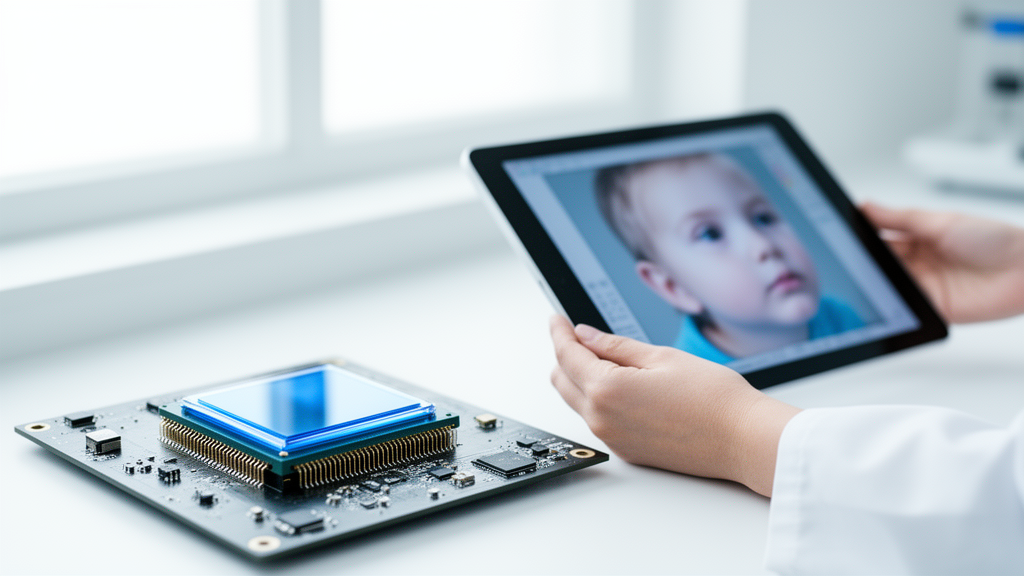
Treacher Collins syndrome (TCS) is a rare genetic disorder that disrupts the development of the bones and tissues of the face, producing distinctive craniofacial features such as underdevelopment of the jaw, palate, and cheekbones. Because the condition can compromise breathing and hearing, early recognition matters enormously for affected children and their families. Yet diagnosis has long depended on specialist clinical judgment, and traditional detection approaches have delivered inefficient results. A new study published in Neural Computing and Applications reports a compact deep learning framework that classifies facial images as TCS or non-TCS, and — crucially — runs on a credit-card-sized edge computer rather than a data center.
The research team, led by J. Madava Venkat and colleagues at Karunya Institute of Technology and Sciences in Coimbatore, India, together with N. Anand in civil engineering and M. Z. Naser of the AI Research Institute for Science and Engineering at Clemson University, set out to answer a practical question: can state-of-the-art computer vision models identify a rare genetic syndrome from ordinary facial photographs while running on affordable, low-power hardware? Their answer is a carefully benchmarked pipeline built around the NVIDIA Jetson Orin Nano, a compact GPU module designed for embedded artificial intelligence workloads.
At the heart of the framework are three convolutional neural network architectures that have shaped modern computer vision. Convolutional neural networks (CNNs) form the baseline, learning hierarchical features directly from pixel data. ResNet, the deep residual architecture introduced by He and colleagues in 2016, uses shortcut connections that let very deep networks train stably by allowing gradients to flow around layers. MobileNetV2, built on inverted residuals and linear bottlenecks, was engineered specifically for mobile and embedded vision, trading some representational depth for dramatic gains in speed and energy efficiency. The team processed input facial images through each architecture on the Jetson Orin Nano’s GPU, comparing how the models balanced diagnostic accuracy against real-world deployment constraints.
The headline result is a revealing trade-off. ResNet-50 achieved the highest classification accuracy for distinguishing TCS from non-TCS faces, confirming that residual networks remain a formidable choice when raw diagnostic performance is the priority. MobileNetV2, by contrast, delivered the lowest inference latency and the lowest energy consumption on the Jetson Orin Nano. That contrast is not a footnote; it is the central engineering insight of the paper. A model that is marginally more accurate but too slow or power-hungry for a clinic in a remote setting may be less useful than a slightly leaner model that returns an answer in milliseconds on a battery-friendly device.
The authors did not stop at accuracy curves. They subjected the framework to comprehensive performance evaluation and statistical validation to confirm its robustness and reliability, demonstrating its potential for efficient deployment on the Jetson Orin Nano. This matters because edge AI in medicine lives or dies on reproducibility: a screening tool that performs well in a laboratory demo but degrades under real-world variability offers little clinical value. By validating performance statistically rather than relying on single-run anecdotes, the study positions its framework as a candidate for genuine field use rather than a proof of concept alone.
The work sits within a rapidly growing body of research on facial phenotyping for genetic disorders. Earlier efforts such as DeepGestalt demonstrated that deep learning could identify rare genetic syndromes from facial images, and subsequent systems have screened for conditions ranging from Turner syndrome to endocrine and metabolic disorders. Studies have applied VGG-16 to genetic syndrome screening, explored few-shot meta-learning for recognizing facial phenotypes, and combined facial images with clinical text in multimodal frameworks. Computer-aided phenotyping tools such as DeepGestalt, GestaltMatcher, and D-Score have been comparatively validated for diagnostic accuracy, and commercial platforms like Face2Gene have been evaluated across large and diverse cohorts — including a 2026 assessment of Face2Gene’s ability to identify Treacher Collins syndrome in varied populations.
What distinguishes the new study is its deliberate focus on the edge. Most facial-analysis research in medical diagnostics assumes cloud-scale computation, but edge computing changes the calculus for rare-disease screening. The Jetson Orin Nano brings GPU-accelerated inference to the point of care, which has direct implications for privacy, since sensitive facial images need not leave the device, and for accessibility, since clinics without reliable high-bandwidth connectivity can still run sophisticated models. Recent benchmarking work on edge AI platforms, including comparisons of NVIDIA Jetson hardware with Raspberry Pi 5 and Coral TPU devices, and research on energy-efficient deployment of vision-based deep networks on tiny autonomous systems, underscores how active this engineering frontier has become.
The clinical stakes for TCS specifically are high. The syndrome arises from disruptions in craniofacial development, and its characteristic features — underdeveloped jaw, palate, and cheekbones — can affect breathing and hearing. Because it is rare, many general practitioners may encounter only a handful of cases in a career, making automated decision support genuinely valuable. A framework that can flag likely TCS from a photograph, running locally on inexpensive hardware, could shorten the diagnostic odyssey that families of children with rare syndromes often endure, and could support earlier referrals for airway, hearing, and surgical management.
The study also reflects a broader methodological trend in medical imaging: the systematic comparison of architectures under deployment constraints rather than accuracy alone. By evaluating CNN, ResNet, and MobileNetV2 side by side on the same edge platform, the researchers provide a template other teams can follow when designing diagnostic tools for resource-limited settings. The trade-off they document — ResNet-50’s superior accuracy versus MobileNetV2’s superior latency and energy profile — is exactly the kind of quantitative guidance that turns laboratory models into deployable clinical systems. Related work on lightweight attention-based networks for multiple genetic syndromes and efficient segmentation models for IoT and edge devices shows the field converging on this accuracy-versus-efficiency design space.
Limitations and next steps remain. The datasets used in the study are available from the corresponding author on reasonable request, and the authors note that the framework classifies faces as TCS or non-TCS rather than grading severity or replacing genetic confirmation. As with all facial-analysis diagnostics, questions of demographic generalizability, dataset bias, and integration with clinical workflows will shape how such tools are adopted. Still, the demonstration that a full deep learning diagnostic pipeline — from convolutional feature extraction to statistically validated classification — can run on a Jetson Orin Nano marks a tangible step toward screening for rare genetic syndromes wherever a camera and a small computer are available. The authors declare no competing interests, and the research received no external funding, adding to the study’s transparency as the field of edge-based medical AI accelerates.
Subject of Research: Deep learning-based detection and classification of Treacher Collins syndrome from facial images using edge GPU hardware
Article Title: Deep learning framework for treacher collins syndrome detection and classification using jetson GPU infrastructure
Article References: Venkat, J. M., Arputharaj, A. J., Andrushia, A. D., Neebha, T. M., Anand, N., & Naser, M. Z. (2026). Deep learning framework for treacher collins syndrome detection and classification using jetson GPU infrastructure. Neural Computing and Applications, 38(20), Article 811. https://doi.org/10.1007/s00521-026-12547-5
Image Credits: AI Generated
DOI: 10.1007/s00521-026-12547-5
Keywords: Treacher Collins syndrome, deep learning, edge computing, NVIDIA Jetson Orin Nano, ResNet-50, MobileNetV2, convolutional neural networks, facial recognition, genetic syndromes, craniofacial disorders, medical AI, computer vision
Cite Scienmag News
Blake Davidson. (October 16, 2026). AI on a Tiny Chip: Deep Learning Spots Treacher Collins Syndrome at the Edge. Scienmag. https://scienmag.com/ai-on-a-tiny-chip-deep-learning-spots-treacher-collins-syndrome-at-the-edge/
Blake Davidson. "AI on a Tiny Chip: Deep Learning Spots Treacher Collins Syndrome at the Edge." Scienmag, 16 October 2026, https://scienmag.com/ai-on-a-tiny-chip-deep-learning-spots-treacher-collins-syndrome-at-the-edge/. Accessed 16 October 2026.
Blake Davidson. "AI on a Tiny Chip: Deep Learning Spots Treacher Collins Syndrome at the Edge." Scienmag. October 16, 2026. https://scienmag.com/ai-on-a-tiny-chip-deep-learning-spots-treacher-collins-syndrome-at-the-edge/


