


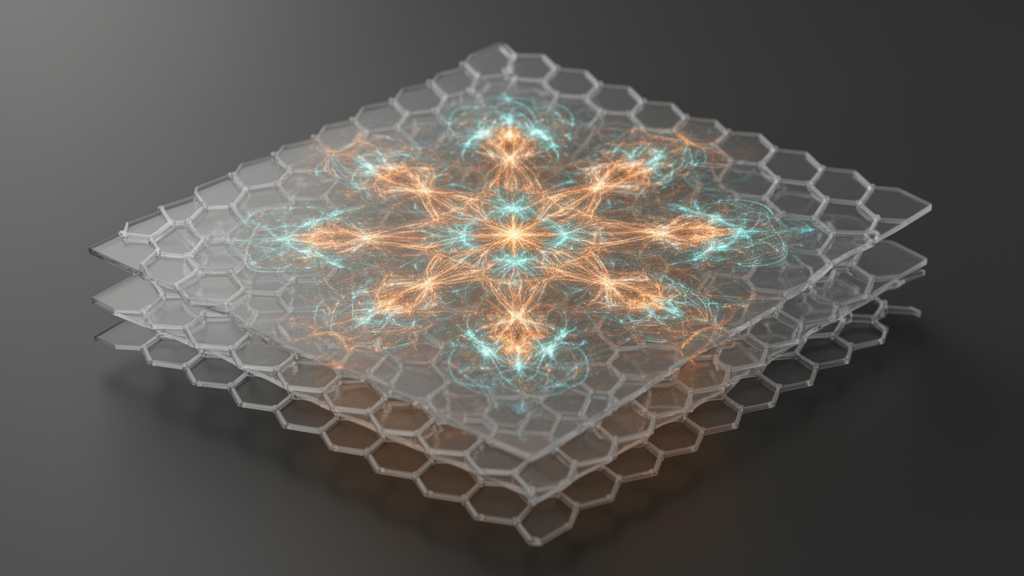
When two sheets of graphene are stacked with a precise 30-degree twist, the resulting material defies one of the most basic expectations of solid-state physics: it forms a quasicrystal, a structure with long-range rotational order but no repeating unit cell. Now, researchers in Brazil have shown that the electrons in this exotic system do not simply spread out uniformly. Instead, some of their wave functions lock onto the quasicrystal’s underlying geometric skeleton, producing localized electronic states arranged in fractal patterns that mirror the dodecagonal tiling of the lattice itself. The findings, published in Frontiers in Carbon, offer the most detailed real-space picture yet of how quasiperiodicity shapes electronic behavior in one of the most unusual carbon materials ever synthesized.
Twisted bilayer graphene has dominated condensed matter research since 2018, when physicists discovered that near certain magic angles, the material hosts superconductivity, orbital magnetism, and a zoo of strongly correlated electronic phases. But the 30-degree twist belongs to a different family altogether. Because the two graphene lattices are rotated by an angle that is incommensurate with the hexagonal symmetry of each monolayer, the combined structure cannot be described by any finite periodic unit cell. Instead, it exhibits twelve-fold, or dodecagonal, rotational symmetry—a hallmark of two-dimensional quasicrystals. Unlike conventional quasicrystals, where every atom sits in an intrinsically quasiperiodic arrangement, the 30-degree twisted bilayer is an extrinsic quasicrystal: its quasiperiodicity emerges purely from the coupling between two perfectly periodic graphene layers.
These systems are no longer theoretical curiosities. Since 2018, dodecagonal graphene quasicrystals have been grown on substrates ranging from silicon carbide and platinum to copper and copper-nickel alloys, using chemical vapor deposition and carbon segregation techniques. Experiments have confirmed their identity through low-energy electron diffraction, transmission electron microscopy, scanning tunneling microscopy, and Raman spectroscopy. Angle-resolved photoemission measurements revealed multiple Dirac cones arranged with twelve-fold rotational symmetry, while scanning tunneling spectroscopy detected a suppression of the density of states at the zone boundary, attributed to generalized Umklapp scattering between the two layers. Magnetotransport measurements have independently confirmed that the low-energy electrons behave as massless Dirac fermions, the relativistic particles that give graphene its extraordinary electronic properties.
Atomic-resolution scanning tunneling microscopy images have long shown a striking flower-like contrast on certain patches of the quasicrystal, regions of higher symmetry that align with the dodecagonal tiling elements. But explaining these patterns theoretically has been formidable. The absence of translational symmetry means standard band-structure techniques, which rely on periodic boundary conditions, cannot be applied directly. Earlier approaches either constructed periodic approximants with unit cells containing tens of thousands of atoms or developed momentum-space tight-binding models that revealed wave functions with fractal inflations of the dodecagonal tiling. Kevin J. U. Vidarte of the Federal University of Rio de Janeiro and Caio Lewenkopf of Fluminense Federal University took a different route, one that sidesteps periodicity entirely.
The duo employed the Haydock-Heine-Kelly recursion technique, a real-space numerical method that exploits the nearsightedness of electronic matter—the principle that local electronic properties depend only on the immediate atomic environment. The method transforms the sparse tight-binding Hamiltonian into tridiagonal form and evaluates the local Green’s function through a continued fraction expansion, which is exceptionally amenable to numerical calculation. Because it never requires periodic boundary conditions, the approach is ideal for strongly disordered, amorphous, and quasicrystalline systems. The researchers increased the number of considered lattice sites until the local density of states converged, typically requiring on the order of a hundred thousand atomic sites. Crucially, the twelve-fold symmetry of the quasicrystal meant they needed to compute local spectral functions for only one twenty-fourth of the carbon atoms within any circular region, a reduction that made the calculations tractable.
The model Hamiltonian respects both the dodecagonal symmetry and the massless Dirac nature of the electrons. Intralayer hopping between nearest neighbors was set to 2.7 electron volts, fitted to density functional theory calculations of graphene monolayers, while interlayer transfer integrals decay exponentially with distance over a characteristic length of 0.45 angstroms, becoming negligible beyond roughly 4 angstroms. The researchers also incorporated the Peierls substitution to account for external magnetic fields, modifying the hopping integrals with phase factors that encode the vector potential of a perpendicular field.
The simulations revealed a homogeneous electron density within each graphene layer individually, but when the two layers were considered together, a non-periodic dodecagonal pattern emerged in real space—precisely matching the flower-like structures observed experimentally. The team then mapped the atomic lattice onto the Stampfli construction, a mathematical scheme that builds the dodecagonal quasicrystal from equilateral triangles, squares, and rhombuses arranged with twelve-fold rotational symmetry. The inflation rule of Stampfli tiles involves rotating the lattice by 15 degrees around its symmetry center and scaling side lengths by a factor of the silver ratio, roughly 2.414, generating new lattices whose vertices coincide with those of the original. By the third inflation, the spectral functions of individual Stampfli tiles converged to characteristic quasicrystal patterns, with standard deviations becoming negligible regardless of radial distance from the twist axis. This self-similarity means the electronic structure can be calculated using only a single Stampfli unit structure—a dramatic computational shortcut that exposes the fractal nature of the local density of states.
The most striking results concern localized states associated with singularities in the valence band. The researchers computed the inverse participation ratio, a standard measure of localization, and identified five distinct energy peaks in the density of states, ranging from roughly 0.4 to 1.2 electron volts below the charge neutrality point. Real-space images of the corresponding wave functions showed that all emergent localized states exhibit non-periodic dodecagonal patterns and can be spatially represented by the quasicrystal lattice at the third inflation of the Stampfli tiles. Some peaks, such as the one near 0.4 electron volts, showed states highly localized on the second ring of carbon atoms closest to the polygon vertices, while others displayed quasi-homogeneous distributions across larger radial distances. Regions centered exclusively on Stampfli rhombuses preserved perfect twelve-fold symmetry, whereas regions centered on vertices of different tile types deviated significantly, displaying imbalances that originate from the distinct symmetry groups of the tiles—twofold for rhombuses, threefold for triangles, and fourfold for squares.
The calculations also resolved a long-standing puzzle about the experimentally observed suppression of the density of states. By quantifying local suppressions at an energy between two of the localized peaks, the team showed that the strongest interlayer coupling effects concentrate at specific radial distances—particularly the second ring centered on polygon vertices and the centers of Stampfli squares. This spatial distribution corresponds to the intersection between the original and mirrored Dirac cones, providing a geometric explanation for the bandgap detected in ARPES and scanning tunneling spectroscopy measurements. When the researchers applied perpendicular magnetic fields, the resulting Landau level spectra followed the linear energy-magnetic field relation characteristic of massless Dirac fermions, with a fitted Fermi velocity of approximately one million meters per second—matching scanning tunneling spectroscopy data. At low energies, the quasicrystal behaves like two separated graphene monolayers, while deviations appear only at higher energies where the localized states reside, though these effects remain experimentally challenging to detect due to disorder-induced broadening.
The efficiency of the real-space approach outperforms previous atomistic calculations by orders of magnitude and opens the door to studying twisted multilayer graphene systems, both commensurate and incommensurate, which involve vastly larger numbers of atomic sites. Of particular interest are the recently observed moiré quasicrystals in twisted trilayer graphene, which promise robust flat bands and a new arena for exploring how quasiperiodicity, fractal geometry, and relativistic electrons intertwine. As graphene twistronics continues to yield surprises, the 30-degree quasicrystal stands as a reminder that some of the deepest connections in physics lie not in perfect crystals, but in the ordered chaos of patterns that never repeat.
Subject of Research: Physics
Article Title: Quasicrystalline 30° twisted bilayer graphene: fractal patterns and electronic localization properties
Article References: Vidarte, K. J. U., & Lewenkopf, C. (2024). Quasicrystalline 30° twisted bilayer graphene: fractal patterns and electronic localization properties. Frontiers in Carbon, 3, Article 1496179. https://doi.org/10.3389/frcrb.2024.1496179
Image Credits: AI Generated
DOI: 10.3389/frcrb.2024.1496179
Keywords: twisted bilayer graphene, quasicrystal, dodecagonal symmetry, fractal states, electronic localization, Stampfli tiles, HHK recursion, Dirac fermions, Landau levels, twistronics, Quasicrystalline, twisted
Cite Scienmag News
Neil Sanderson. (October 16, 2026). Quasicrystalline 30° Twisted Bilayer Graphene Reveals Fractal Electronic Patterns. Scienmag. https://scienmag.com/quasicrystalline-30-twisted-bilayer-graphene-reveals-fractal-electronic-patterns/
Neil Sanderson. "Quasicrystalline 30° Twisted Bilayer Graphene Reveals Fractal Electronic Patterns." Scienmag, 16 October 2026, https://scienmag.com/quasicrystalline-30-twisted-bilayer-graphene-reveals-fractal-electronic-patterns/. Accessed 16 October 2026.
Neil Sanderson. "Quasicrystalline 30° Twisted Bilayer Graphene Reveals Fractal Electronic Patterns." Scienmag. October 16, 2026. https://scienmag.com/quasicrystalline-30-twisted-bilayer-graphene-reveals-fractal-electronic-patterns/


